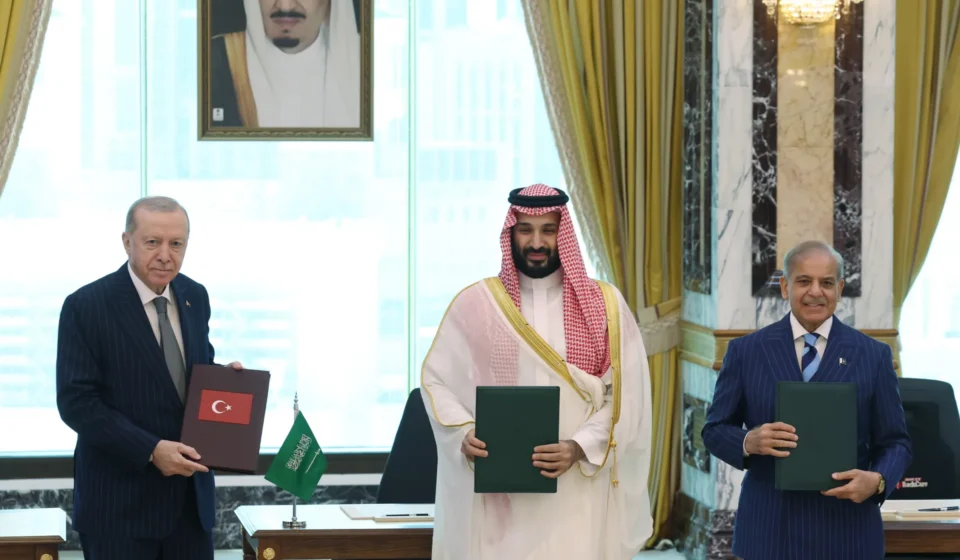

Saudi Arabia, Pakistan and Turkiye have signed the Mecca Joint Defence Agreement, a tripartite pact announced in a joint statement published by the official Saudi press agency and Pakistan’s Ministry of Foreign Affairs on Friday. The accord, sealed in Mecca after nearly a year of negotiations, commits the three states to “further strengthening their collective security” and says an attack on any member will be regarded as an attack on all, a Pakistani statement said, adding the measure is “intended to strengthen collective deterrence.”
The deal comes amid heightened military tensions in the region. Saudi Arabia has faced repeated strikes blamed on Iran, Houthi forces in Yemen and Shia armed groups in Iraq since the United States and Israel attacked Iran on February 28, a conflict that has threatened Saudi oil exports, stalled development plans and raised questions about the reliability of Washington’s long-standing security umbrella. While Turkiye and Pakistan have so far avoided major direct attacks, both countries have said they want to calm regional conflicts that endanger their security and economies.
The agreement was signed during high-profile visits to Saudi Arabia: Pakistan’s Prime Minister Shehbaz Sharif, accompanied by army chief Asim Munir, performed Umrah in Mecca the day before, and Turkish President Recep Tayyip Erdogan travelled to meet Crown Prince Mohammed bin Salman. Observers note that finalising the pact in Islam’s holiest city adds symbolic weight to a security arrangement built on decades of bilateral military ties.
Military cooperation underpins the new pact. Pakistan has long provided training and technical assistance to Saudi forces, while Turkiye and Pakistan have exchanged warships and training aircraft. In 2023 Riyadh agreed to buy Turkish drones in what Ankara described as its largest defence export contract.
Saudi deputy minister for public diplomacy Rayed Krimly said the pact “does not represent any intention to build a military axis or a sectarian/religious bloc,” posting on X that it is “not linked to nuclear ambitions or an arms race, but rather to building sustainable, self-reliant capabilities.” Erdogan described the agreement on X as signed “based on collective deterrence” and said Ankara will continue to seek conflict resolution “through dialogue and diplomacy on the basis of respect for international law.” Sharif called the pact a “historic endeavour” that serves “the interests of our homelands and enhances the security and stability of our region.”
Critics warned the paper pact may not be enough. Iranian lawmaker Ebrahim Rezaei posted that “a paper agreement with Turkiye and Pakistan will not bring them security” and urged Riyadh to “reform your policies so that you do not need to beg for security from others.”
Al Jazeera correspondents and regional analysts saw broader implications: the pact “essentially puts three of the largest Muslim populations together,” Al Jazeera’s Osama Bin Javaid said, noting Pakistan’s nuclear arsenal and battle‑hardened military, Turkiye’s drone and munitions capabilities and Saudi Arabia’s economic weight. Analysts argue the alliance aims to combine “deterrence and diplomacy,” and could also boost economic and defence cooperation if trust among the partners holds.
Original Source: https://www.aljazeera.com/news/2026/8/7/saudi-%E2%81%A0arabia-pakistan-and-turkiye-sign-defence-deal-amid-regional-turmoil
Category:
Tags:
Publish Date: 2026-08-08 03:42:00