Architecting Modular Floating PV Platforms for Global Offshore Scale

The long view: modularization and industrialization are now coming to the energy hardware layer
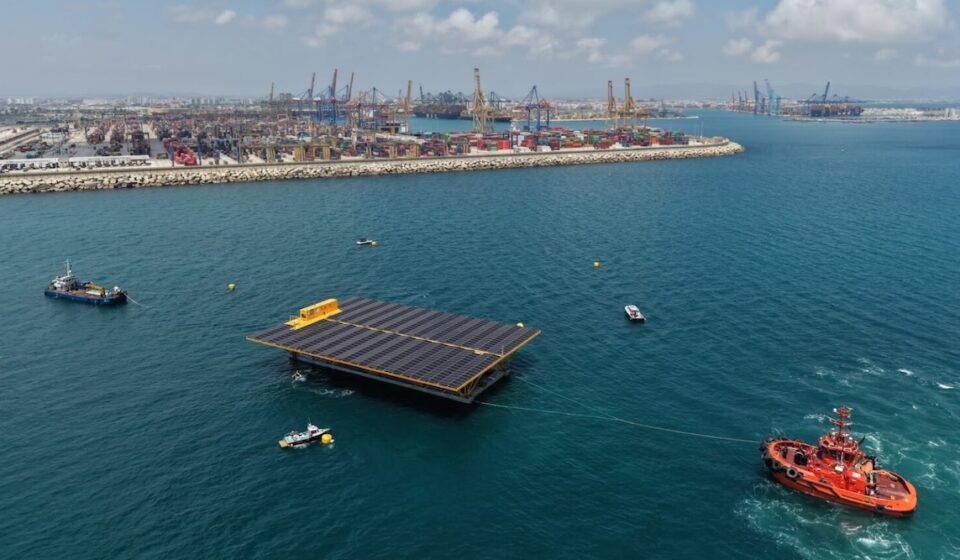
Ten years from now we will look back and realise that decarbonisation shifted from bespoke engineering projects to industrialised platforms – the same way cloud architecture moved from one-off datacenter builds to reusable, composable infrastructure. A recent pilot – a 500 kW catamaran-style floating PV platform deployed to the Port of Valencia as part of a 1 MW pilot project – is a timely reminder of that transition and the architectural lessons it holds for technology leaders today.
What happened (in brief)
A modular floating photovoltaic platform, built in a shipyard and designed for open-sea resilience, has entered a testing phase off Valencia’s breakwater. The design emphasises repeatable manufacture, simple maintenance, and workforce reuse from shipbuilding – a deliberate move toward scale rather than a one-off prototype.
Why this matters for architects and founders
This is more than an energy story; it’s an exercise in systems architecture applied to physical infrastructure. Three strategic implications stand out:
-
Industrial modularity reduces time-to-scale – and shifts architectural risk
Seeing solar arrays as modular “platform units” changes the R&D and deployment playbook. Enterprises that treat renewable installations as repeatable, spec-driven modules can reduce unit costs, accelerate testing, and create predictable supply chains. The trade-off is that early standardisation locks in design decisions; if those prove suboptimal for different geographies (deeper waters, higher waves, different regulations), retrofitting becomes expensive. CTOs must therefore enforce strong interface contracts and versioning for hardware modules – analogous to API-first design in software – so upgrades and variant builds remain manageable. -
Floating PV is a cyber-physical system that needs cloud-native operational thinking
Operational resilience depends on more than buoyancy and corrosion protection. For reliable, economically viable O&M you need telemetry, remote diagnostics, predictive maintenance models, and secure OT–IT integration. Practically, that means:
- Edge nodes for local sensor ingestion and anomaly detection (latency matters for storm responses).
- Digital twins to validate structural changes under simulated sea states before physical deployment.
- Secure telemetry and role-based access to prevent OT compromises.
Architecturally, treat each platform as a microservice: local processing and fail-safe autonomic behaviour, with aggregated cloud services for fleet-wide analytics and optimisation.
- Cross-industry partnerships and skilled re-use are strategic levers
The Valencia project deliberately leverages shipbuilding skills. This is a template: successful scale requires tapping adjacent industrial capabilities (shipyards, ports, maritime insurers). For founders, that opens a route to faster capacity build-out without having to create new heavy-industrial skill pools from scratch. The governance question is how to form long-term, risk-sharing partnerships so IP, quality control and liability are well balanced.
Relevance for India and Northeast innovators
India has a strong and growing interest in floating solar on reservoirs and coastal sites; the approach of modular, shipyard-enabled platforms is directly applicable. For the Northeast – a region of complex hydrology and many reservoirs – modular floating PV can serve dual goals: renewable generation and evaporation reduction. Startups and state agencies should consider pilot partnerships that couple maritime/shipyard knowhow (where available) with local civil engineering and grid-integration expertise.
Practical takeaways for decision-makers
- Adopt an interface-first mindset for physical modules: define electrical, mechanical and data contracts before scaling production.
- Invest early in digital twins and edge analytics to reduce O&M costs and insurance premiums.
- Design for regulatory and environmental variability: hold capacity for one-off variants within your modular product family.
- Forge partnerships with adjacent industries (shipyards, ports, insurers) and structure shared-risk commercial models.
- Treat fleet management as a cloud-native problem: continuous deployment, observability, and security aren’t optional.
Closing thought
The move to industrialised floating PV is a microcosm of a broader shift: the future of infrastructure will be defined by how well we combine repeatable hardware platforms with cloud-native operational intelligence – and by the partnerships we forge to turn prototypes into planetary-scale solutions.
About the Author: Sanjeev Sarma is the Founder Director and Chief Software Architect at Webx Technologies. With a core focus on Generative AI integration, Cloud-Native Scalability, and Enterprise Software Architecture, he has spent over two decades driving digital transformation across Northeast India and beyond. Beyond his corporate leadership, Sanjeev is deeply invested in shaping the future of the IT industry. He serves as an Industry Expert on the Board of Studies for Assam Don Bosco University’s School of Technology, advises state technology committees, and actively mentors emerging tech startups at STPI. He brings a unique, dual perspective of high-level enterprise execution and future-ready academic curriculum development.