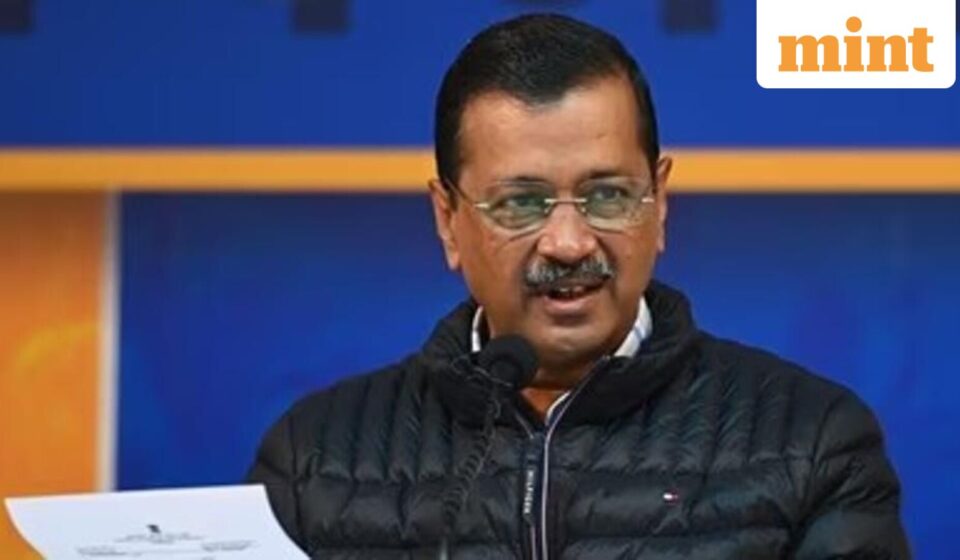
Arvind Kejriwal’s Bold ‘Satyagrah’: Former Delhi CM Stands Firm Against Excise Policy Case Before Justice Swarana Kanta!

In a significant and unusual action, Arvind Kejriwal, chief of the Aam Aadmi Party (AAP), announced on Monday that he and his legal team would withdraw from participating in the ongoing excise policy case before Justice Swarana Kanta Sharma. In a letter to Sharma, the former Chief Minister of Delhi raised concerns over a “serious issue of conflict of interest,” pointing out that both of Justice Sharma’s children are affiliated with various advocacy panels of the Union Government, with the Central Bureau of Investigation (CBI) as the opposing party in the case.
Kejriwal previously sought to have the case reassigned, expressing doubts about the impartiality of Justice Sharma. He claimed that her continued involvement could compromise the fairness of the proceedings. However, Justice Sharma dismissed Kejriwal’s request for recusal, arguing that public figures should not undermine the judiciary’s credibility. She noted that such actions could lead to mistrust in the judicial system, suggesting that Kejriwal’s application inadvertently put the court on trial.
In his April 27 letter, Kejriwal asserted that the Solicitor General, Tushar Mehta, handles the cases opposing him and assigns cases to Justice Sharma’s children, leading to potential bias. “Tushar Mehta decides how many and which cases should be assigned to Your Ladyship’s children,” he wrote, indicating that an increase in assignments would lead to higher fees for them. He expressed that this situation creates an unavoidable public perception of conflict, stating, “Taken together, these are, at the very least, troubling.”
Kejriwal detailed the rapid advancements in Justice Sharma’s children’s legal careers since her elevation to the Delhi High Court in March 2022. He pointed out that within months, her son became empaneled as a Group A counsel for the Supreme Court, while her daughter was appointed as the Government Pleader at the Delhi High Court. He articulated that these developments, occurring in quick succession, raised significant concerns about impartiality.
The national convenor of AAP emphasized in his letter that the judgment that rejected his recusal request has further eroded his confidence in a fair trial. He questioned how he could expect an unbiased hearing when his concerns had been interpreted as a challenge to the judge’s integrity. “If a litigant’s plea is seen as a challenge, how can I trust that I will be heard fairly?” he asked, reinforcing the emotional weight of his apprehensions.
Kejriwal evoked Mahatma Gandhi’s concept of Satyagraha to express his current stance, acknowledging that his withdrawal could harm his legal interests. “I am prepared to bear those consequences,” he said, emphasizing the weight of his moral convictions. He insisted that engaging in proceedings that appear compromised would betray both his conscience and the dignity of the judiciary. “To do so would be an injustice to the people of India who still see courts as a sanctuary against governmental overreach,” he stated.
By opting out of the proceedings, Kejriwal has raised pivotal questions about judicial integrity, potential conflicts of interest, and the broader implications for public trust in the legal system. The AAP leader’s decision underscores a willingness to prioritize ethical considerations over personal legal battles, positioning the ongoing case at the intersection of politics and the judiciary.
This situation is set against a backdrop of increasing scrutiny on the judicial system’s impartiality, making it a crucial development for observers of Indian politics and law.
Original Source: https://www.livemint.com/news/india/arvind-kejriwals-satyagrah-former-delhi-cm-to-boycott-excise-policy-case-proceedings-before-justice-swarana-kanta-11777302704562.html
Category :
Tags:
Publish Date: 2026-04-27 20:57:00