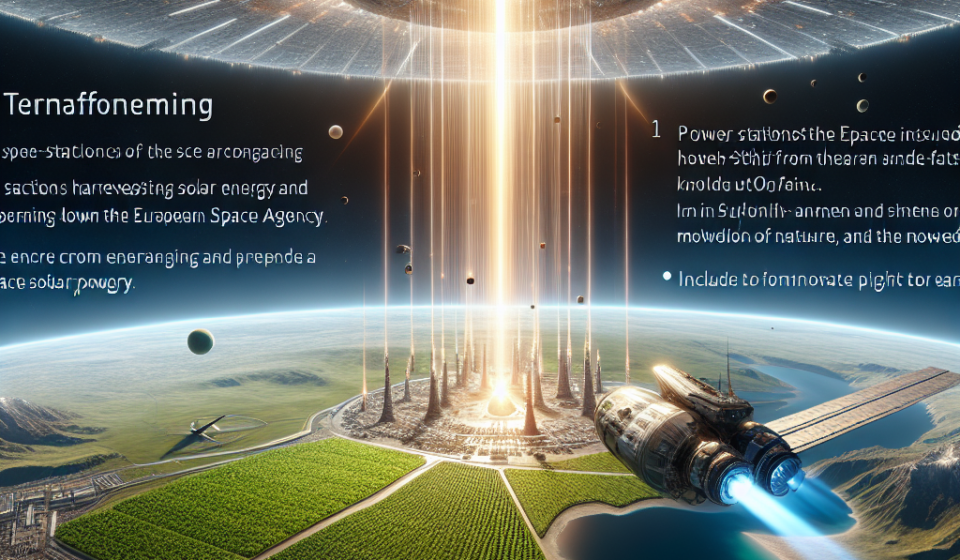

We are conditioned to think of “space-first” breakthroughs as grand orbital missions: megastructures, headline budgets, and decade-long programs. That instinct is often seductive – and strategically dangerous. The more interesting play right now is the inverse: prove the physics and business model on Earth, then lift what works into orbit.
Context (signal)
I recently read about TerraSpark, a Luxembourg startup spun out by people who led Europe’s Solaris SBSP work. Rather than leap directly to geostationary gigawatt platforms, TerraSpark is adopting a phased strategy: commercial radio‑frequency wireless power transmission on the ground first, revenue pilots for remote sites/events, then incremental orbital demonstrations (2026–2028 road‑map quoted), with commercial scale beyond 2030.
Analysis – why this matters for architects, CTOs and founders
1) De‑risking by inversion is an architectural pattern worth learning. Complex systems often fail not because the core physics is wrong, but because integration, regulation, and operations are underestimated. TerraSpark’s “ground-first” pattern separates three risk domains: (a) core RF/beam physics and alignment, (b) regulatory and safety acceptance, and (c) operational business model. Demonstrating each independently minimizes unknowns when you cross domains in orbit.
2) Build vs. buy – modularity wins. For enterprise adopters and utilities, emerging energy-delivery modalities must appear as composable, replaceable modules (receiver, DC‑coupling, storage, telemetry). Early pilots should prefer COTS and containerised control stacks so systems are auditable and upgradeable. Over‑verticalisation makes sense later, when scale and launch economics demand bespoke hardware.
3) Spectrum, safety and standards are the real blockers – not just engineering. RF power at useful densities intersects aviation, communications and public safety. That’s a governance and standards problem as much as one of beam steering. My experience advising technology committees tells me regulatory engagement is not optional; it must be a parallel track, with measurable milestones (spectrum allocation, permissible irradiance, fail‑safe norms) baked into engineering sprints.
4) Cyber‑physical risks require Zero Trust thinking. Beaming power is a physical act controlled by software. Integrity of command & control, protection against jamming/spoofing, and secure OTA update paths must be designed from day one. Treat receivers and ground ops as critical infrastructure with full lifecycle security and incident playbooks.
5) Business model discipline: revenue before orbit. The startup’s choice to sell terrestrial services (remote industrial, events) aligns incentives: customers fund iteration, regulators see safe deployments, and engineering learns operational patterns. For founders, this is an ideal “product‑market fit” loop in hard‑tech: solve a present pain while learning to scale.
A practical Bharat/Northeast lens (where relevant)
India’s geography – islands, remote mines, border posts and tea estates – has recurring, high‑value off‑grid power needs. A terrestrial RF pilot could be a pragmatic demonstration in such settings, provided regulatory and environmental clearances are secured. India’s recent encouragement of private space activity (IN‑SPACe, NewSpace ecosystem) also means there are potential public‑private pathways to responsibly explore orbital use‑cases later.
Actionable takeaways
– Design pilots as compliance stories: include independent safety audits, community engagement, and clear measurable acceptance criteria for regulators.
– Architect receivers as standardised microgrid nodes with well‑defined APIs for energy accounting, telemetry and dispatch.
– Prioritise cyber‑physical security and independent red‑teaming before public demos.
– Build partnerships early with utilities, standards bodies and launch providers – the problem spans multiple industries.
– Use revenue pilots to iterate product, not to validate physics alone.
Closing thought
The most sustainable innovations are seldom the loudest at Day One. Proving complex, world‑changing systems by making them commercially useful on Earth is not a compromise – it’s smart systems thinking. If space‑based solar is to become a reality, the shortest, most robust path may very well run through terrestrial pragmatism.
About the Author Sanjeev Sarma is the Founder Director of Webx Technologies Private Limited, a leading Technology Consulting firm with over two decades of experience. A seasoned technology strategist and Chief Software Architect, he specializes in Enterprise Software Architecture, Cloud-Native Applications, AI-Driven Platforms, and Mobile-First Solutions. Recognized as a “Technology Hero” by Microsoft for his pioneering work in e-Governance, Sanjeev actively advises state and central technology committees, including the Advisory Board for Software Technology Parks of India (STPI) across multiple Northeast Indian states. He is also the Managing Editor for Mahabahu.com, an international journal. Passionate about fostering innovation, he actively mentors aspiring entrepreneurs and leads transformative digital solutions for enterprises and government sectors from his base in Northeast India.