
In a groundbreaking new study, scientists suggest that prime numbers may offer insights into the enigmatic and chaotic regions within black holes. This innovative research bridges the gap between number theory and the extreme environments of the universe, unveiling a striking connection that could reshape our understanding of black hole physics.
Prime numbers, defined as integers greater than one that can only be divided by one and themselves, include well-known examples like 2, 3, 5, and 7. Traditionally regarded as foundational elements in mathematics, these numbers may play a significant role in the complex behavior observed near black hole singularities. Researchers posit that the chaotic conditions in these astronomical structures could adhere to patterns reminiscent of prime number distributions, suggesting a deeper mathematical framework governing both gravity and numerical sequence.
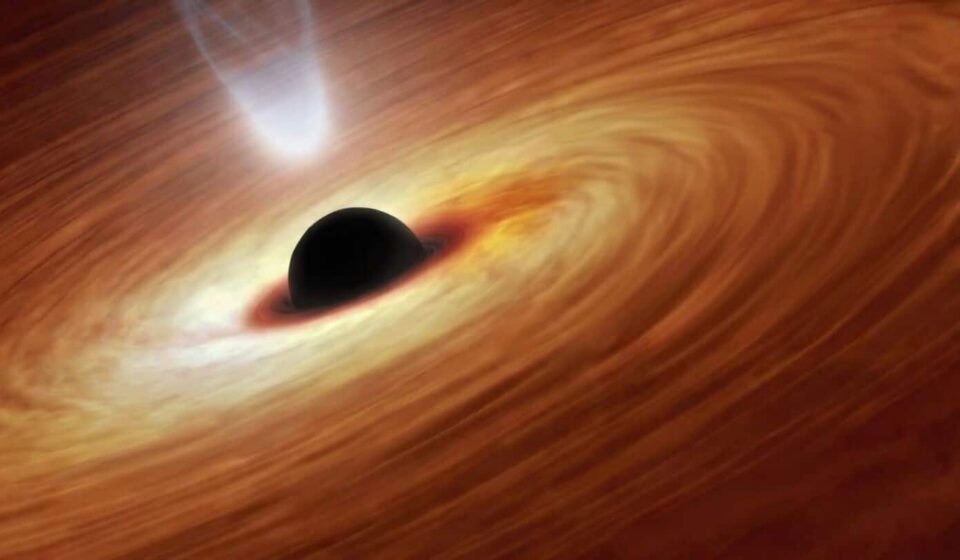
At the core of a black hole lies a singularity, where gravitational forces become so intense that they warp our familiar laws of physics. This peculiar region represents a frontier where space and time behave in unexpected ways, prompting scientists to explore the possibility of uncovering hidden mathematical patterns that could describe these chaotic phenomena. Recent studies indicate that prime number sequences might mirror the irregular behaviors observed in the proximity of singularities.
The mathematical exploration of prime numbers involves sophisticated functions, one of the most significant being the Riemann zeta function. This complex function is essential in understanding the distribution of prime numbers along the number line. Notably, physicists have observed strikingly similar patterns in equations detailing chaotic gravitational systems, including those surrounding black holes. These parallels raise intriguing possibilities about the relationship between prime number spacing and the dynamics that dictate black hole behavior.
Adding another layer to this investigation, the concept of “primons” has emerged in theoretical physics. Proposed decades ago, primons are hypothetical particles theorized to associate each particle’s energy level with prime numbers. At the heart of this idea lies the Riemann zeta function, a critical tool in deciphering prime distribution. While initially dismissed as a speculative mathematical notion, recent revelations about the connections between prime numbers and black hole dynamics have reignited interest in the primon theory, suggesting that the universe may indeed have a profound mathematical underpinning woven into its very fabric.
As scientists continue to dive into this uncharted territory, the implications of these findings could extend beyond theoretical physics. They may influence our understanding of the universe at both a micro and macro scale, potentially leading to groundbreaking advancements in fields ranging from mathematics to astrophysics. While the full extent of these connections remains to be explored, the notion that numbers-with their inherent simplicity-could unlock the secrets of the cosmos emphasizes the elegance and mystery of the mathematical universe.
As this research progresses, further studies will undoubtedly shed light on how prime numbers can elucidate the intricate behaviors surrounding black holes, paving the way for exciting discoveries in both mathematics and the fundamental laws of the universe. This merging of disciplines may ultimately redefine our understanding of both numbers and the universe itself, encouraging future generations to rethink the connections between seemingly unrelated areas of study.
In conclusion, the intersection of prime numbers and black hole physics presents a thrilling new frontier for researchers and enthusiasts alike, as they seek to uncover the profound truths hidden within the cosmos.
Original Source: https://www.newsbytesapp.com/news/science/prime-numbers-could-unlock-secrets-of-black-holes/story
Category :
Tags:
Publish Date: 2026-03-10 18:11:00