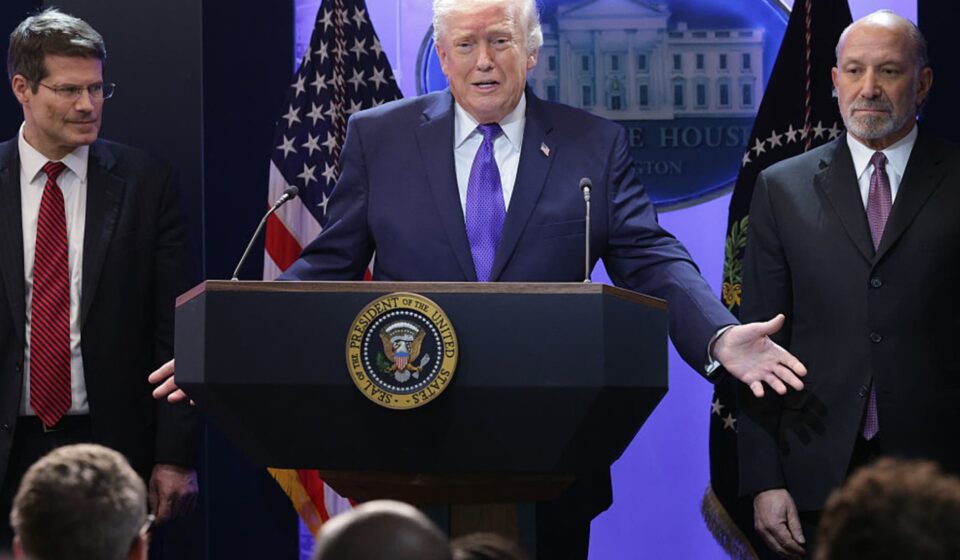

President Donald Trump announced on Friday plans to sign an executive order imposing a new 10% “global tariff,” just hours after the Supreme Court invalidated his previous “reciprocal” import duties. This significant ruling dealt a blow to Trump’s trade strategy, which he has defended as crucial for boosting the U.S. economy and revitalizing its manufacturing sector.
During a White House press briefing, a visibly frustrated Trump expressed his dismay over the court’s decision, branding it “deeply disappointing.” He stated, “I’m ashamed of certain members of the court, absolutely ashamed for not having the courage to do what’s right for our country.” The Supreme Court’s ruling disrupted the legal basis for many of the tariffs that Trump argues are vital for protecting American industries.
Despite this setback, Trump vowed to pursue alternative avenues for imposing tariffs without congressional approval. When challenged about his reluctance to work with lawmakers, he emphasized, “I don’t have to… I have the right to do tariffs.” His remarks showcased a mix of defiance and criticism aimed at the justices, particularly Neil Gorsuch and Amy Coney Barrett, both of whom he nominated. Trump remarked, “I think their decision was terrible. I think it’s an embarrassment to their families.”
The upcoming 10% duties will be enacted under Section 122 of the Trade Act of 1974, which allows for tariffs to be in place for a maximum of 150 days unless renewed by Congress. When asked about the limitation and the prospect of obtaining congressional support, Trump asserted, “We have the right to do pretty much what we want to do.”
In addition, he confirmed that all existing tariffs currently enforced under Sections 232 and 301 will remain “in full force and effect,” reinforcing the administration’s commitment to its trade agenda. Trump elaborated that his administration is also leveraging Section 301 to initiate several investigations into alleged unfair trade practices, potentially leading to further tariffs.
The Supreme Court ruling specifically targeted tariffs imposed via the International Emergency Economic Powers Act (IEEPA). Trump’s previous tariffs were closely tied to this law, which the high court determined does not grant the President the authority to impose tariffs sustainably. Last year, a significant portion of U.S. tariff revenue originated from these IEEPA duties.
Trump remains optimistic, stating, “Other alternatives will now be used to replace the ones that the court incorrectly rejected,” predicting increased tariff revenue and economic strength. Treasury Secretary Scott Bessent, addressing the Economic Club of Dallas shortly after Trump, echoed this sentiment, suggesting that the administration’s strategy would facilitate stable tariff revenue by applying other existing tariff laws.
As the administration pivots in response to the Supreme Court decision, all eyes will be on how these new tariffs impact both international trade relations and the domestic economy in the months to come. The implications of Trump’s global tariff strategy underscore the economic landscape that remains uncertain following the court’s ruling, marking yet another chapter in the evolving story of U.S. trade policy.
Tags: Donald Trump, tariffs, Supreme Court, trade policy, economic strategy, trade laws, Section 122, IEEPA.
Original Source: https://www.cnbc.com/2026/02/20/trump-global-trade-tariff-supreme-court.html
Category :
Tags:
Publish Date: 2026-02-21 04:18:00