
We obsess about model size and compute, but the real production friction is often mundane: where do you keep the key‑value (KV) cache so steady, low‑latency reasoning can scale across hundreds or thousands of users? The answer matters more than another billion‑parameter model – because without a practical engineering pattern for KV cache management, real world LLM deployments will buckle under memory pressure, cost, or latency.
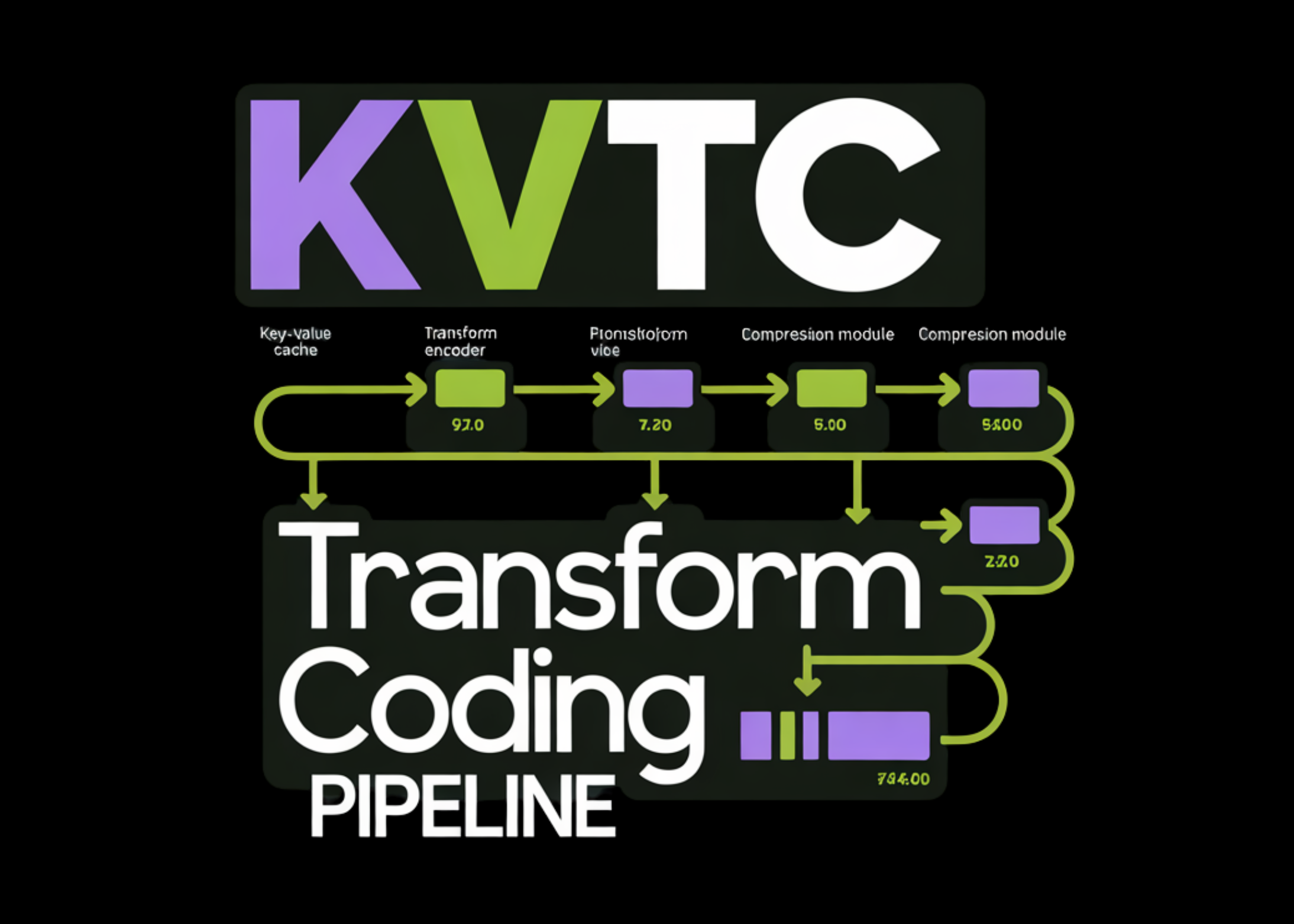
The signal: NVIDIA researchers recently proposed KVTC, a transform‑coding pipeline that compresses KV caches on and off GPU using PCA‑based decorrelation, adaptive quantization and parallel DEFLATE via nvCOMP. The headline: up to ~20× compression with minimal impact on reasoning and long‑context accuracy, plus operational gains in Time‑To‑First‑Token and storage overhead.
Why this matters to architects and CTOs
– Memory is the hidden choke point. For modern Transformers, KV caches can occupy gigabytes per session; that footprint determines how many concurrent sessions a GPU can host, and therefore the unit economics of inference.
– KVTC reframes the trade‑space: instead of choosing between keeping caches hot, paying recompute costs, or offloading expensive raw bytes, you can shift to a middle path – compressed, fast to decode, and small enough to keep more sessions on‑chip or move cheaper to DRAM/SSD with lower transfer overhead.
– The engineering pattern here is not simply “compress more.” It’s about protecting the tokens that matter (recent sliding window and oldest attention sinks), managing calibration (global PCA basis), and integrating compression into serving stacks so latency wins are realized in the wild.
Architectural trade‑offs and practical considerations
– Accuracy vs. compression: The method’s adaptive quantization and DP allocation are clever; but high compression ratios rely on assumptions about head correlations and data distribution. Expect edge cases – specialized prompts or domain‑specific vocabularies – where reconstruction noise can affect attention. Validate per workload.
– Operational complexity: Adding a compression/decompression layer increases system paths. You must measure TTFT, throughput, and memory savings against the extra compute on the GPU (nvCOMP) and potential queues on decompression.
– Vendor and hardware dependencies: NVidia’s nvCOMP and GPU acceleration make this particularly attractive on H100/A‑series fleets, but always evaluate portability. If you run mixed GPU clouds or on‑prem non‑NVIDIA hardware, the cost/benefit calculus changes.
– Security and compliance: Compressed caches still contain semantic traces of user prompts. Treat offloaded compressed caches as sensitive data – encrypt at rest, enforce access controls and auditing. Compression does not substitute for data residency or privacy safeguards.
Concrete actions for CTOs and platform teams
1. Pilot, don’t adopt blindly: Run a controlled pilot with representative workloads (support transcripts, legal docs, search sessions). Measure TTFT, throughput, and end‑user quality (not just perplexity).
2. Benchmark both tails: Test worst‑case prompts and domain shifts. Monitor for accuracy collapse at extreme compressions and set safe‑guards (fallback to full cache).
3. Integrate with eviction policies: Use KVTC alongside prefix sharing and intelligent eviction. Compression makes on‑chip retention cheaper – use that headroom to favour warm sessions with high reuse.
4. Operationalize calibration: Maintain PCA bases per model family and version; automate re‑calibration when model or data distribution shifts.
5. Harden governance: Encrypt compressed offloads, enforce retention limits, and log decompression events for audit.
A note for Bharat and cost‑sensitive deployments
For Indian enterprises and public sector platforms where GPU budgets are constrained, the ability to host more concurrent sessions per GPU has direct ROI. Compressed KV caches can enable long‑context services (digital grievance redressal, legal aid chatbots, language preservation tools) at lower operating cost – especially relevant where hybrid cloud/on‑prem mixes and intermittent bandwidth are common. That’s frugal engineering with real societal impact.
Takeaways
– KV cache management is the next battleground for scalable LLM serving.
– KVTC offers a pragmatic lever: large memory savings with modest accuracy trade‑offs when integrated correctly.
– The decision is operational, not purely algorithmic – pilot, benchmark, and govern.
Closing thought
The future of practical AI isn’t just bigger models – it’s smarter system design that squeezes efficiency from the whole stack so useful services reach more people affordably.
About the Author
Sanjeev Sarma is the Founder Director of Webx Technologies Private Limited, a leading Technology Consulting firm with over two decades of experience. A seasoned technology strategist and Chief Software Architect, he specializes in Enterprise Software Architecture, Cloud-Native Applications, AI-Driven Platforms, and Mobile-First Solutions. Recognized as a “Technology Hero” by Microsoft for his pioneering work in e-Governance, Sanjeev actively advises state and central technology committees, including the Advisory Board for Software Technology Parks of India (STPI) across multiple Northeast Indian states. He is also the Managing Editor for Mahabahu.com, an international journal. Passionate about fostering innovation, he actively mentors aspiring entrepreneurs and leads transformative digital solutions for enterprises and government sectors from his base in Northeast India.