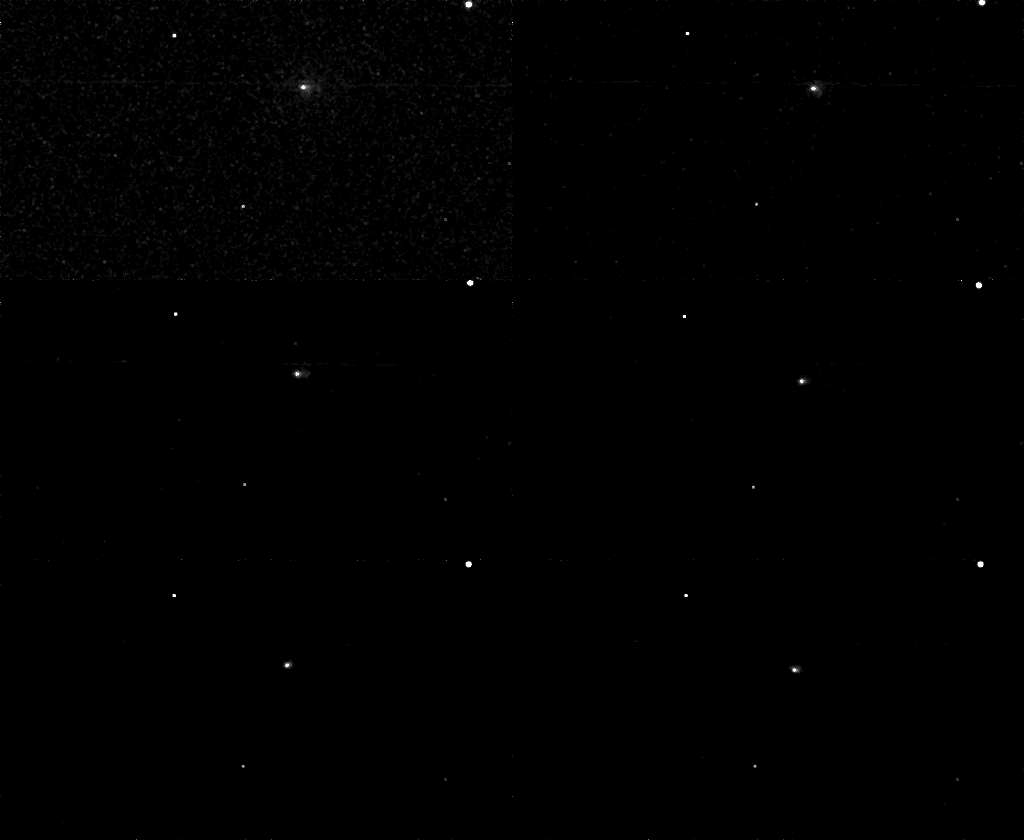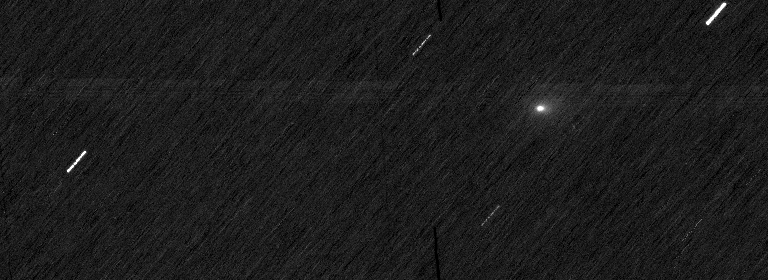

On October 3, 2025, the interstellar object 3I/ATLAS passed within 30 million kilometers of Mars, drawing the attention of astronomers worldwide. The European Space Agency (ESA) has released new imaging data captured by its two Mars orbiters: the ExoMars Trace Gas Orbiter (TGO) and Mars Express. The images, taken with a five-second exposure time by the Colour and Stereo Surface Imaging System (CaSSIS) on the TGO, depict 3I/ATLAS as a fuzzy ball of light, reminiscent of a July 2025 image taken by the Hubble Space Telescope, albeit from a much greater distance of 450 million kilometers. Notably, the brief exposure time of 0.5 seconds on Mars Express was insufficient to capture 3I/ATLAS.
The angular resolution of the CaSSIS camera is 11.36 micro-radians per pixel, translating this resolution into 340 kilometers at the closest approach of 3I/ATLAS. This pixel size exceeds the estimated diameter of 3I/ATLAS’s nucleus, which ranges from a minimum of 5 kilometers to a maximum of 46 kilometers. The minimum mass necessary to avoid detecting its non-gravitational acceleration is approximately 33 billion tons.
Previously, the highest-resolution image from the Hubble telescope displayed 3I/ATLAS as a significant light source, measuring around 4,000 kilometers and extending toward the Sun at a length-to-width ratio of about 10. Some extension was also visible in the CaSSIS images, as the Martian orbiters viewed the passage of 3I/ATLAS almost perpendicularly. The images reveal that the brightest glow surrounding 3I/ATLAS is about twice the diameter of the bright stars in the same frame, measuring approximately 680 kilometers, indicating CaSSIS can only detect the brightest region and may miss lower surface-brightness areas visible in Hubble’s images.
The primary mirror of the CaSSIS is just 13.5 centimeters in diameter, approximately 300 times smaller than Hubble’s. The identified glow in the CaSSIS image aligns with Hubble’s surface brightness profile, enhanced by brighter sunlight conditions near Mars during the observation. This finding suggests no significant increase in outgassing from 3I/ATLAS over the last three months.
In the coming days, lower-quality images may emerge from the Moderate Resolution Imaging Camera (MoRIC) aboard China’s Tianwen-1 and the Emirates eXploration Imager on the UAE’s Hope Orbiter. However, the most anticipated images will come from NASA’s High Resolution Imaging Experiment (HiRISE) camera, which is expected to provide the highest resolution down to 30 kilometers per pixel. The HiRISE’s larger diameter of 50 centimeters will enable it to detect the glow surrounding 3I/ATLAS from a greater distance than CaSSIS.
The scientific community eagerly awaits NASA’s data, as the findings from these images could offer crucial insights about the size and composition of 3I/ATLAS. The brightest pixel found in the HiRISE image could yield significant constraints on the diameter of this intriguing interstellar object.
Original Source: https://avi-loeb.medium.com/first-images-of-3i-atlas-from-exomars-tgo-3dd902ff8849
Category:
Tags:
Publish Date: 2025-10-08 03:39:00