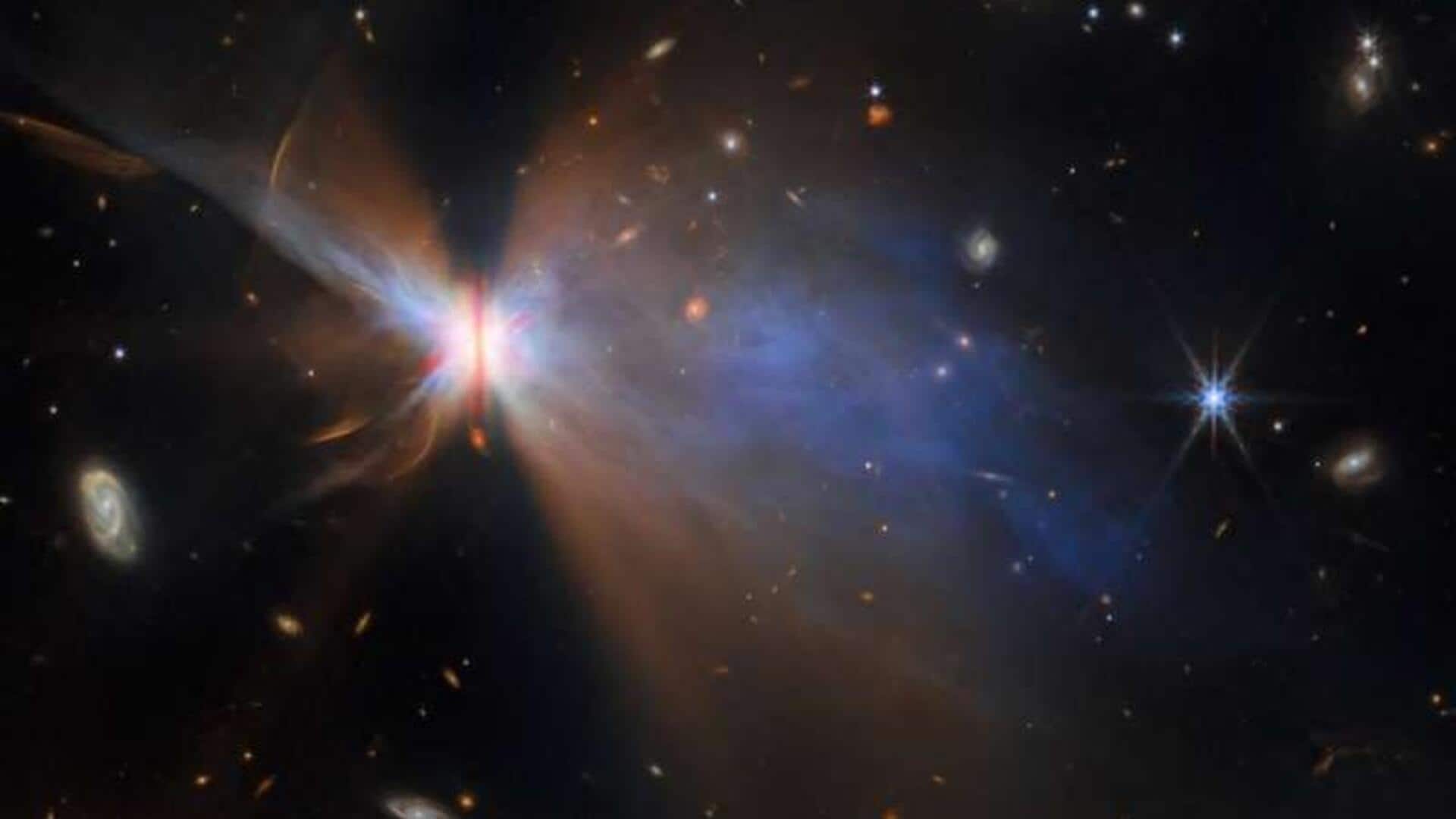
Unveiling Cosmic Wonders: Webb Telescope Captures Breathtaking Planet-Forming Disk 525 Light-Years Away!

The James Webb Space Telescope (JWST) has unveiled an extraordinary image of a young star, known as IRAS 04302+2247, situated approximately 525 light-years away in the Taurus star-forming region. This groundbreaking observation sheds light on the intricate processes of dust grain formation within protoplanetary disks, crucial for understanding the early stages of planet formation.
In various stellar nurseries across the galaxy, nascent stars are emerging from vast clouds of cold gas. As these young celestial bodies evolve, they gather surrounding gas into narrow, dusty protoplanetary disks, setting the groundwork for planetary assembly. By studying these distant formations, researchers glean insights into events that transpired around 4.5 billion years ago in our own solar system during the birth of the Sun and its planetary companions.
IRAS 04302, or IRAS 04302+2247, serves as a prime example of a protostar, still in the process of accumulating mass from its environment. Surrounding this star is a protoplanetary disk, where fledgling planets may be forming. Observations from JWST show the disk aligned edge-on, appearing as a slender band of dusty gas that obscures the light from the forming protostar at its center.
The dusty gas within IRAS 04302’s protoplanetary disk acts as essential fuel for developing planets, creating an environment conducive to their growth. When viewed face-on, these disks often reveal intricate structures like rings, gaps, and spirals — features that may suggest the presence of emerging planets or highlight gravitational instabilities and areas where dust grains accumulate.
The edge-on perspective of IRAS 04302’s disk also offers insights into its vertical structure, particularly the disk’s thickness. Dust grains are known to migrate toward the midplane of the disk, settling into a thin, dense layer that favors planet formation. The thickness of this layer serves as an indicator of how effectively dust grains are coalescing, an essential aspect of creating new celestial bodies.
Intriguingly, IRAS 04302 has earned the endearing nickname “Butterfly Star,” a moniker derived from the striking features observed in its environment. The dense column of dusty gas surrounding IRAS 04302 obscures its bright light, allowing JWST to capture delicate structures nearby more clearly. This phenomenon reveals two ethereal reflection nebulae flanking the disk, illuminated by light from the central protostar reflecting off surrounding nebular material, further enhancing the star’s butterfly-like appearance.
JWST’s observations not only enrich our understanding of protoplanetary disks but also provide critical data for tracing the evolutionary history of stars and planets. The findings from IRAS 04302 exemplify the fusion of cutting-edge technology and astronomy, bringing us closer to unraveling the complex story of our universe’s formation. As we continue to explore these cosmic wonders, the insights gained will deepen our appreciation for the intricate processes that give rise to the planets we know today.
Original Source: https://www.newsbytesapp.com/news/science/webb-telescope-reveals-protoplanetary-disk-in-unprecedented-detail/story
Category :
Tags:
Publish Date: 2025-08-30 17:47:00