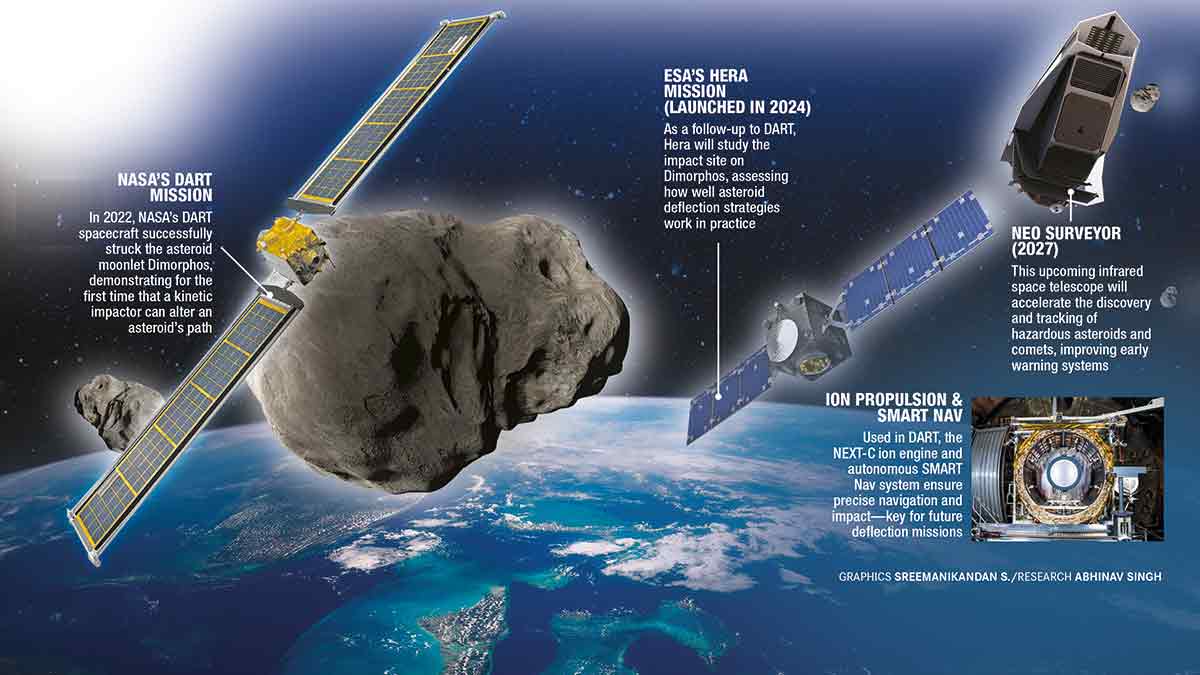

Planetary defense, a critical initiative focused on detecting and tracking asteroids and comets that could threaten Earth, gained attention following significant historical events like the 1908 Tunguska explosion in Siberia, which devastated 2,000 square kilometers of forest, and the formation of Meteor Crater in Arizona, resulting from an asteroid impact 50,000 years ago. For much of history, the prospect of averting an asteroid strike seemed almost unthinkable. Today, however, scientists worldwide are increasingly optimistic about protecting the planet through coordinated efforts involving leading space agencies from Japan, India, Europe, and the United States, who are actively monitoring, studying, and working on ways to deflect near-Earth objects (NEOs).
Japan’s space agency, JAXA, is a key player in this arena. Its missions, Hayabusa and Hayabusa2, successfully demonstrated the feasibility of collecting samples from asteroids and returning them safely to Earth. Makoto Yoshikawa, the scientist behind these missions, remarked to THE WEEK that while collisions with celestial bodies are rare, the potential damage is significant. “That is why JAXA continues to send spacecraft to study near-Earth asteroids,” he explained, adding that the agency has developed a technique called “stacking” to detect and track these objects effectively.
Hayabusa2 is currently undergoing an extended mission, with a flyby of asteroid 98943 Torifune expected in July 2024, followed by a rendezvous with asteroid 1998 KY26 in 2031. These smaller asteroids are more challenging to detect yet might pose greater risks. Additionally, JAXA is contributing to the European Space Agency’s (ESA) Hera mission, which launched on a SpaceX Falcon 9 in October. This mission aims to study the Didymos-Dimorphos binary asteroid system, with an arrival planned for December 2026. JAXA has equipped Hera with a thermal infrared camera to assist in analyzing the impact site from NASA’s DART mission, which struck the asteroid successfully in 2022.
India is also enhancing its planetary defense strategies. S. Somanath, the former chairman of the Indian Space Research Organisation (ISRO), emphasized the importance of preparedness in the face of potential asteroid impacts, which, unlike missiles, can strike unexpectedly and cause significant devastation. Although ISRO has not yet launched a dedicated planetary defense mission, it actively monitors NEOs using ground-based observatories and satellites, demonstrating its commitment to global partnerships like the International Asteroid Warning Network (IAWN) and the Space Mission Planning Advisory Group (SMPAG). India’s focus includes the observation of asteroid 99942 Apophis, which will come within 32,000 kilometers of Earth on April 13, 2029, highlighting the country’s growing interest in protecting its expanding space infrastructure.
The ESA is planning the RAMSES (Rapid Apophis Mission for Space Safety), set for potential launch in April 2028, to intercept Apophis prior to its 2029 flyby. Meanwhile, NASA leads the global initiative with its Planetary Defense Coordination Office (PDCO), established in 2016 to supervise asteroid detection, tracking, and risk assessment. The upcoming NEO Surveyor mission will employ an infrared space telescope to identify most potentially hazardous NEOs within 50 million kilometers of Earth.
NASA’s DART mission marked a pivotal test of kinetic impact as a defensive strategy, proving that it’s possible to alter a smaller asteroid’s trajectory if it poses a threat. Annapurni Subramaniam, director of the Indian Institute of Astrophysics (IIA), cautioned against outdated methods of destroying asteroids with explosives, stating that deflecting them by crashing a spacecraft into them is a preferable approach. Mapping and monitoring nearby asteroids is crucial for identifying potential hazards, such as Apophis. “Once a potentially hazardous asteroid is detected, the next step is to calculate its orbit and develop a strategy to alter it if necessary,” she noted.
The approaching flyby of Apophis is anticipated to be one of the most scrutinized events for planetary defense. Observations from telescopes, radar systems, and spacecraft will help scientists refine orbital models and evaluate how Earth’s gravity might influence the asteroid. Srimathy Kesan, founder of Space Kidz India, highlighted the potential devastation from an asteroid like Apophis, indicating that the energy released could cause catastrophic destruction and loss of life. This underscores the urgency for sustained investment in planetary defense technologies and international collaboration.
Original Source: https://www.theweek.in/theweek/specials/2025/08/23/asteroid-deflection-space-missions-planetary-defence-earth.html
Category:
Tags:
Publish Date: 2025-08-24 10:24:00