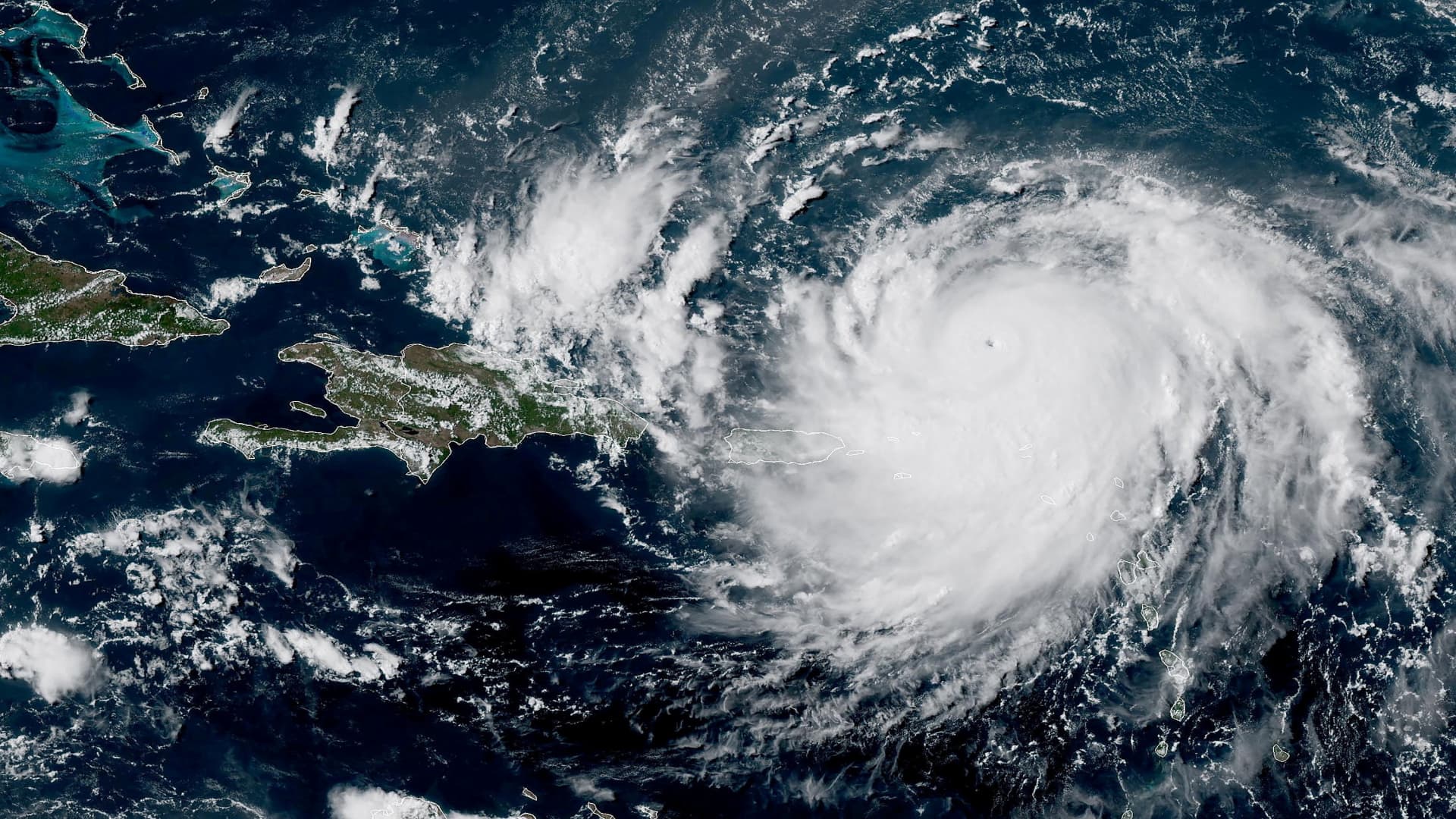

Hurricane Erin, the inaugural storm of the 2025 Atlantic hurricane season, weakened to a Category 3 on Sunday, yet its expanding outer bands are wreaking havoc across the Virgin Islands and Puerto Rico. Forecasters have warned that while the storm’s maximum winds diminished, its overall size surged, prompting tropical storm warnings for the Turks and Caicos Islands and the southeastern Bahamas. During the day, Puerto Rico and the Virgin Islands experienced heavy rains and tropical-storm winds as Erin’s outer bands encircled the region.
Despite forecasts indicating that Erin is unlikely to strike the U.S. East Coast directly, Dare County emergency officials expressed concern over the storm’s increasing dimensions, which threaten the North Carolina Outer Banks. This vulnerable chain of barrier islands, jutting into the Atlantic Ocean, is under a state of emergency, with evacuation orders in place for Hatteras Island beginning Monday. The National Weather Service has warned that sustained heavy surf and high winds could jeopardize segments of North Carolina Highway 12, crucial for connecting this popular tourist destination to the mainland.
The eye of the storm is projected to remain at least 200 miles from the Outer Banks, but it will still generate hazardous rip tides along the entire East Coast. Bermuda is also expected to encounter similar conditions as Erin shifts to a north-northeast trajectory. Just a day prior, Erin had reached a perilous Category 5 status, showcasing winds of up to 160 mph (260 kph) before abruptly weakening. As of Sunday afternoon, the storm’s sustained winds were recorded at 125 mph (205 kph), according to the National Hurricane Center in Miami.
Richard Pasch, a meteorologist at the National Hurricane Center, emphasized the risks associated with Erin, stating, “You’re dealing with a major hurricane. The intensity is fluctuating. It’s a dangerous hurricane in any event.” By late Sunday, the storm was estimated to be about 275 miles northwest of San Juan, Puerto Rico, and 165 miles east of Grand Turk Island, moving west-northwest at 13 mph (20 kph). On its current forecast track, Erin’s core is expected to pass to the east and northeast of the Turks and Caicos Islands and southeastern Bahamas overnight and into Monday.
The storm’s impact has already been felt in Puerto Rico, where approximately 147,000 customers were left without power due to the rain and winds, as reported by Luma Energy, which manages the island’s power transmission and distribution. Additionally, over 20 flights have been canceled due to inclement weather.
Swells from Erin are anticipated to affect the Virgin Islands, Puerto Rico, Hispaniola, and the Turks and Caicos Islands over the coming days. Fortunately, the Coast Guard has lifted port restrictions in Puerto Rico and the U.S. Virgin Islands as conditions begin to improve. A tropical storm warning signifies that tropical storm conditions are expected in the designated areas within the next 24 hours, with severe rainfall of 3 to 6 inches-up to 8 inches in some localized areas-forecasted for the Virgin Islands and Puerto Rico.
The alarming trend of rapidly intensifying hurricanes in the Atlantic has been linked to climate change, with scientists noting that rising ocean temperatures and increased atmospheric water vapor provide hurricanes with more fuel for rapid development and increased rainfall. As Erin continues to evolve, both residents and officials are urged to stay vigilant and prepared.
Original Source: https://www.cnbc.com/2025/08/17/hurricane-erin-caribbean.html
Category :
Tags:
Publish Date: 2025-08-18 04:30:00