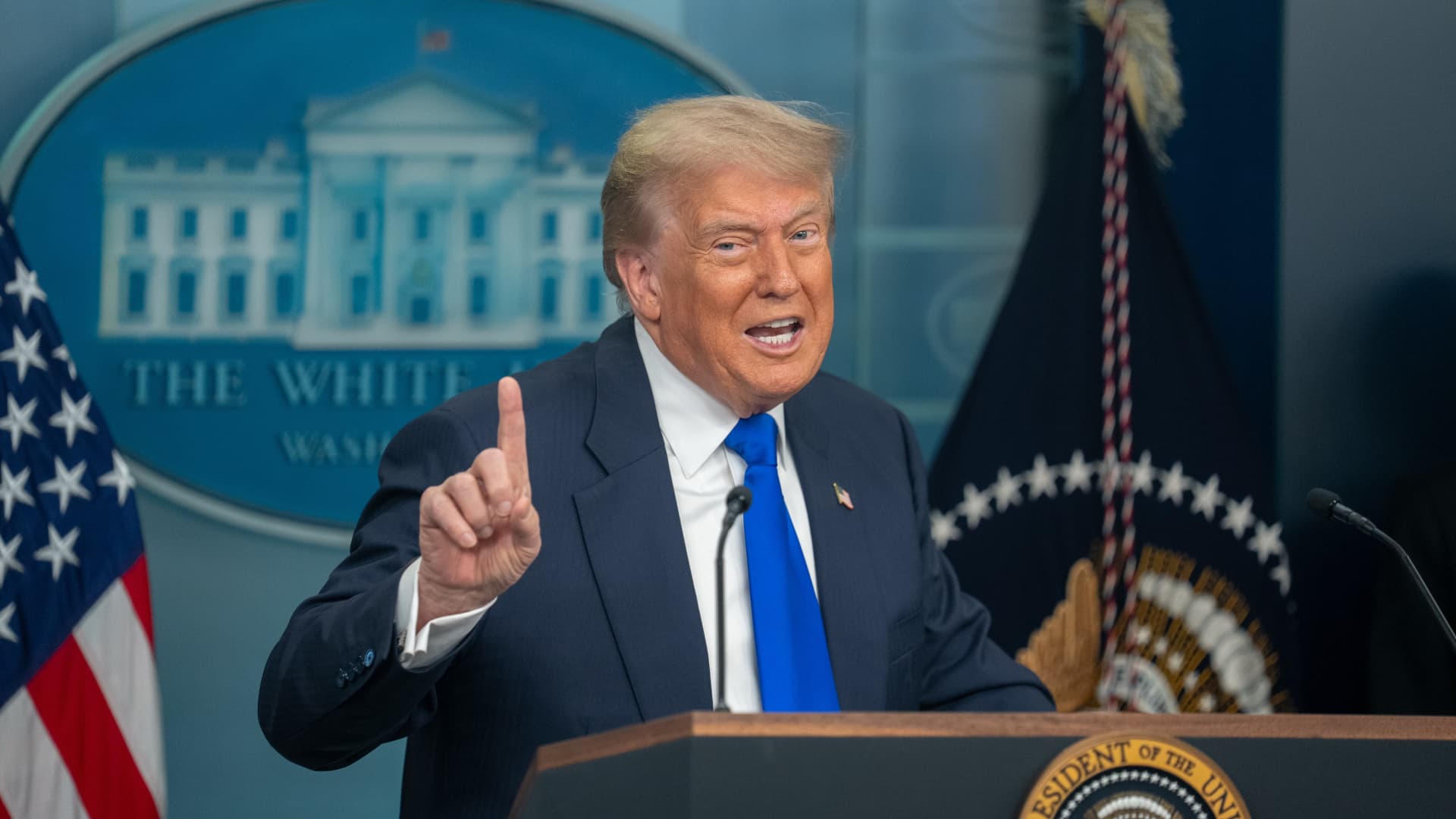

U.S. President Donald Trump’s administration is facing a looming deadline in trade negotiations with the European Union, as both parties struggle to finalize an agreement before July 9. This date marks the end of a 90-day reprieve on Trump’s reciprocal tariffs, after which EU goods entering the U.S. may be subjected to duties as steep as 50%. If an accord is not reached, retaliatory measures from the EU, which have been temporarily paused, may swiftly follow.
The U.S.-EU trade relationship is crucial to the global economy, representing roughly 30% of international goods traffic, according to the European Council. In 2024, trade between the partners was valued at approximately 1.68 trillion euros ($1.98 trillion) when considering both goods and services. Although the EU enjoyed a surplus of 198 billion euros in goods, it faced a deficit of around 148 billion euros in services, resulting in an overall trade surplus of about 50 billion euros last year.
Trump has consistently criticized the trade dynamics between Washington and Brussels, labeling them as imbalanced and alleging that the EU exploits the U.S. These trade talks have been marked by sluggish progress, with insiders indicating that a rudimentary political agreement may be the best realistic outcome for Europe. European Commission President Ursula von der Leyen echoed these sentiments, stating, “What we are aiming at is an agreement in principle,” while adding that achieving a detailed agreement during the reprieve was “impossible.”
Von der Leyen further emphasized that “all the instruments are on the table” should negotiations fail to result in a deal. Meanwhile, European Trade Commissioner Maros Sefcovic highlighted the week’s discussions with U.S. officials as “productive,” affirming their ongoing commitment to a robust transatlantic trade agreement.
U.S. Treasury Secretary Scott Bessent, however, appeared less optimistic, commenting on CNBC’s “Squawk on the Street,” “We’ll see what we can do with the European Union.” Experts remain doubtful about the likelihood of a comprehensive deal being reached in the immediate future.
Former U.S. Ambassador to the EU, Anthony Gardner, noted that the details necessary for an all-encompassing agreement are extensive, pointing out that such documents can reach thousands of pages. He suggested that a more feasible outcome could resemble the heads of terms the U.S. signed with the U.K., but cautioned that the content would likely differ significantly.
Carsten Nickel, managing director at Teneo, projected that the best possible outcome for the EU might be a broad agreement that grants additional time for discussions. He proposed that the deal should include acceptance of a 10% baseline tariff from the U.S., allowing for future dialogues on specific sector exemptions. Nevertheless, he warned of persistent uncertainty, stating that any agreement would likely remain a point of contention, susceptible to changes at the whim of U.S. decision-makers.
Nickel also indicated that the EU is unlikely to impose retaliatory measures unless full tariffs are enacted. He concluded, “Even then, I think the EU will tread carefully,” suggesting that any repercussions would be approached with caution. As the July 9 deadline approaches, the global economy watches closely, awaiting the outcome of these pivotal negotiations.
Original Source: https://www.cnbc.com/2025/07/04/trumps-tariffs-deadline-is-looming-for-europe-heres-where-things-stand.html
Category :
Tags:
Publish Date: 2025-07-04 17:23:00