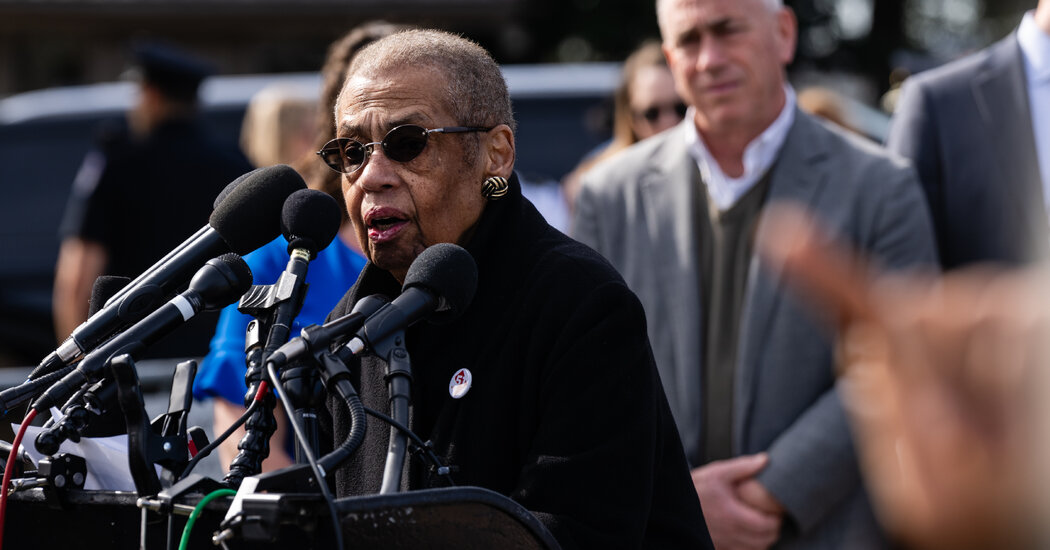

At a recent gala honoring her career, Representative Eleanor Holmes Norton, Washington D.C.’s nonvoting delegate and a prominent Democrat, struggled to deliver her remarks. As she addressed the audience at Arena Stage, references to the “National Environment for the Arts” and the contributions of a local theater were marred by stumbles and mispronunciations, leaving those in attendance unsettled. An attendee noted the stark contrast between a video montage celebrating her extensive achievements over three decades in public office and her faltering speech.
Ms. Norton’s performance spotlighted the decline that friends and colleagues have observed, prompting private discussions about whether she should consider retirement. Although she turns 88 this week, Norton remains determined to run for re-election, stating to reporters, “I don’t know why anybody would even ask me” about her capacity to serve. Yet, the concerns are evident. Once a vocal presence in the House, she now often remains silent during sessions, at times relying on staff to navigate her duties.
Her decline is reflective of a broader issue in Congress, where some long-standing members struggle to recognize their diminishing capacity. Ms. Norton’s activity has plummeted; she spoke on the House floor just four times this year, down significantly from previous sessions. In private meetings, she frequently uses vague sentences and relies on aides for support, leading to concerns about her ability to communicate effectively.
Former confidants and colleagues, including Donna Brazile, acknowledge her contributions but suggest it may be time for new leadership. “This is an opportunity to help the District write a new chapter,” Ms. Brazile said, advocating for Norton to consider stepping aside. As her time in Congress coincides with critical moments for Washington, D.C., concerns about her effectiveness have grown, particularly with recent legislative attempts by House Republicans to undermine the city’s autonomy.
D.C. Mayor Muriel Bowser recently refrained from expressing confidence in Norton’s ability to serve effectively, further emphasizing the urgency of the situation. Norton’s role as a nonvoting member limits her to lobbying and persuasion, heightening the alarm around her current condition. In her prime, she was an unyielding advocate for voting rights and local autonomy; now, many fear her legacy could diminish without a graceful exit.
Colleagues like Representative Jamie Raskin, a close ally, express both admiration for her past achievements and a desire for generational change. “It’s going to take a new generation of leadership to win statehood and the battles of the day,” he noted, reflecting a collective concern among her peers. As Norton deliberates her future, challengers, including Kelly Mikel Williams, argue it’s time for voters to reassess their choices, especially when considering the responsibilities of such a significant role at an advanced age.
As Norton’s situation continues to unfold amidst pressing political challenges, her legacy hangs in the balance. The conversation around her potential retirement serves as both a challenge and an opportunity for D.C. to embrace new leadership while reflecting on the impactful career of a civil rights icon.
With the District facing legislative challenges and calls for independence, Norton’s ability to effectively advocate for D.C. is now under scrutiny. Prospective voters are already considering how her age and health may affect the essential representation they need in Congress.
Original Source: https://www.nytimes.com/2025/06/11/us/politics/eleanor-norton-age-congress-dc.html
Category : United States Politics and Government,Elderly,Law and Legislation,Democratic Party,House of Representatives,Norton, Eleanor Holmes,Trump, Donald J,Washington (DC)
Tags:
Publish Date: 2025-06-11 16:55:00