Groundbreaking Discovery: Chandrayaan-3 Unveils Water-Ice Beyond Moon’s Poles – A Revolutionary Leap in Space Exploration

A recent analysis of data from India’s Chandrayaan-3 mission suggests that water-ice may be more widespread on the Moon than previously thought, potentially extending beyond the known polar regions. Researchers at the Physical Research Laboratory in Ahmedabad have been examining temperature data collected by the Chandra’s Surface Thermophysical Experiment (ChaSTE), which was one of the instruments aboard Chandrayaan-3, to make this groundbreaking discovery. The new findings have been published in the esteemed journal, Communications Earth and Environment.
The ChaSTE instrument has provided the first on-site temperature measurements of the Moon’s surface and sub-surface near the poles, marking a departure from the satellite-based estimates used earlier. The researchers noted significant temperature variations, even with minor changes in altitude over short distances on the Moon’s higher latitudes. Inclined surfaces that do not directly face the Sun may have conditions resembling those in the polar regions, with the possibility of harboring water-ice just below the surface.
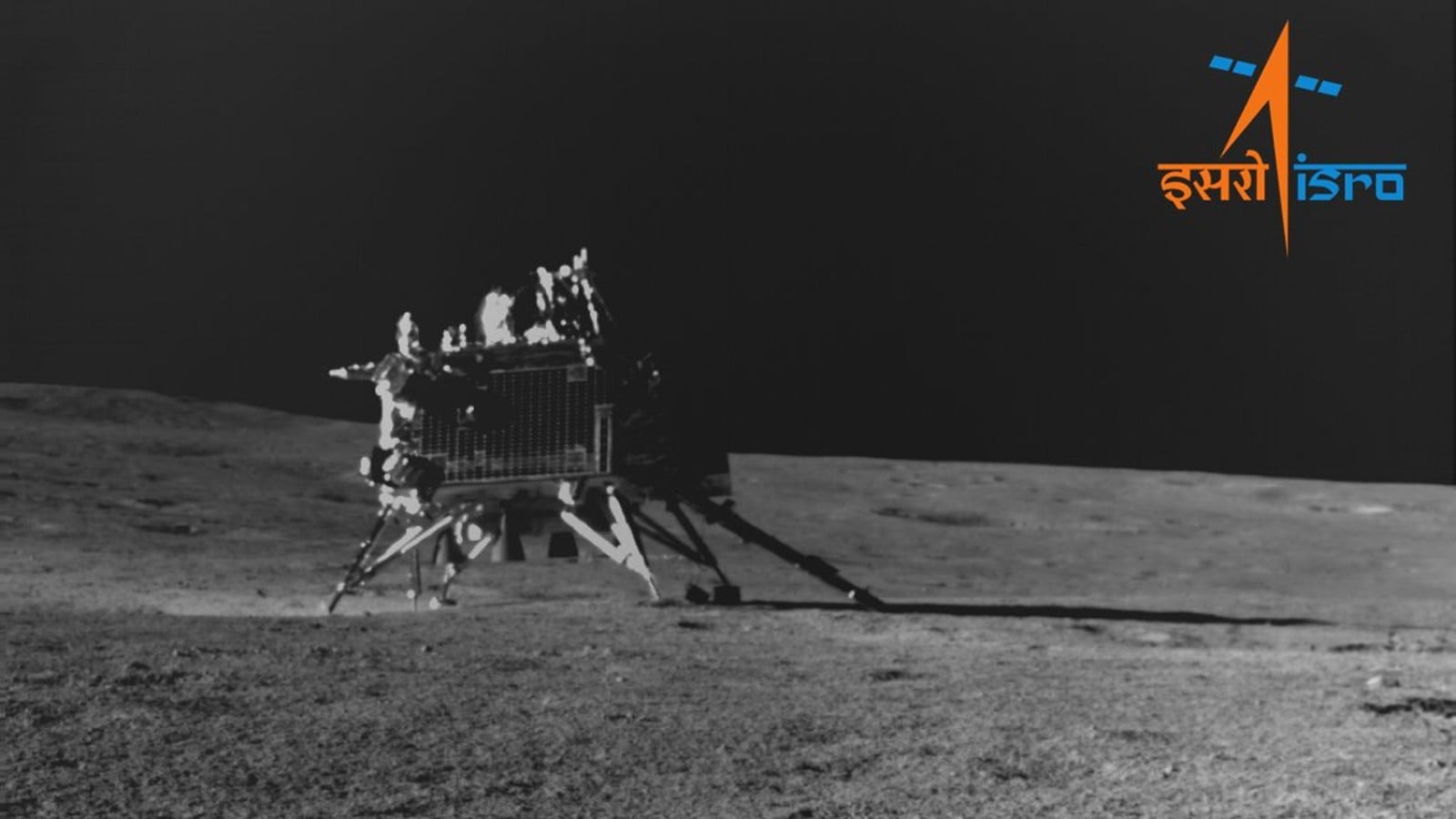
In contrast to the previous understanding that water-ice is confined to lunar polar craters, Chandrayaan-3’s ChaSTE data indicates such deposits might exist outside these areas. This study led by K Durga Prasad explores the potential of water-ice in regions like Shiv Shakti point, where the spacecraft had landed, providing new opportunities for exploration and utilization. Although not in the exact polar region, the Vikram lander of Chandrayaan-3, situated at 70 degrees South, provides a strategic vantage for this investigation.
One of the key observations was a considerable temperature difference over small distances. For instance, ChaSTE recorded a temperature of 355 Kelvin (approximately 82 degrees Celsius) on a Sun-facing slope, while a flat region just a meter away measured 332 Kelvin (about 59 degrees Celsius). These temperature disparities offer novel insights into the properties of the lunar surface, suggested by the study to be important for further examination into the presence of water-ice.
The significant temperature differences at various lunar locations are not direct evidence of water-ice, but they present intriguing clues for probing the Moon’s sub-surface. Regions with inclines that exceed 14 degrees in the poleward direction might mimic polar environments, creating shallow depth conditions conducive for water-ice accumulation. The research proposes that these high latitude sites, with their temperature variability and potential for water-ice deposits, are promising for scientific and exploration endeavors.
ChaSTE’s findings hint at a fine-scale spatial variability in the temperatures of the Moon’s regolith, offering new possibilities for water-ice scouting and resource prospecting. Such high-latitude areas offer not only promising scientific insights but could also reduce technical challenges when compared to exploration near the Moon’s poles. As Prasad’s team emphasizes, these areas could be crucial for future lunar missions aiming for habitability and resource extraction.
This enhanced understanding of lunar topography and temperature distribution could pave the way for future missions that might utilize the Moon’s natural resources, a step forward in humanity’s quest to explore and inhabit our celestial neighbor. The groundbreaking work carried out by Chandrayaan-3 and the potential identification of viable water-ice locations provide a promising outlook for continued exploration of the Moon.
Original Source: https://indianexpress.com/article/technology/science/presence-of-water-ice-likely-outside-moons-polar-regions-as-well-chandrayaan-3-data-9879720/
Category :
Tags:
Publish Date: 2025-03-11 06:48:00