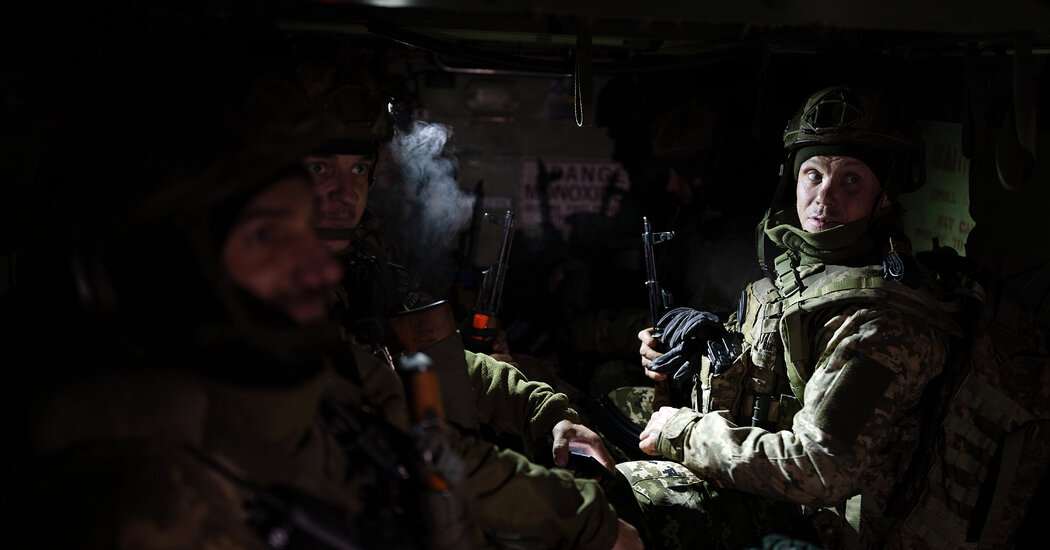

Ukrainian forces have effectively stalled Russia’s prolonged offensive in the eastern Donetsk region, gradually reclaiming small territories, as corroborated by Ukrainian soldiers and military analysts. Despite Russia maintaining the overall initiative with daily assaults across the eastern front, their offensive strength has diminished after 15 months of continuous operations. Depleted brigades and struggles in replacing destroyed equipment have created opportunities for the Ukrainian military to exploit.
Michael Kofman, a senior fellow at the Carnegie Endowment for International Peace, notes that the Russian offensive has stalled due to unfavorable weather, exhaustion among Russian troops, and Ukraine’s effective tactical adaptations. While stability in Donetsk is yet to be achieved, the situation shows signs of improvement as Ukraine innovatively compensates for the shortage of troops.
Discussions between Ukrainian and American officials in Saudi Arabia this week, following a tense exchange earlier this year, are expected to address the intelligence-sharing pause that has impacted Ukraine’s capacity to strike Russian command centers and logistics hubs effectively. The lack of intelligence is particularly problematic in the Kursk region, where Russian and North Korean forces have been advancing. A senior U.S. military official emphasized that this intelligence gap is significantly hampering Ukraine’s ability to target high-value Russian assets.
In response, Ukraine has proposed a partial truce in air and sea operations, accepting that some territory would remain under Russian occupation. However, U.S. officials have stated that intelligence support will resume only after Ukraine meets unspecified demands from the White House.
The conflict’s intensity remains concentrated along the Donbas front, extending 260 miles and encompassing Donetsk. While Russia made substantial gains in the southern Donbas last year, capturing the remaining Ukrainian strongholds remains a challenge.
In Pokrovsk, Russian forces, who advanced close to the city last December, have been impeded by well-prepared Ukrainian defenses. As the Russian advance slowed, Ukrainian counterattacks became more frequent, aiming to exploit Russian vulnerabilities. Major Taras of the 68th Jaeger Brigade recounted a successful operation to reclaim part of Dachenske, yet acknowledged the need for more resources to maintain control.
Toretsk has seen fierce urban combat for months. Capt. Bohdan Ravlikovskyi of the Azov Brigade described street-level conflicts where Ukrainians and Russians have at times occupied the same structures. Russian assaults aim to penetrate deeply using various vehicles and infantry but have been met with recent Ukrainian counterattacks.
Chasiv Yar, known as a strategic buffer protecting cities under Kyiv’s control, has experienced relentless Russian assaults. Russian tactics have included bombing, armored assaults, and infiltration, though control remains contested. Lt. Mykola of the 5th Assault Brigade noted the continuous yet degraded quality of Russian forces after persistent fighting.
Overall, while Ukrainian forces remain outnumbered, increased use of modern tactics, including drones, is having a cumulative impact on Russian operations. Despite logistical challenges, Ukraine’s resilience and tactical adjustments are crucial in the ongoing conflict.
Original Source: https://www.nytimes.com/2025/03/10/world/europe/ukraine-russia-eastern-front-line.html
Category : Russian Invasion of Ukraine (2022),Foreign Aid,Defense and Military Forces,Drones (Pilotless Planes),International Relations,United States International Relations,Chasiv Yar (Ukraine),Donbas (Ukraine),Donetsk (Ukraine),Pokrovsk (Ukraine),Toretsk (Ukraine),Ukraine,Russia
Tags:
Publish Date: 2025-03-10 09:31:00