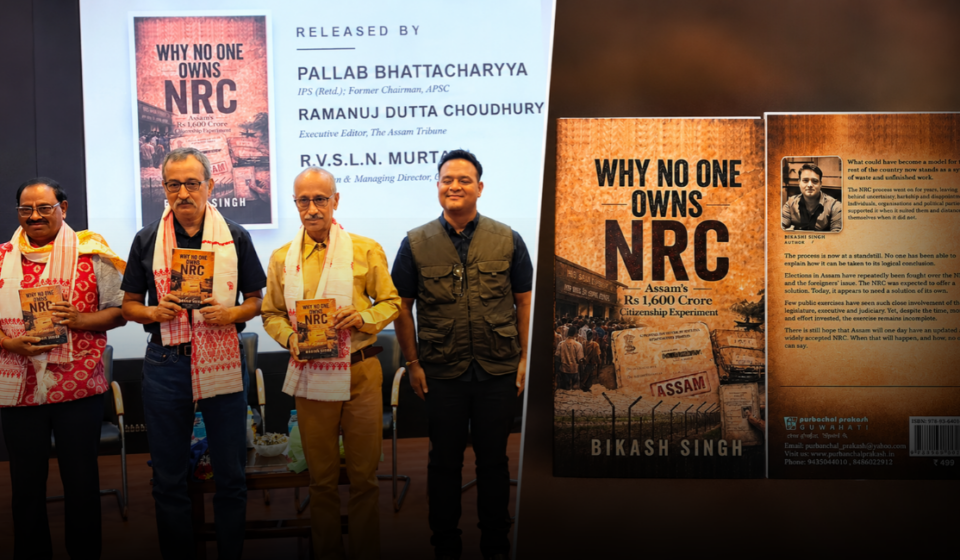

Senior journalist Bikash Singh’s book, “Why No One Owns NRC: Assam’s Rs 1,600 Crore Citizenship Experiment,” was launched in Guwahati on Sunday, offering a detailed analysis of Assam’s National Register of Citizens (NRC) update beyond political controversy. It was released at NedFi House in Dispur by retired IPS officer and former Assam Public Service Commission chairman Pallab Bhattacharya, The Assam Tribune executive editor Ramanuj Dutta Choudhury and NedFi chairman and managing director P.V.S.L.N. Murthy. Senior journalists, academics and prominent citizens attended.
The book examines the process’s historical and legal foundations, document-verification experiences, administrative machinery and unresolved questions years after the final list. It asks who bears institutional responsibility for one of India’s largest citizenship verification exercises, involving crores of people and huge public spending. It also documents citizens gathering ancestral papers, proving lineage, attending hearings and waiting years for inclusion, as well as the roles of officials, technology and resources.
The final NRC published on August 31, 2019, included 3,11,21,004 names out of 3,30,27,661 applicants, leaving 19,06,657 excluded. Yet the process did not end clearly. Many families remain uncertain over official notification, rejection slips and legal challenges.
Speaking at the launch, Singh said the Assam NRC was not merely an administrative process or political debate. “Through documents, family history and government records, lakhs of people had to prove their identity, and a huge institutional system was activated to verify those claims,” he said. He added that it was urgent to record the experiences of those who went through the process, the officials who implemented it, the resources spent and the unanswered questions. Singh said the book tries to place the process in context and explain why Assam’s NRC and the national NRC debate are often viewed alike despite distinct historical and legal bases.
Murthy said the book reflects a journalist’s pain at the lack of meaningful progress after the 2019 final list and urged readers to understand its concerns. Choudhury said political parties have not shown sustained interest in a credible NRC, with electoral calculations and vote-bank politics overshadowing the issue; a 2005 decision to complete the update in two years was followed by actual work only in 2015, and the current government’s dissatisfaction has made the NRC’s future more uncertain. Bhattacharya recalled the movement’s road blockades and high expectations, and the challenges of maintaining law and order during the tense 2018–19 update while in police service.
A key section explains the difference between the Assam NRC and the proposed all-India NRC. The Assam exercise was rooted in the 1985 Assam Accord, which set March 24, 1971, as the cut-off. It drew legal basis from Section 6A of the Citizenship Act, 1955, and Rule 4A of the Citizenship Rules, 2003, requiring applicants to prove eligibility through legacy data and lineage documents such as the 1951 NRC or pre-1971 electoral rolls. By contrast, the general framework for the National Population Register and citizenship verification under Rule 4 is separate. The book makes clear that although the two are often discussed together nationally, their legal and administrative backgrounds differ.
Original Source: https://assam.nenow.in/assam-nrc-book-launch-journalist-bikash-singhs-book-examines-the-rs-1600-crore-exercise-and-19-06-lakh-excluded-applicants/
Category: Popular Stories,অসম,দেশ,ভাষা-সাহিত্য,শীর্ষ সংবাদ
Tags:
Publish Date: 2026-11-29 21:47:00