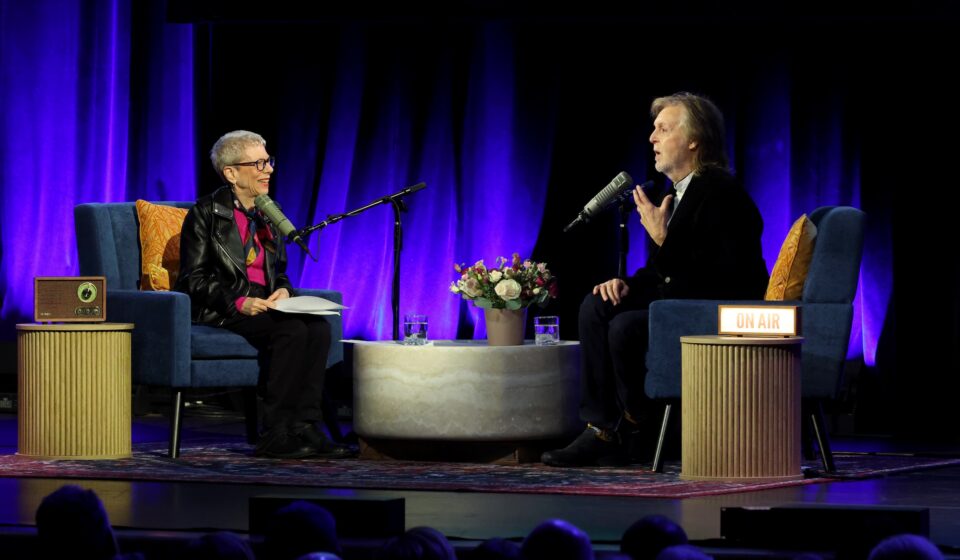
Terry Gross & Paul McCartney Face New York Audience in Must-Watch NYC Cultural Moment

The Beatle Who Wouldn’t Talk: McCartney, Mortality, and the Art of the Elegant Dodge
There are interviews that glitter, and interviews that leave a bruise. Sir Paul McCartney’s newly recorded conversation with Terry Gross is the rare creature that does both-gliding from music-hall nostalgia to the cold shadow of assassination, then landing, with astonishing grace, on the afterlife.
McCartney opened the vaults with warmth, recalling how he and John Lennon bonded over 1920s British music hall songs, the breakup of the Beatles, the depression that followed, and the birth of Wings-a band launched in a van, touring English college campuses with no dates booked. It is the stuff of rock lore: scrappy, romantic, and just reckless enough to work.
Then Gross turned the conversation toward the darker side of pop life. In 1980, Lennon was assassinated by a fan with mental health issues. In 1999, George Harrison was stabbed multiple times during a home invasion by a fan with similar problems. Two years later, Harrison died of cancer.
“Were you worried that people would come after you?” Gross asked. “You weren’t just another celebrity who decided, ‘This is a new era, I need more security.’ You would have been the third Beatle to be attacked.”
“I don’t even like to talk about it,” McCartney said.
“I can understand that,” Gross replied.
“So, why are we talking about it?” McCartney shot back.
“Because I didn’t know that you didn’t want to talk about it,” Gross said. “I will now drop it.”
“You know what I mean,” McCartney said. “I think the less you bother with all that stuff, the better off you are.”
“Okay, done,” Gross said.
Done-but not quite. Gross pivoted from one uncomfortable subject to another: his age and the limits of his voice. “How are you writing for your voice now?” she asked. “You’ve aged and your voice isn’t as high and you probably don’t have as wide a range as you used to.”
McCartney, ever the showman, explained that some songs are lowered to suit him. “They’re not, ‘Yeah!’” he said, lifting his voice into a crackling high pitch. “That gets over that problem. But I still sing songs on stage that are high. I just scream them.”
That led to “The End of the End,” from his 2007 album Memory Almost Full, whose chorus imagines an afterlife. Gross asked what he envisions death to be.
“I’m just guessing,” McCartney said. “I’m guessing you’re going to a better place. I mean, why not? I don’t know because nobody knows. The Pope doesn’t know. Dalai Lama doesn’t know. Nobody knows. But if you’re going to imagine it, I don’t think it does any harm to imagine it as a better place.”
The conversation was recorded for a future episode of Fresh Air. And if this is McCartney at his most guarded, it is also McCartney at his most human-still dodging, still charming, still searching for a better place.