
Nine months after Bangladesh’s February 12, 2026 general election ended 18 months of interim rule, the country has regained electoral legitimacy but not institutional stability. Prime Minister Tarique Rahman’s Bangladesh Nationalist Party holds 212 of 299 contested parliamentary seats, yet it faces rising domestic, economic and diplomatic risks. These include street violence reportedly linked to the banned Awami League, tension over the July National Charter, an energy crunch, banking distress and a diplomatic freeze with India before the Ganga Water Sharing Treaty expires on December 12, 2026.
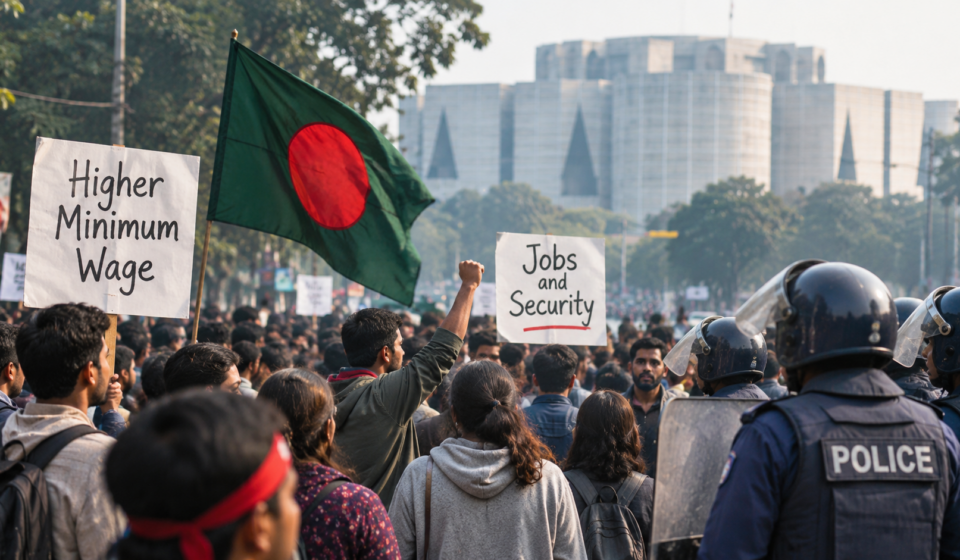
November 2026 brought a sharp security deterioration, coinciding with the first anniversary of Sheikh Hasina’s in absentia death sentence by the Dhaka International Crimes Tribunal. Police recorded at least 78 crude bomb blasts and 74 torched incidents across more than 28 districts in ten days, while a week-long Awami League agitation culminated in a November 19 nationwide lockdown. Hasina’s London-based counsel applied on November 9 for a new passport and national identity card, and unverified rumours of a December return prompted security assessments and pre-emptive highway closures around Awami League strongholds, including Gopalganj. Garment-worker protests demanding a Tk 30,000 monthly minimum wage also turned into clashes across the Savar-Ashulia belt, shutting at least 50 factories; Rahman attributed the unrest to an Awami League conspiracy. The government has launched a Tk 2,339.21 crore security modernisation drive, but had spent only Tk 110.63 crore by September 2026. The armed forces remain aligned with civilian authority, and military intervention is a low-probability risk unless law enforcement collapses under urban violence and banking insolvency.
Economic fragility is the government’s central legitimacy test. The war in Iran that began on February 28, 2026, disrupted LNG supplies from Qatar, which provides about 78% of Bangladesh’s LNG via the Strait of Hormuz, causing power shortages and fiscal strain. Diesel prices rose 17.4% in September and cooking gas cylinder prices about 18% in October, keeping inflation at 8%–9% against a 5%–6% comfort band. The World Bank cut FY 2026 growth to 3.4%–3.9%, while the ADB projects 3.7%; the UN warns that 18.1 million people face acute food insecurity from September to December 2026. Non-performing loans reached 32.26% by March 2026, reportedly the world’s second-highest ratio after Ukraine, concentrated in five state-owned banks. The World Bank approved a $450 million financial-sector support project in June 2026, and Dhaka is negotiating a $4.5 billion IMF programme. A three-year deferral of least-developed-country graduation to November 24, 2029, protects duty-free access in 38 markets covering 73% of exports, including a $38.7 billion readymade garment sector.
Rahman’s “Bangladesh First” policy seeks to reduce over-reliance on any single patron, but India remains the hardest challenge. The Hasina extradition deadlock threatens the Ganga treaty, the only formal agreement covering Bangladesh’s 54 shared rivers with India. Bangladesh is counterbalancing through a June 2026 Beijing visit that produced 15 memoranda of understanding, two agreements, a 16-point communiqué, an approximately $300 million grant and a Mongla investment memorandum. An October 2026 Tokyo summit positioned Japan as a trusted third pole, with a projected ¥1 trillion in private investment over five years and maritime patrol vessel aid. US engagement has brought Development Finance Corporation eligibility but also criticism over a reciprocal trade agreement and a $3.7 billion Boeing order. In November 2026, the International Court of Justice held Myanmar responsible for genocide against the Rohingya, but the ruling lacks independent enforcement and faces likely UN Security Council vetoes; the Arakan Army now controls borderlands across the Naf River.
Three scenarios loom for 2026–2027: reform stagnation with managed friction; institutional consolidation and a reset with India; or a compound crisis spiral involving a lapsed Ganga treaty, Awami League disruption, Islamist counter-mobilisation, garment shutdowns and military stabilisation. To avoid the worst, Bangladesh and India should secure an interim Ganga treaty extension, while Dhaka should prioritise IMF liquidity, LNG and power stability, wage grievances and July Charter checks. Regional partners should also combine legal pressure on Myanmar with pragmatic border management and sustained humanitarian funding in Cox’s Bazar.
Original Source: https://eastmojo.com/national-news/2026/11/25/troubled-waters-in-dhaka-governance-deadlock-renewed-unrest-and-geopolitical-realignments/
Category: National News,News,Northeast News,Opinion,Premium ,Top News
Tags:
Publish Date: 2026-11-25 12:30:00