Electrifying Heavy Freight: Adani Cement’s Structural Tipping Point

The Truck Is the Easy Part
Everyone is celebrating 410 electric trucks. I’m more interested in the 410 charging decisions nobody wants to make.
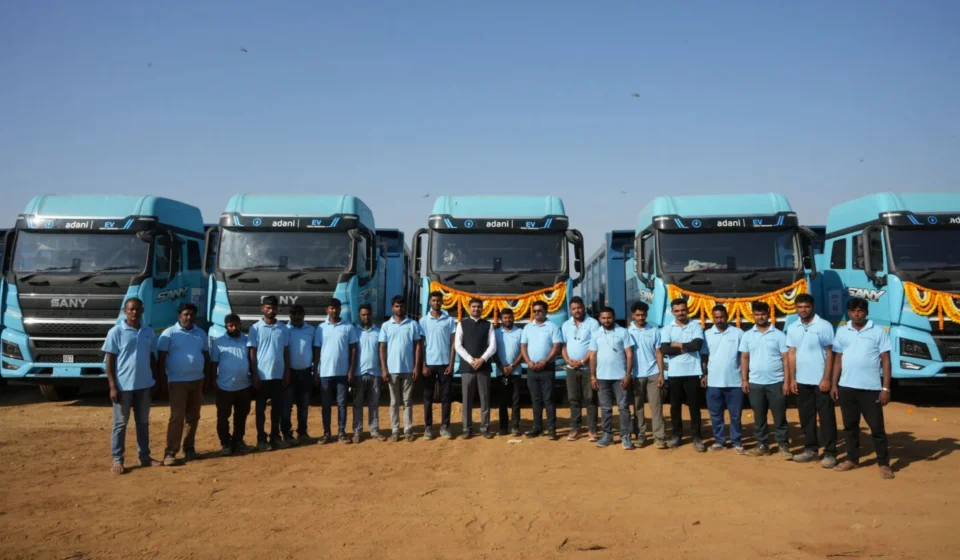
I recently came across Adani Cement’s announcement that it has flagged off heavy-duty electric trucks at its Sanghi plant in Gujarat – 410 trucks by March 2027, cutting over 25,000 tonnes of CO₂ and displacing roughly 11 million litres of diesel annually, with a stated goal of moving 10% of road logistics volume on 2000+ EVs by 2030. The economics are laid out cleanly: diesel up 60% over a decade, Li-ion pack costs down ~70%, solar tariffs down 47%.
But here’s what the press release doesn’t say, and what enterprise architects should be asking.
Electrification is an energy architecture problem, not a procurement problem. A diesel fleet is operationally simple: fuel arrives by tanker, and the depot is just parking. An electric fleet turns every depot into a distributed energy node – load orchestration, demand charges, charging-window scheduling against dispatch plans, and increasingly co-located solar plus storage. That is the same discipline we apply to data centre capacity planning, now applied to a truck yard. Get it wrong and the TCO case collapses not on vehicle price but on peak demand tariffs and charger idle time.
The measurement layer is the real deliverable. You cannot credibly claim 25,000 tonnes of avoided CO₂ without telemetry – kWh per km, payload, gradient, route profile, and crucially the provenance of the electrons. Scope 3 decarbonisation lives or dies on an auditable data pipeline, not a spreadsheet stitched together at year-end. Enterprises that treat MRV (measurement, reporting, verification) as an afterthought will find their sustainability claims unbankable when auditors, lenders, or global customers start asking for evidence.
Beware hardware-shaped tech debt. Charging standards, connector protocols, and battery-swap architectures are still contested ground. A fleet locked into a proprietary charging ecosystem for a fifteen-year asset life is technical debt with a steering wheel. Interoperability and open standards at the depot level are strategic, not idealistic.
And then there is the human layer. A depot’s uptime SLA replaces the fuel pump. Drivers need new behaviour models, mechanics need high-voltage certification, and dispatch planners need to think in state-of-charge the way they once thought in litres. Transformation friction always shows up in the last mile of the org chart.
The Bharat angle – and specifically the Northeast – matters here. Cement movement across Assam and Meghalaya runs on gradients, and regenerative braking on hilly routes is a genuine, underappreciated advantage. But hill-grid reliability means depot-level solar plus storage isn’t a nice-to-have; it’s the precondition. Equally important: most trucks on our highways are owned by small operators, not large fleets. The scalability lesson for India is that charging infrastructure may need to behave like public infrastructure – discoverable, interoperable, and shared across MSME transporters – rather than captive to individual plants.
Three takeaways for CTOs and founders:
- Treat fleet electrification as an integration programme: energy, telemetry, ERP/TMS, and finance, not four separate projects.
- Build the MRV data layer before you build the sustainability narrative.
- Design for interoperability; negotiate charger protocols as hard as you negotiate vehicle prices.
The vehicle is a commodity that is rapidly improving. The architecture around it is where competitive advantage – and stranded cost – will actually be decided.
About the Author: Sanjeev Sarma is the Founder Director and Chief Software Architect at Webx Technologies. With a core focus on Generative AI integration, Cloud-Native Scalability, and Enterprise Software Architecture, he has spent over two decades driving digital transformation across Northeast India and beyond. Beyond his corporate leadership, Sanjeev is deeply invested in shaping the future of the IT industry. He serves as an Industry Expert on the Board of Studies for Assam Don Bosco University’s School of Technology, advises state technology committees, and actively mentors emerging tech startups at STPI. He brings a unique, dual perspective of high-level enterprise execution and future-ready academic curriculum development.