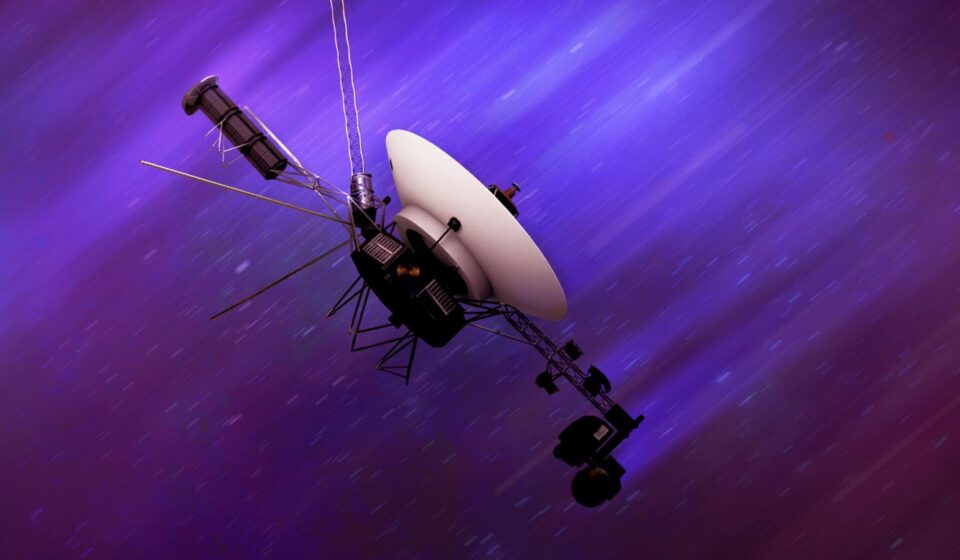

NASA’s Voyager 1 has become the first human-made object to reach one light-day from Earth, crossing a threshold that means radio signals take exactly 24 hours to travel between the spacecraft and ground stations. The probe reached the mark on Nov. 18, 2026, at 2:16 a.m. PST (10:16 UTC), at a distance of about 16.1 billion miles (25.9 billion kilometers), or roughly 173.14 astronomical units, NASA announced.
Flight controllers at NASA’s Jet Propulsion Laboratory in Pasadena, California, confirmed the passage through radio carrier tracking by the Deep Space Network. Because a command now takes 24 hours to reach Voyager 1, round-trip verification requires 48 hours. The milestone cements Voyager 1’s status as the most distant human-made artifact, moving through interstellar plasma beyond the heliopause.
“Traveling a light-day is a singular feat for a spacecraft, but Voyager is so much more than a distant traveler,” said Joe Westlake, director of NASA’s Heliophysics Division. He noted that the mission’s Grand Tour of the outer planets made it remarkable for planetary science, while its long afterlife has made it central to heliophysics and studies of the Sun.
The tracking feat relies on NASA’s Deep Space Network, whose 70-meter (230-foot) antennas at Goldstone in California, near Madrid in Spain and near Canberra in Australia maintain line-of-sight contact as Voyager 1 speeds outward at about 38,000 miles per hour (61,000 kilometers per hour). In mid-November, engineers encountered a telemetry anomaly when frame synchronization paused on Nov. 14, though a strong S-band carrier signal persisted. Mission operators confirmed the milestone through Doppler tracking and trajectory modeling, according to Space.com.
Voyager 1 launched on Sept. 5, 1977, and flew by Jupiter in 1979 and Saturn in 1980. A close encounter with Titan bent its path out of the ecliptic plane and into deep space. On Aug. 25, 2012, at 121.6 AU, it crossed the heliopause into interstellar space.
The achievement drew praise from mission leaders. “Voyager 1 crossing the light-day threshold is yet another historic feat on an extraordinary voyage of discovery,” said Dave Gallagher, director of JPL. He credited exceptional teams who built, programmed and still fly the spacecraft, keeping them connected across vast distances. Voyager project manager Suzanne Dodd said the flight team communicates with both probes daily and continues troubleshooting the telemetry stream.
For university researchers, Voyager 1 offers irreplaceable in situ measurements of interstellar plasma density, cosmic rays and galactic magnetic fields, data that help calibrate models and detectors without relying solely on remote spectroscopy. NASA makes calibrated telemetry available through open data systems, supporting long-term archives and independent analysis.
Voyager 1 is powered by three plutonium-238 radioisotope thermoelectric generators that lose about four watts per year. Engineers have shut down heaters and non-essential systems to preserve science. NASA expects at least one instrument to operate through the late 2020s, with carrier tracking possibly continuing past 2030. Voyager 2 is projected to reach one light-day around 2035. In about 40,000 years, Voyager 1 will drift within 1.6 light-years of the red dwarf Gliese 445, carrying Earth’s message through the Milky Way.
Original Source: https://casrai.org/news/nasa-voyager-1-reaches-one-light-day-distance-interstellar-milestone-2026
Category:
Tags:
Publish Date: 2026-11-22 02:27:00