Cargo-First Electrification: A Strategic Model for Inland Fleet Investment

Why Buying for Today’s Traffic Spike Creates Tomorrow’s Technical Debt
In enterprise architecture, one of the costliest mistakes an organization can make is mistaking a temporary traffic spike for a permanent workload. When teams over-provision rigid infrastructure based on this quarter’s anomalies, they don’t buy resilience-they buy decades of stranded technical debt.
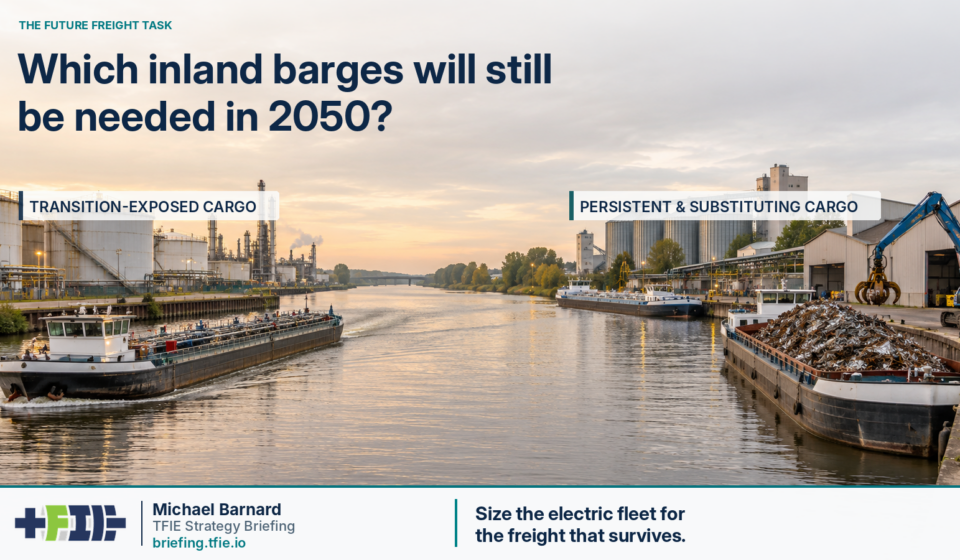
I saw a striking physical-world parallel to this recently while reading an analysis of European inland waterway electrification. Even though coal throughput at Rotterdam saw a 15.3% rebound in 2026, long-term scenario modelling to 2050 shows bulk cargo in major industrial corridors shrinking by roughly 40% as fossil fuels phase out and circular feedstocks like scrap steel take over. Vessel operators rushing to buy 30-year battery-powered barges based on today’s freight market risk electrifying a fleet for cargo that will soon vanish.
Designing for the Future Workload, Not the Legacy Asset
As an architect, what stood out to me wasn’t the maritime economics-it was the system-design flaw of starting with the hardware before modelling the future service. In cloud-native architecture and enterprise modernization, we face this exact tension during every platform migration.
Three architectural principles from this shift translate directly to how CTOs, researchers, and founders should approach Generative AI integration, cloud infrastructure, and legacy systems:
- Beware the “Biofuel Trap” of Hype-Cycle Provisioning: The European corridor model highlights a deceptive curve where biofuel feedstocks peak around 2030 before collapsing by 2050. In tech, we see this constantly-enterprises locking into rigid, capital-heavy infrastructure to chase a transient five-year trend. True scalability requires elastic systems that can absorb a temporary surge without locking your balance sheet into rapidly depreciating assets.
- Decouple Propulsion from Payload: One of the sharpest insights in the analysis is the distinction between physical hulls and “powered vessel-equivalents.” In pushed barge formations, a single powered pusher unit moves multiple unpowered cargo barges. Electrifying the entire hull count inflates capital requirements unnecessarily. In modern software design, this is the textbook case for decoupling compute from storage, or separating the orchestration layer from legacy data containers. Modernize the high-utilization engine; don’t waste capital rebuilding every passive vessel around it.
- Replace Static Planning with Living Telemetry: External constraints like low river water levels force vessels to carry less per journey, altering unit economics overnight. Static five-year roadmaps fail under dynamic bottlenecks. The proposed solution-a “living cargo and route register” linking real-time utilization, contracts, and grid readiness-is essentially an event-driven observability backbone. Before deploying heavy capital, you need live telemetry.
Lessons for Riverine Economies and India’s Digital Stack
Sitting in Guwahati, I couldn’t help but think of our own riverine arteries, particularly the Brahmaputra (National Waterway 2). Much like the Rhine, our waterways navigate dramatic seasonal draught variations and rapidly evolving industrial corridors. As India invests heavily in green logistics and inland freight, we have a rare opportunity to leapfrog asset-heavy mistakes. By combining frugal, modular propulsion with a Digital Public Infrastructure (DPI) approach-creating open, living registries that pair river-depth telemetry and AI-driven demand forecasting with port grid capacity-we can ensure infrastructure investments follow bankable, long-term utility rather than short-term noise.
Strategic Takeaways for Leaders
- Model the 2035 workload, not the 2026 spike: Audit which business services have durable customer demand before committing to long-term capital or cloud lock-in.
- Target the high-utilization core: Identify the “pushers” in your legacy stack-the high-frequency engines where modernization yields the highest return-while keeping passive layers modular.
- Build the observability layer first: Establish a living register of usage, real-world constraints, and unit economics before sizing your underlying infrastructure.
Whether you are moving millions of tonnes of bulk cargo down a river or orchestrating millions of API calls in the cloud, capital always flows best when you map the future of the journey before you buy the engine.
About the Author: Sanjeev Sarma is the Founder Director and Chief Software Architect at Webx Technologies. With a core focus on Generative AI integration, Cloud-Native Scalability, and Enterprise Software Architecture, he has spent over two decades driving digital transformation across Northeast India and beyond. Beyond his corporate leadership, Sanjeev is deeply invested in shaping the future of the IT industry. He serves as an Industry Expert on the Board of Studies for Assam Don Bosco University’s School of Technology, advises state technology committees, and actively mentors emerging tech startups at STPI. He brings a unique, dual perspective of high-level enterprise execution and future-ready academic curriculum development.