Scaling Deep-Tech Energy Infrastructure: Capital, Silicon, and Smart Grids

The Most Important Software in India’s Energy Transition Won’t Run in the Cloud
We measure India’s power future in gigawatts – generation targets, storage capacity, transmission corridors. But the intelligence that actually determines whether that power reaches a household without tripping a feeder lives somewhere far less glamorous: inside firmware on a few million embedded devices bolted to walls and substations across the country.
That is the layer worth watching.
The signal
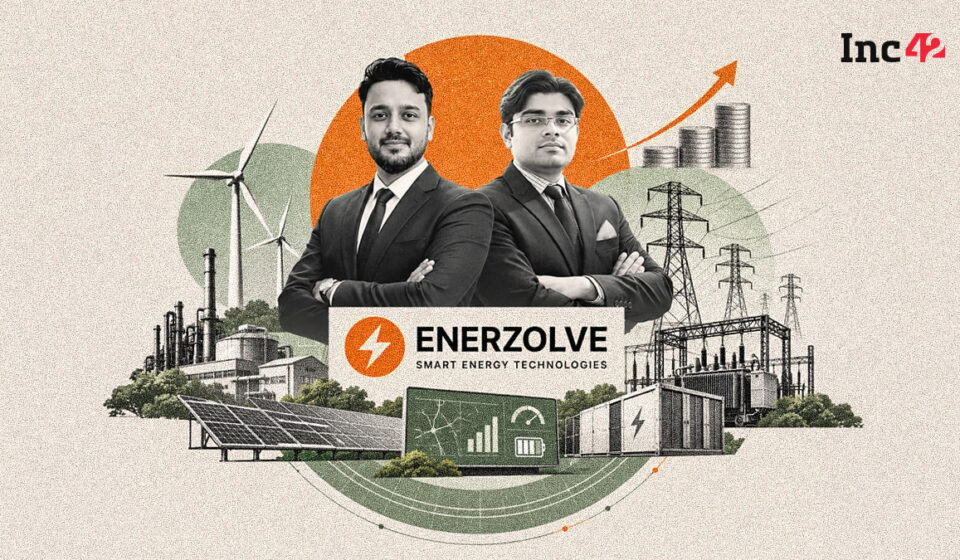
Bengaluru-based deeptech startup Enerzolve Smart Technologies is reportedly in talks to raise $16–20 Mn led by existing investor Jungle Ventures – less than a year after a $5.1 Mn seed round. It builds semiconductor-powered hardware and embedded systems across instrumentation, power electronics and battery storage: smart meters, protection relays, grid analysers, battery management systems, inverters. Notably, it is investing in core IP across silicon, firmware and power electronics, not just assembling boards.
Why this is an architecture story, not a funding story
Anyone who has modernised a legacy enterprise system knows the drill: lift, shift, refactor, iterate. Grid infrastructure denies you all of that comfort. A protection relay has to be correct on day one and trustworthy for 20–30 years. Yet the software inside it now needs to be patchable, observable and secure on a cadence closer to months.
That collision – 30-year asset life versus six-month software release cycles – is the central design constraint of modern energy infrastructure. And it is an order of magnitude harder than anything we debate in cloud-native circles. You cannot “roll back” a transformer.
The second structural shift: vertical integration is returning. Fifteen years of abstraction layers told us to buy the stack and integrate at the API. Energy hardware inverts that. If your core IP spans silicon, firmware and power conversion, you own your destiny – but you also own your yield curves, your supply chain exposure and your certification timelines. IEC 61850, DLMS/COSEM compliance and CEA approvals aren’t checkboxes; they are moats that take years and burn capital. I would argue the $18 Mn here isn’t growth capital at all. It is manufacturing and certification capital – the brutal valley between a working prototype and a deployable product.
Third: operational technology security. At national scale, meter data is behavioural data. It reveals occupancy, work hours, income patterns. Firms building this layer should be designing consent architecture and interoperable protocols from day one, not retrofitting them after the first audit. A proprietary black box at the grid edge is a decade-long liability for the DISCOM that buys it. Open APIs and offline-first firmware are not idealism – they are risk management.
The Northeast lens
I have spent years arguing in state technology forums that our region is not a smaller version of the plains – it is a different design problem. Low-density load, difficult terrain, feeder-level fragility, monsoon-driven outages. If smart grid and storage intelligence is designed for dense urban feeders only, it will fail here. If it is ruggedised, bandwidth-tolerant and capable of operating autonomously when the backhaul drops, the Northeast becomes a proving ground for the most resilient architectures in the country. The startups that get this right won’t just win contracts here – they’ll export that ruggedness.
What I’d tell founders
- Choose deep tech only if you can stomach a five-year horizon. Vertical integration buys control and costs speed.
- Certification is product strategy, not paperwork. Start it before your first pilot.
- Design for disconnection. The edge must keep working when the cloud doesn’t.
- Treat interoperability as a competitive advantage, not a concession.
Closing thought
The cloud taught us to move intelligence to where the data is. The grid is teaching us something older and harder – that some intelligence must survive forty years, a monsoon, and a firmware update gone wrong. That is architecture in its truest form.
About the Author: Sanjeev Sarma is the Founder Director and Chief Software Architect at Webx Technologies. With a core focus on Generative AI integration, Cloud-Native Scalability, and Enterprise Software Architecture, he has spent over two decades driving digital transformation across Northeast India and beyond. Beyond his corporate leadership, Sanjeev is deeply invested in shaping the future of the IT industry. He serves as an Industry Expert on the Board of Studies for Assam Don Bosco University’s School of Technology, advises state technology committees, and actively mentors emerging tech startups at STPI. He brings a unique, dual perspective of high-level enterprise execution and future-ready academic curriculum development.