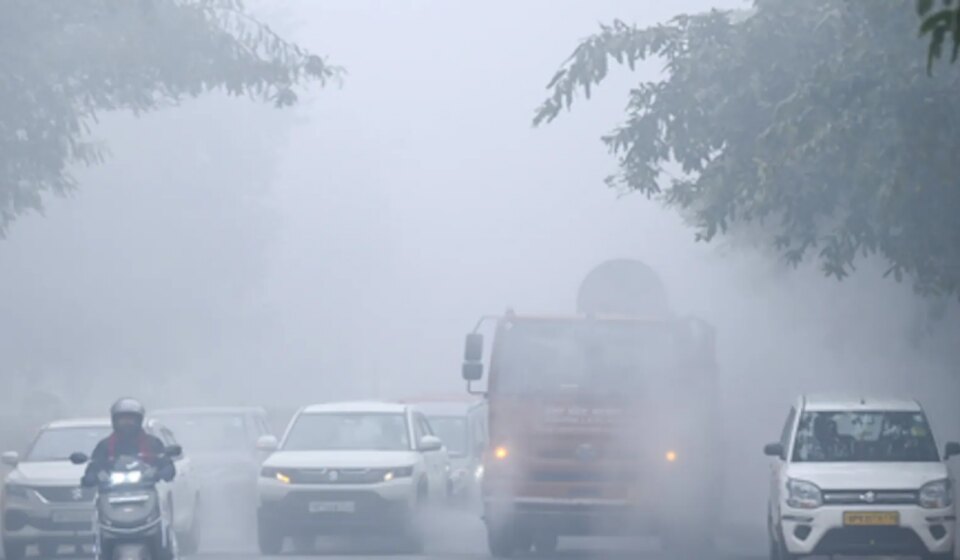

A thick blanket of smoke has engulfed Delhi-NCR during Diwali celebrations, triggering low-visibility conditions and renewing concerns over toxic air, with Delhi’s overall Air Quality Index (AQI) recorded at 373 in the “very poor” category at 11:05 PM on November 8, 2026. The crisis has renewed scrutiny of both pollution control measures and the reliability of official air quality data.
Ahead of the festival, the Commission for Air Quality Management (CAQM) enforced Stage 3 of the Graded Response Action Plan (GRAP) across Delhi-NCR, describing the move as a “pre-emptive” step after forecasts warned of deteriorating air quality. On Diwali night, Noida recorded an average AQI of 319, also “very poor,” while Ghaziabad stood at 360, Gurugram at 280 and Faridabad at 297. Several Delhi areas, including Alipur, Bawana, Burari, Chandni Chowk, Mundka, Punjabi Bagh, Rohini and Vivek Vihar, recorded AQI levels above 400 in the “severe” category.
The Air Quality Early Warning System has predicted that Delhi’s air quality is likely to remain in the “severe” category from November 9 for a few days. Under CPCB classifications, an AQI between 301 and 400 is “very poor,” while 401 to 500 is “severe.” Delhi’s air is expected to plunge further into the “severe” category after Diwali.
As official pollution data trickles in, activists and environmentalists are questioning its authenticity and the implementation of control norms, arguing that restrictions are being flouted. Environmentalist Bhavreen Kandhari told NDTV that existing policies have fundamental flaws and that official figures do not reflect conditions on the ground. She said many citizens own independent AQI monitors and have recorded pollution levels daily at the same time for years, offering consistent comparisons that are “an eye-opener.”
Kandhari said that while the Sameer app may show an AQI hovering around 400, what citizens are witnessing and measuring raises serious questions about the actual pollution burden, adding that a citywide average cannot capture the reality of every neighbourhood. Criticising the firecracker policy, she asked what the point of restricted bursting windows is when violations continue unchecked, warning that children’s lungs and developing brains are paying the price.
She also alleged that at least 11 monitoring stations experienced data gaps on November 6, with 22 missing hourly PM2.5 readings and 27 missing PM10 readings. IIT Delhi, Nangloi and NSIT Dwarka experienced significant outages, including during evening hours, she said. Kandhari called for transparent, credible air quality data rather than “imaginary numbers” that offer reassurance while people struggle to breathe.
Despite debate over the data and the restrictions in place, the situation on the ground remains difficult to deny. Poor AQI and reduced visibility point to the recurring nature of Delhi’s winter pollution crisis and raise fresh questions about the efficiency of control measures and the factors driving the annual emergency.
Original Source: https://www.ndtv.com/india-news/delhi-pollution-delhi-diwali-pollution-delhi-aqi-delhi-aqi-delhi-ncr-chokes-on-diwali-night-as-smoke-engulfs-city-aqi-nears-400-12301098#publisher=newsstand
Category:
Tags:
Publish Date: 2026-11-09 00:40:00