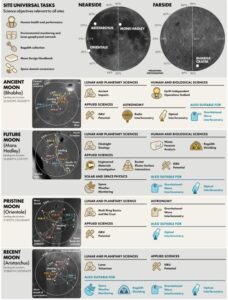

A new National Academies of Sciences, Engineering, and Medicine report has identified four locations on the Moon beyond the South Pole where human explorers-not just robots-could yield valuable science. The NASA-commissioned study, “Human Exploration Across the Moon,” comes just before an update on Artemis, NASA’s program to return American astronauts to the lunar surface for the first time since 1972.
NASA is intent on establishing a Moon base at the South Pole and landing astronauts there starting in 2028. The report, a companion to the Academies’ science strategy for human Mars exploration, offers alternative destinations for the future or if those plans change.
Co-chaired by UC San Diego geologist James Day and former NASA executive Dan Dumbacher of Purdue University, the committee identified sites between 84 degrees north and south latitude where human explorers, rather than robots, would deliver results matching the Academies’ Decadal Surveys across NASA’s five science disciplines.
In priority order: Bhabha Crater (“Ancient Moon”), Mons Hadley (“Future Moon”), Orientale Basin (“Pristine Moon”), and Aristarchus Plateau (“Recent Moon”). Farside Bhabha Crater lies in the South Pole Aitken Basin, the Moon’s oldest impact basin, and could host telescopes shielded from Earth’s interference. Nearside Mons Hadley, where Apollo 15 landed, would let astronauts examine hardware and biological materials left behind and could host a space weather observatory. Orientale Basin, on the Moon’s western edge, is the solar system’s best-preserved large multi-ringed impact basin and a possible gravitational wave observatory site. Aristarchus Plateau would illuminate the volcanic processes that shaped the Moon.
Six Apollo crews landed near the equator on the nearside from 1969 to 1972, but Artemis targets the South Pole, where comet-deposited water ice is thought to lie in permanently shadowed regions. Only the United States has landed humans on the Moon; robotic landers from other countries and companies, except China, have been on the nearside.
The South Pole is challenging, with steep slopes, low Sun angles, and temperature extremes, but its ice could sustain outposts or produce rocket propellant. Not everyone agrees it is the best first target: astronaut Victor Glover, who circled the Moon on Artemis II in April, said in July that a site nearer the equator might be a better choice.
NASA’s Aerospace Safety Advisory Panel, in a public summary of its latest quarterly meeting, said Artemis IV involves a large number of firsts and announced a formal recommendation urging the agency to re-examine the mission’s objectives and potentially its architecture for “a more balanced approach to risk,” according to panel member and former astronaut Charlie Precourt.
Under a reformulated plan, Artemis III will fly next year as an Earth-orbital rehearsal for rendezvous and docking with lander test articles from SpaceX and Blue Origin, before the first crewed landing on Artemis IV in 2028. At the report’s October 21 briefing, Dumbacher said the study gives NASA “a solid case of science objectives and locations that NASA can factor into their planning,” though the agency decides when and where to go.
Original Source: https://spacepolicyonline.com/news/moons-south-pole-not-the-only-compelling-location-for-human-exploration/
Category:
Tags:
Publish Date: 2026-10-23 02:14:00