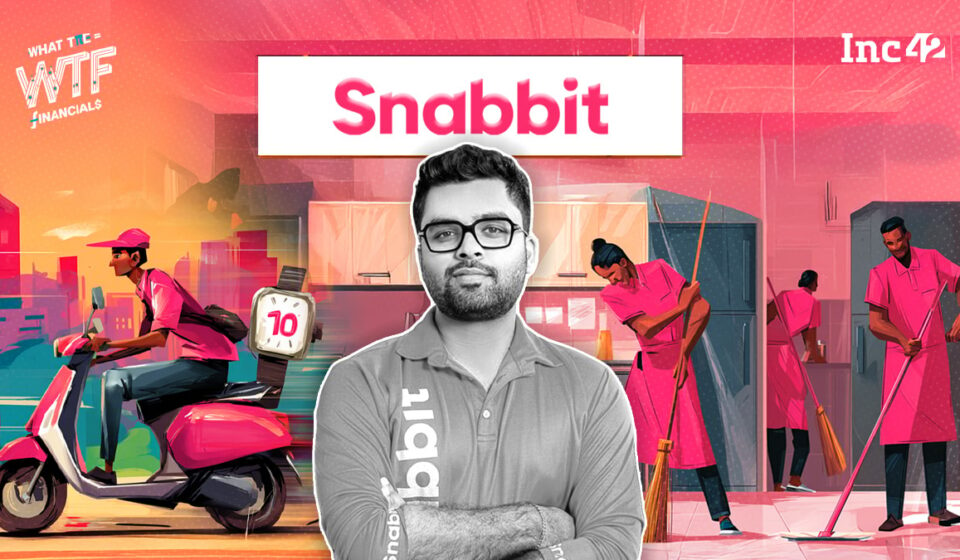
The Price of Instant: Decoding Unit Economics in Quick Home Services

You Can’t Cache a Human Being: The Real Lesson in Snabbit’s ₹167 Crore Loss
A number made the rounds this week: Snabbit – the startup promising a trained professional at your door in 10–15 minutes – spent roughly ₹16 to earn every rupee of operating revenue in FY26. ₹194.8 crore of expenses against ₹12.2 crore of revenue, and a net loss of ₹167.8 crore.
The easy take is recklessness. I think that misses the engineering lesson hiding inside the income statement.
The signal behind the noise
Quick context: founded in 2024 by a former Zepto executive, Snabbit closed its first full financial year with a ₹167.8 crore loss on ₹12.2 crore of operating revenue, while sitting on ₹319 crore in cash, zero borrowings, and a 35,000 daily-jobs run-rate – up 70x in a year. Loss per job has fallen from ~₹1,500 to under ₹200, and rivals Pronto and Urban Company’s InstaHelp are tracing the same burn curve.
Density is an architecture decision
We keep reading the “micromarket” strategy as marketing. From a systems lens, it is the architecture. Delivering a human to a doorstep in 10–15 minutes is fundamentally a latency problem – and in physical systems, latency is governed by distance and positioning, not cleverer routing. That is edge computing logic: you don’t shave milliseconds by optimizing the algorithm; you shave them by moving capacity closer to the user. A trained professional pre-positioned within two kilometres is, functionally, an edge node. You can’t cache a human being – but you can provision one at the edge.
Which is why “go deep in five cities” beats “go wide in twenty.” A sparse supply graph cannot be fixed with better dispatch software.
This is not a software business
The expense sheet reveals what Snabbit actually is: ₹63.1 crore on service professionals, ₹23.8 crore on fulfilment, plus training and uniforms. That’s not a marketplace’s cost structure; it’s a full-stack operations company with software inside. The distinction is everything – a marketplace’s marginal cost trends to zero, while an operations company scales with people, training pipelines and quality control. Its margin ceiling is set by physics and management bandwidth, not server bills. Founders who model this category as SaaS will be structurally surprised.
Growth debt: the liability nobody line-items
Urban Company’s admission that InstaHelp won’t meaningfully touch its bottom line for 4–5 years is the most honest sentence in this category – it prices the capital duration of the whole game. Yes, the loss-per-job curve from ₹1,500 to ₹200 is genuine progress. But an EBITDA loss at 199% of transaction value means the system is still paying people to use it. In software, we call this technical debt – borrowed speed that compounds. Quick services are running a newer liability: growth debt. I keep asking the founders I mentor one question: what durable asset did the burn actually purchase? Density, retention and trust are assets. Discount-driven volume is rent.
The algorithm is the workplace
Something else we builders under-weight: the reporting on worker conditions – earnings anxiety, rigid logged-in hours, no waiting areas or washrooms. When you design dispatch and incentive systems, you are architecting a person’s working day. Enterprise teams treat developer experience as first-class; labour platforms need the same rigour for worker experience – or regulation will design it for them.
The skilling engine hiding in plain sight
There’s a quieter India story too. Onboarding 40,000 trained professionals makes these platforms de facto skilling engines for one of the world’s largest informal workforces – verified identity, predictable earnings, UPI-settled payouts: digital public infrastructure by another name. And the density-first model poses an open question for tier-2 India: can a city like Guwahati ever clear the supply-density bar, or does the model need re-architecting for less dense markets? I suspect the latter – a design problem worth a founder’s ambition.
What I’d tell founders
- Treat density as a distributed-systems problem, not a marketing plan. Position supply before chasing demand.
- Know whether you’re a software company or an operations company – your margin ceiling follows from that answer, not your pitch deck.
- Judge burn by the durable asset it buys: density, retention, trust. Volume bought at a discount is rented.
- Watch the slope of the unit-economics curve, not the snapshot loss.
- Design the worker’s day as deliberately as the customer’s app.
The 10-minute economy won’t be won by whoever burns fastest. It will be won by whoever architects trust at the doorstep – on both sides of the door. Speed is easy to buy. Reliability, you have to engineer.
About the Author: Sanjeev Sarma is the Founder Director and Chief Software Architect at Webx Technologies. With a core focus on Generative AI integration, Cloud-Native Scalability, and Enterprise Software Architecture, he has spent over two decades driving digital transformation across Northeast India and beyond. Beyond his corporate leadership, Sanjeev is deeply invested in shaping the future of the IT industry. He serves as an Industry Expert on the Board of Studies for Assam Don Bosco University’s School of Technology, advises state technology committees, and actively mentors emerging tech startups at STPI. He brings a unique, dual perspective of high-level enterprise execution and future-ready academic curriculum development.