
A Canadian radio-telescope experiment has detected ancient hydrogen using only its own observations for the first time, potentially offering a more cost-effective way to study dark energy and the universe’s accelerating expansion. The result, published Sept. 28, 2026, in The Astrophysical Journal, followed seven years of work to confirm that the faint signal was not a false alarm.
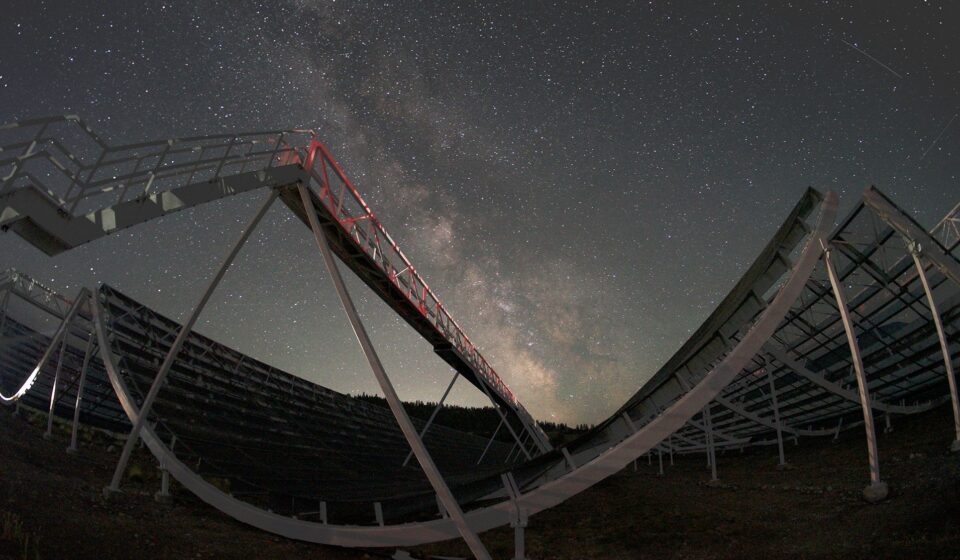
The Canadian Hydrogen Intensity Mapping Experiment, or CHIME, is a group of radio telescopes located mainly near Penticton, British Columbia. It maps the entire northern sky every day. Until now, researchers have needed to compare CHIME’s observations with data from other telescopes, a process that can be expensive and time-consuming. An independent measurement could help scientists study how matter is distributed through space and how the universe has expanded at different stages of its history.
The new paper, which was nearly a decade in the making, is based on 94 nights of observations from 2019 that were carefully checked before publication. CHIME can detect radio signals from as far back as roughly three billion years after the Big Bang, when the universe was only a fraction of its current age.
“Hydrogen is the most common element in the universe and the raw material from which stars form,” said Arnab Chakraborty, a postdoctoral fellow at the University of Toronto and a co-author of the study. “Its faint radio emission acts like a cosmic tracer, revealing how matter is distributed across space.”
The researchers tested the signal extensively before relying on it. “We worked very hard to convince ourselves that this wasn’t a false alarm,” Chakraborty said. “After all the tests, the signal remained. That gave us confidence we were seeing real hydrogen from the distant universe.”
An accompanying paper in The Astrophysical Journal estimates that about 2% of the hydrogen is neutral atomic hydrogen, meaning its atoms contain one proton and one electron and have no overall electric charge. That finding is broadly consistent with measurements from other telescopes, said Shabbir Shaikh, a postdoctoral fellow at Arizona State University and a co-author of both papers.
By mapping this hydrogen, scientists may gain new clues about the universe’s expansion and the role of dark energy. The team plans to analyze CHIME’s remaining seven years of observations for additional information.
Original Source: https://www.livescience.com/space/astronomy/ancient-hydrogen-spotted-in-the-early-universe-could-open-a-new-way-to-study-spaces-baffling-expansion
Category:
Tags:
Publish Date: 2026-10-01 02:58:00