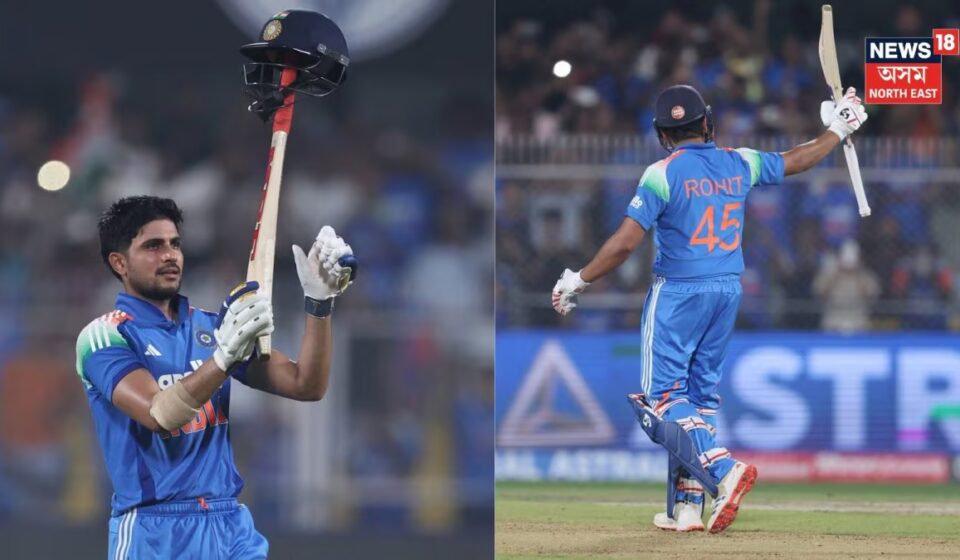
India vs West Indies 2nd ODI Records: শুভমন গীলে অসমত একেদিনাই ভাঙি পুৰা একাধিক অভিলেখ! ইতিহাস সৃষ্টিকাৰী ইনিংছে চমকপ্ৰদ!

No Script, No Second Take: Gill and Rohit Create a Historic Guwahati Blockbuster
By Rupaliparda
GUWAHATI, SEPTEMBER 30, 2026 — Under the floodlights at Barsapara Cricket Stadium, Guwahati did more than host cricket-it staged a night that practically demanded a standing ovation. With 406 runs to chase, India’s campaign possessed every ingredient for a disaster. Instead, Shubman Gill and Rohit Sharma rewrote the script with a performance so commanding that it felt less like a chase and more like a coronation.
West Indies had produced the kind of total that normally makes dressing rooms fall deathly quiet. Their innings, however, unfolded like a three-act spectacle. John Campbell smashed 101 from 68 balls, Shai Hope made 104, and Amir Jangou delivered a spectacular 114 from 77 deliveries. The visitors reached 406 all out-a formidable mountain, although on this particular evening, it looked strangely climbable.
After all, 406 was the sort of number usually reserved for economic forecasts and scorecard nightmares. India, however, attacked it as though the target were merely a rough draft.
Gill supplied the innings with the leading-man energy cricket fans crave. Reaching his double hundred in just 117 balls, he continued punishing the West Indies attack while Rohit played the composed, elegant supporting role his admirers have come to expect. Every delivery demanded presence of mind, yet India’s batting brimmed with assurance-the confidence of a team that sensed history was waiting just beyond the boundary rope.
Their opening partnership surged to 255 in 43.3 overs, with India only two wickets down while chasing the enormous total. Remarkably, the stand finished just three runs short of India’s opening-wicket record: the 258 assembled by Sachin Tendulkar and Sourav Ganguly against Kenya in 2001.
Three runs! In cricket, that is an astonishingly intimate margin. Had one boundary been different, Gill and Rohit would have rewritten a record that had stood for a quarter-century.
Gill’s innings was not merely a spectacle of muscle, either. His 117-ball double century made him the fastest Indian captain to reach 200 in ODIs, surpassing Ishan Kishan’s previous 126-ball record. Record books generally resist dramatic alterations, but Gill simply refused to read them.
Rohit, meanwhile, brought up his own century and crossed the 12,000-run milestone in international cricket-a landmark that places his career in an orbit occupied by very few players. There was another piece of theatre for the statisticians too: the two innings together contained five centuries-three for West Indies and one each for Gill and Rohit. Five hundreds in one match; even the statisticians may have required a moment, and probably a cup of tea.
India ultimately completed the chase with eight wickets in hand, becoming the first team to win a One Day International after successfully pursuing more than 400 runs.
If this were a film, the climax would have seemed impossible, the music would have swelled, and the audience would have refused to leave the theatre. But Barsapara was real, the applause was thunderous, and the record will be harder to erase than most celluloid legends.
The scoreboard may call it a chase. Generations of Indian cricket fans will call it a masterpiece.