The New Tech Order: How Policy, Industry and Founders Are Reshaping Innovation

The New Tech Order Will Be Won by Architecture, Not AI Hype
The most consequential signal in the TechSparks 2026 announcement is not an individual product or speaker. It is the widening of the room in which technology is decided.
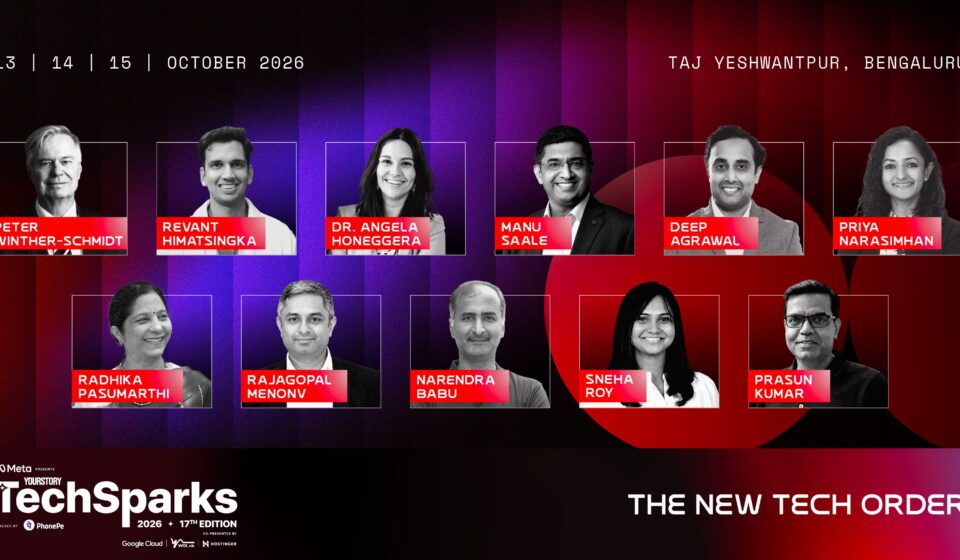
YourStory’s flagship summit in Bengaluru, scheduled for October 13–15 under the theme “The New Tech Order,” brings ministers, global institutions, founders and technologists into the same conversation. The apparent range-AI, deeptech, fintech, aerospace, mobility and digital infrastructure-is really one story: technology will be shaped as much by policy, trust and infrastructure as by code.
Technology is becoming a governance system
Years ago, enterprise architecture focused primarily on systems, interfaces and operating costs. That remains necessary, but it is no longer sufficient. An AI model, payment rail or app marketplace now depends on a web of public policy, identity, data rights, cross-border relationships and institutional trust.
This is why I read the presence of policymakers, diplomats and business leaders on the same stage as important as the technology itself. The architecture brief has expanded: we must design for scale and performance, but also provenance, accountability, accessibility, resilience and public legitimacy.
Data sovereignty is often reduced to server location. That is too narrow. The real questions are: who can access the data, under what authority, can workloads and identity records move between providers, and can citizens or regulators verify what happened?
Sovereignty does not require every system to be isolated; it requires critical capabilities and bargaining power to remain visible and controllable.
AI’s real production test is trust
Across the speaker domains-voice generation, incident management, payment verification, automotive engineering and app distribution-the same transition is visible: AI is moving from isolated assistant to operational participant. A model that can generate an answer is not the same as a system that can safely recommend, trigger or approve an action.
That distinction changes system design. My concern is not model capability; it is the gap between a compelling demonstration and a dependable institution. A probabilistic component must not be treated like a deterministic library.
Every production AI system needs clear boundaries for autonomy, traceable data provenance and model versions, continuous evaluation, observability, rollback paths and human escalation. A resilient architecture makes failure visible and recoverable instead of hiding it behind a polished interface.
The most important prerequisite is often not a larger model, but a better data architecture: ownership, permissions, lineage and reliable feedback loops. Without them, copilots and fine-tuning simply create a new layer of technical debt.
The last mile is the strategic test
The attention to feature-phone payment access and alternative app distribution is significant not because of any particular brand, but because it exposes a hard truth: digital infrastructure is not democratic merely because it is advanced. It must work across uneven connectivity, language diversity, older devices, low digital literacy and distrust.
India’s digital public infrastructure offers a useful lesson: shared rails can lower entry barriers, but only when they remain interoperable, privacy-preserving and easy to challenge. In a region such as Northeast India, the test is not simply whether a service works from a metropolitan data center; it is whether it degrades gracefully and remains accountable in remote, linguistically diverse and connectivity-constrained environments.
What technology leaders should do now
Technology leaders must map dependencies across models, data, cloud, identity, payments, vendors and policy, expanding their view beyond just the application layer. They should separate pilot success from production readiness by measuring reliability, security, explainability, accessibility and total cost of ownership. Furthermore, architecture must be designed for portability and exit so that innovation does not become irreversible lock-in.
Bringing legal, security, domain, accessibility and public-policy perspectives into architecture reviews from the beginning is essential. Ultimately, organizations must measure trust, adoption and measurable outcomes, avoiding the focus on merely the number of AI experiments announced.
The New Tech Order is not a contest to deploy the most AI. It is a contest to build systems that scale capability without surrendering resilience, sovereignty or human agency. The organizations that understand this distinction will shape the next decade; those that equate innovation with speed will eventually inherit its architectural debt.
About the Author: Sanjeev Sarma is the Founder Director and Chief Software Architect at Webx Technologies. With a core focus on Generative AI integration, Cloud-Native Scalability, and Enterprise Software Architecture, he has spent over two decades driving digital transformation across Northeast India and beyond. Beyond his corporate leadership, Sanjeev is deeply invested in shaping the future of the IT industry. He serves as an Industry Expert on the Board of Studies for Assam Don Bosco University’s School of Technology, advises state technology committees, and actively mentors emerging tech startups at STPI. He brings a unique, dual perspective of high-level enterprise execution and future-ready academic curriculum development.