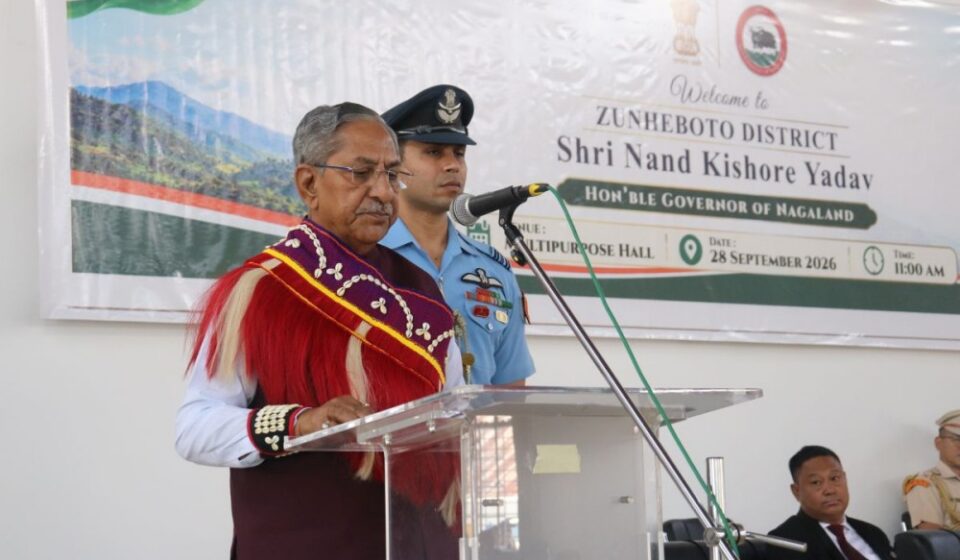

Nagaland Governor Nand Kishore Yadav on September 28 called for stronger delivery of government services in remote communities, closer coordination among departments and time-bound implementation during his visit to Zunheboto district. Addressing officials at the Multipurpose Hall in Zunheboto, he said scheme success should be measured by tangible improvements in people’s lives rather than by funds released or expenditure recorded.
Yadav said the visit was intended to assess the “actual situation on the ground”, identify what was functioning effectively and examine gaps and constraints affecting government programmes. Emphasising that the district administration represents the government at the grassroots, he said teachers, health workers, agricultural officers, police personnel and village-level functionaries form the immediate connection between public services and citizens.
The Governor urged officials to focus on remote and difficult areas so that development reaches beyond district headquarters and administrative centres. “The real question should be: What has changed on the ground because of the government intervention?” he asked.
On education, Yadav called for attention to learning outcomes, attendance, student retention, infrastructure and the transition from school to higher or vocational education. He asked the Education Department to identify schools requiring urgent intervention and prepare a priority list. On healthcare, he said functioning health centres must have adequate personnel, essential medicines and operational equipment to ensure timely treatment.
He also urged agriculture officials to move beyond a subsidy-focused approach and promote productivity, processing, packaging, market linkages and income generation. Farmer groups, cooperatives, self-help groups and producer organisations should be strengthened to connect local growers with markets beyond the district, particularly in horticulture, vegetables and spices.
Yadav described roads, electricity, drinking water, telecommunications and digital connectivity as essential infrastructure. He said interdepartmental coordination was vital, noting that schools, for example, require roads, power, water and sanitation. For delayed projects, officials should identify the problem and responsible department, set deadlines and monitor outcomes. He also proposed district-level dashboards to track targets, pending works, financial progress and major bottlenecks, while ensuring that digital governance does not exclude citizens with limited access to technology.
The Governor also called for coordination between police, village authorities, civil society and community institutions to identify emerging issues early, particularly those affecting women, children and vulnerable groups. He highlighted the tourism potential of Satoi Wildlife Sanctuary and Ghosü Wildlife Bird Sanctuary, encouraging responsible development through homestays, local cuisine, handicrafts, cultural experiences and trained local youth.
MLA and Advisor K. Tokugha Sukhalu said prolonged violence and other challenges had hindered Zunheboto’s development, but progress was now visible across education, healthcare, administration and infrastructure. He described the district, once known as the “land of warriors”, as increasingly becoming the “land of peace”. Deputy Speaker S. Toiho Yeptho expressed hope that government schemes would reach the grassroots. The programme was chaired by Deputy Commissioner Dharam Raj, IAS, and included presentations from the Public Health and Engineering Department, Forest Department and Medical Department.
Original Source: https://www.morungexpress.com/gov-calls-for-outcome-based-governance
Category: Nagaland
Tags:
Publish Date: 2026-09-28 22:25:00