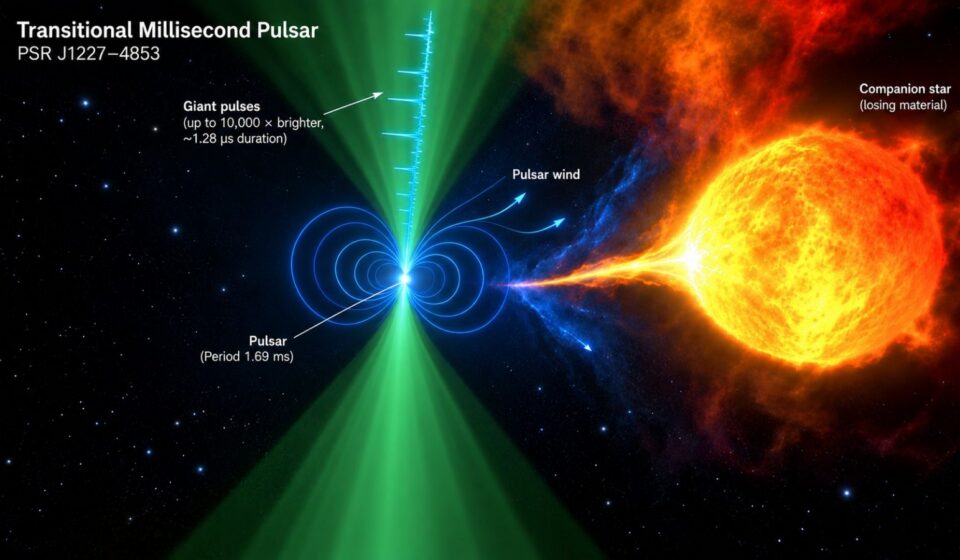

Astronomers from India, the United States, Germany and the United Kingdom have detected exceptionally bright, microsecond-long radio flashes from a rare neutron star using the upgraded Giant Metrewave Radio Telescope (uGMRT) at Khodad, about 80 km from Pune. The discovery provides a new opportunity to investigate how rapidly rotating neutron stars produce some of the universe’s most extreme radio signals.
The low-frequency uGMRT is operated by the National Centre for Radio Astrophysics (NCRA), a unit of the Tata Institute of Fundamental Research (TIFR), an institution aided by India’s Department of Atomic Energy. Among the world’s most sensitive radio telescopes, it combines high sensitivity with microsecond time resolution and long-term monitoring capabilities.
The target, PSR J1227-4853, is a pulsar-a rapidly spinning, highly magnetised neutron star, or the dense core left behind after a massive star explodes. Saptarshi Sarkar, the study’s lead author and a PhD student at NCRA-TIFR, said it is one of only three known transitional millisecond pulsars among more than 3,000 known pulsars. Like a lighthouse beam sweeping past Earth at regular intervals, a pulsar’s radio emission reveals its rotation. Studying a pulsar during a transitional stage offers astronomers a rare opportunity to investigate how neutron stars evolve.
PSR J1227-4853 completes an astonishing 592 rotations every second-almost twice as fast as a typical kitchen blender. Over several years, the researchers monitored the pulsar for about 174 hours and identified 235 individual giant pulses.
Some flashes were nearly 1,000 times brighter than the pulsar’s normal radio emission. The shortest lasted just 1.28 microseconds, or one-millionth of a second. “What struck me most was just how extreme these pulses are, both in terms of their brightness and their short duration,” Sarkar said. He described the shortest flashes as about 100,000 times shorter than an eye blink.
Around 20 pulsars, including PSR J1227-4853, are known to produce giant pulses, Sarkar said, making this finding “a case of the rarest of the rare.” Published in The Astrophysical Journal, the study establishes the pulsar as a laboratory for exploring how rapidly spinning neutron stars generate exceptionally bright and brief radio flashes. It may also help astronomers understand the different mechanisms behind the universe’s most extreme radio bursts.
Jayanta Roy, a co-author and associate professor at NCRA, credited the discovery to the uGMRT’s high sensitivity, microsecond time resolution and ability to conduct long-term monitoring campaigns.
Original Source: https://indianexpress.com/article/cities/pune/upgraded-giant-metrewave-radio-telescope-discovers-extreme-radio-flashes-from-rare-neutron-star-10892661/
Category:
Tags:
Publish Date: 2026-09-24 20:37:00