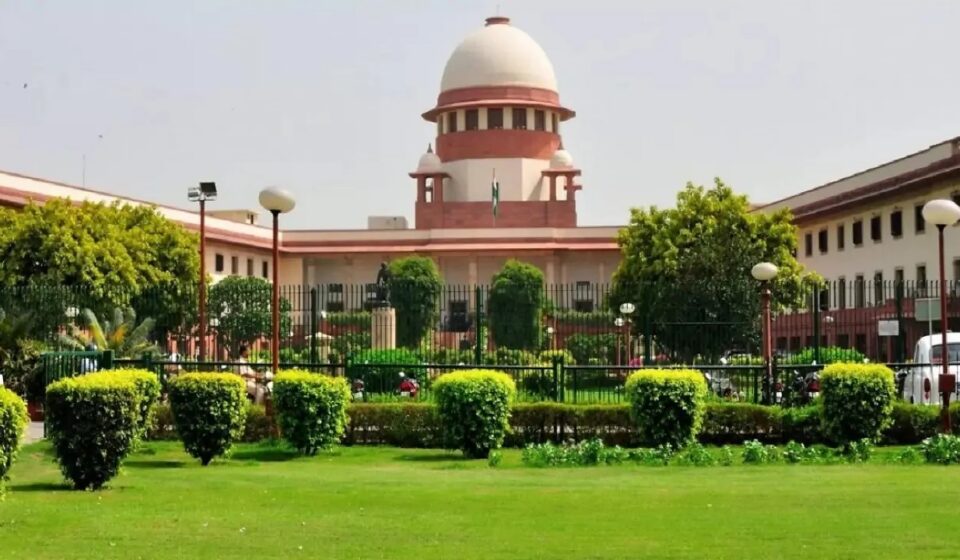

The Supreme Court of India on Thursday acquitted a man accused in a fabricated sexual assault case, setting aside the rulings of both the Delhi High Court and lower courts. A bench comprising Justice Prashant Kumar Mishra and Justice Aniruddha Bose delivered the landmark verdict after carefully examining the entire case. The court found the accusation to be baseless, noting that a woman had filed a false complaint of sexual abuse against her own minor daughter in 2015 following a water dispute in a slum area in Kalkaji, South Delhi. The accused was discharged under Section 6 of the Protection of Children from Sexual Offences (POCSO) Act, 2012, and Section 363 of the Indian Penal Code (IPC).
Previously, the lower court had sentenced the accused to ten years of rigorous imprisonment and a fine under the POCSO Act, along with one year of rigorous imprisonment under IPC Section 363. He had already been acquitted under IPC Section 506. The Delhi High Court subsequently upheld the lower court’s conviction. However, the Supreme Court, after a thorough review, cancelled all prior judgments.
During the ruling, the Supreme Court made a critical legal clarification regarding Sections 29 and 30 of the POCSO Act. These provisions create a legal presumption against the accused in certain circumstances. However, the bench emphasized that this presumption does not automatically render the prosecution’s evidence as true. Justice Aniruddha Bose, who authored the verdict, stated that if the accused is able to highlight significant inconsistencies in the complainant’s statement and demonstrate a lack of supporting evidence, the predetermined presumption of guilt becomes ineffective. He further noted that this legal presumption can never be used to corroborate evidence already favoring the accused.
Justice Bose also added that treating the victim’s statement as an undeniable truth in every case was never the intention of the law. The Supreme Court expressed regret that both the lower court and the Delhi High Court had been influenced by the POCSO Act’s presumption and had overlooked significant contradictions present in the mother’s testimony. The court made it clear that such a legal presumption should never relieve courts of their fundamental responsibility to independently and impartially analyze evidence. Even an illogical and implausible narrative cannot lead to an acquittal based solely on reliance on legal presumptions, the apex court firmly stated.
The bench also provided important guidance regarding the standard of proof in criminal cases. The court clarified that the burden of proof placed on the accused does not in any way alter the standard of proof generally applicable in criminal proceedings. Through this historic judgment, the Supreme Court has once again placed special emphasis on impartiality and meticulous analysis of evidence in cases under the POCSO Act, establishing a clear direction for the adjudication of such cases in the future.
Original Source: https://assam.nenow.in/supreme-court-pocso-act-verdict-acquits-a-man-convicted-in-2015-ruling-that-sections-29-and-30-do-not-make-allegations-conclusive/
Category: Popular Stories,দেশ,শীর্ষ সংবাদ
Tags:
Publish Date: 2026-09-19 18:47:00