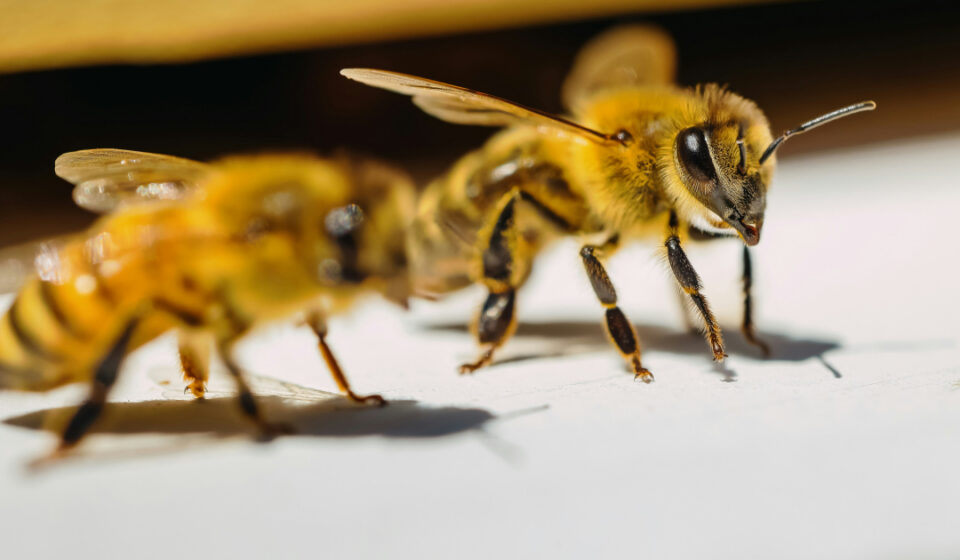

In a summer in Concord, Massachusetts, a routine study of honey bee waggle-dance sounds led James C. Nieh to an unexpected discovery: short, loud piping sounds from dance followers that he called “stop signals.” Those signals, produced when feeders became overcrowded, caused dancers to pause and perform fewer dance circuits, reducing recruitment to a food source. That unplanned finding launched a career-long inquiry into animal communication and shaped Nieh’s view of scientific resilience: persistence paired with the flexibility to follow surprising results.
A waggle dance normally tells nestmates the direction and distance of a profitable food source. While recording those dances, Nieh noticed followers sometimes bumped the dancer and emitted a distinct “beep.” Earlier literature had labeled similar noises as food-begging, but Nieh found that signaling bees rarely received food. Instead, stop signals correlated with crowding at the feeder and consistently suppressed the intensity of subsequent dances-fewer circuits meant fewer recruits. Recording hundreds of dances made the pattern clear.
Nieh’s fieldwork later extended beyond Concord and taught him when persistence matters-and when changing course is wiser. In Panama, he tested whether stingless bees Melipona panamica used odor trails across water. After repeated setbacks-predation by a lizard and toad, torrential rain, lightning, wasps and bullet ants-he finally trained the bees across the gap and learned they did not use odor trails. In Brazil, planned experiments with Melipona rufiventris were repeatedly derailed by aggressive Trigona spinipes that located and overran feeders. Rather than keep fighting the interference, Nieh redirected his research and found that T. spinipes scouts followed scent marks left by M. rufiventris, effectively eavesdropping on competitors and seizing resources.
Later, when inter-colony attacks forced a honey bee experiment off course, Nieh and colleagues noticed an increase in stop signals after attacks. Follow-up work showed that stop signals serve a protective function: they suppress recruitment when continued foraging becomes dangerous or unprofitable, including during predator attacks at rich food sources. Several of his most consequential studies began as apparent failures that pointed toward stronger, biologically driven questions.
Nieh uses these episodes to argue that scientific resilience is not mere stubbornness. Sometimes it is continuing an experiment because the question remains vital; other times it is recognizing that an obstacle reveals a new phenomenon. He warns, however, that celebrating resilience should not be an excuse to underfund research. Much essential science requires sustained investment and support for training the next generation. When resources are limited, a well-chosen question can still guide impactful, smaller-scale work.
More than 35 years after that Concord summer, Nieh says he is still listening to bees. James C. Nieh is Professor in the Department of Ecology, Behavior, and Evolution and an Associate Dean in the School of Biological Sciences at the University of California, San Diego, a Fellow of the Royal Entomological Society, and a recipient of the Hambleton Award and the Springer Nature Editor of Distinction Award.
Original Source: https://press.princeton.edu/ideas/science-needs-failure
Category:
Tags:
Publish Date: 2026-09-16 02:09:00