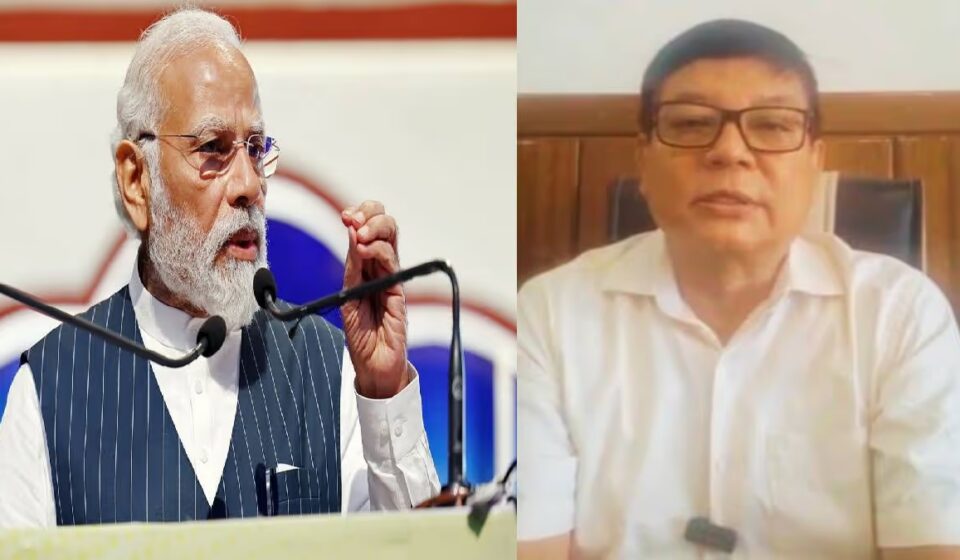

Senior Congress leader and former Assam Leader of the Opposition Debabrata Saikia has issued a wide-ranging critique of the Narendra Modi government as the prime minister marks 25 years as head of a government, saying the milestone should prompt an accounting not just of achievements but of democratic health, institutional independence, civil liberties and ordinary citizens’ economic security.
Modi entered his 25th year as head of a government in October 2025, having first taken oath as Gujarat chief minister in October 2001; official records also show he became India’s longest-serving elected prime minister in continuous tenure in June 2026.
In a statement, Saikia said a quarter-century in power requires scrutiny beyond headline projects and statistics, arguing that governance must be judged by the condition of constitutional institutions, protection of rights and the material lives of people. He warned that parliamentary scrutiny has narrowed, citing the passage of major laws without extensive committee review or full debate. He pointed specifically to the three farm laws enacted in 2020 and repealed in 2021 after sustained farmers’ protests.
Saikia questioned the government’s handling of the 2019 changes in Jammu and Kashmir, including the abrogation of Article 370 and the reorganisation of the former state into two Union Territories, saying such consequential constitutional steps should involve greater transparency, consultation and guarantees of civil rights. He raised alarms about civil liberties, pointing to the use of stringent laws, investigations into civil society groups, allegations of surveillance and the Pegasus controversy, and he flagged restrictions that critics say have affected journalists, activists and dissenting voices.
On freedom of expression, Saikia pointed to controversies over films, documentaries and online content critical of the government. On secularism and minority rights, he cited the Citizenship Amendment Act, 2019, and disputed demolitions in some states, noting the Supreme Court’s November 2024 guidelines that require due process before properties of accused persons are demolished.
Economically, Saikia criticised past measures including demonetisation and raised concerns about employment, inflation and the condition of small businesses and informal workers, arguing that policy must be assessed by household expenditure, jobs and savings. He opposed charges on certain high-value UPI merchant transactions, while the new framework announced in September 2026 has been described as a merchant discount rate (MDR) for specified person-to-merchant transactions above ₹2,000 rather than a UPI tax; person-to-person transfers remain free and the government says about 96% of merchant transactions will be unaffected.
Saikia also questioned the independence of agencies such as the Enforcement Directorate, Central Bureau of Investigation and Income Tax Department, and urged transparency to restore public confidence. He echoed opposition concerns about electoral rolls, voting data, EVMs, vote counting and political funding, and recalled the Supreme Court’s 2024 judgment striking down the electoral bonds scheme in favour of greater transparency.
Turning to unrest and regional issues, Saikia said prolonged ethnic violence in Manipur exposed governance failures and a duty to protect citizens and rehabilitate the displaced. He criticised concentration of economic assets among large corporate groups and called for transparent public asset allocation and independent regulation. On Assam-specific matters he pressed for completion of the NRC process (the Final NRC of August 31, 2019 excluded 1,906,657 people, official data shows), long-term measures for flood and river-erosion rehabilitation after severe July 2026 floods, and consideration of Scheduled Tribe status for six communities.
Noting recent data, Saikia pointed to rising prices — retail inflation rose to 4.82% in August 2026 from 4.45% in July, and food inflation stood at 5.95% — and questioned unmet 2014 promises on black money, jobs and farmers’ incomes. He also alleged erosion of India’s diplomatic influence and raised concerns about the trade deficit with China and ties with neighbours. Saikia criticised the prime minister’s limited engagement in open press forums, saying Modi has relied more on speeches and selected interviews. Concluding, Saikia said the 25-year milestone should be a period of accountability: “25 years in power means a time of accountability for 25 years,” he said, invoking former prime minister Atal Bihari Vajpayee’s 2002 remarks on “Rajdharma” while urging that democratic institutions, constitutional values and social harmony remain central to governance.
Original Source: https://www.indiatodayne.in/assam/story/25-years-in-power-means-accountability-congress-leader-debabrata-saikia-raises-questions-over-modi-government-1451365-2026-09-16?utm_source=rssfeed
Category:
Tags:
Publish Date: 2026-09-16 12:26:00