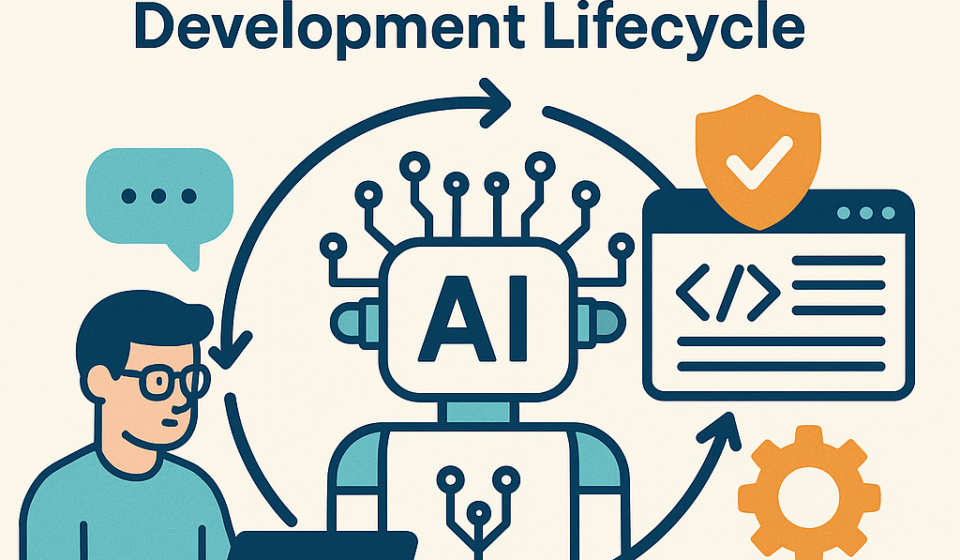
Architecting Responsible AI Agents for the Software Development Lifecycle

We chase bleeding‑edge models and benchmarks as if capability alone solves business risk. The uncomfortable truth: deployment, not invention, is where most organisations fail – and where Responsible AI must actually live.
A short signal
Recently I reviewed a webinar outline that introduces types of AI, surfaces common concerns, explains a corporate Responsible AI approach, and invites students to practice those principles on an SDLC agent case study. The session is designed to be interactive and practical, aimed at learners and IEEE chapters who want hands‑on experience with governance applied to real developer tooling.
What this really signals for enterprise architects
The core principle beneath that webinar is simple but often ignored: Responsible AI is an engineering requirement, not a compliance checkbox. Treating it as a separate ethics team activity creates brittle systems. When organisations build AI into the software delivery pipeline – for example, as developer assistants or SDLC agents – the governance needs to be embedded inside the architecture itself.
Key architectural implications and trade‑offs:
- Design for observability from day one. Models must expose lineage, inputs, confidence, and drift metrics just like microservices expose latency and error rates. Without continuous telemetry, mitigation becomes reactive and expensive.
- Make explainability part of the API. For production agents that recommend code, tests, or deployment changes, responses should include provenance (training subset, prompt, model version) so reviewers can triage errors quickly. This is a trade‑off: richer metadata increases payload and cost but reduces time‑to‑resolution.
- Adopt model CI/CD with safety gates. Traditional CI/CD pipelines must evolve into MLOps pipelines with automated bias checks, regression tests on representative benchmarks, and human review gates for high‑risk changes. Speed vs stability is real: remove any notion of “one‑click” promotion for models used in safety‑critical or compliance contexts.
- Human‑in‑the‑loop isn’t a fallback; it’s a system design. For developer agents that can change code, incorporate approval workflows, limited scopes (can suggest, cannot commit), and clear audit trails. This reduces the blast radius of hallucinations or unsafe suggestions.
- Prepare for long‑tail governance costs. Early wins from a model proof‑of‑concept can hide mounting tech debt: undocumented data sources, undocumented preprocessing, and ad‑hoc retraining scripts. Plan for maintenance budgets and detectability of “ghost models” running in forks or edge deployments.
- Data sovereignty and DPI considerations matter. When agents are trained or fine‑tuned on enterprise or citizen data, architectures must support data minimization, encrypted datasets, and, if required by law or policy, localized model serving. This is especially relevant where national data policies impose localization or consent requirements.
Where students and IEEE chapters can add immediate value
Education settings are the perfect sandbox for Responsible AI practices. Rather than only building feature demos, student projects should:
- enforce dataset documentation (datasheets) and model cards,
- instrument models with simple drift detectors,
- and run tabletop incident simulations where a model produces an unsafe output and the team must respond.
For my part, I encourage local IEEE chapters and university clubs to treat Responsible AI as a systems engineering exercise: small teams should deliver both a model and the governance artefacts (audits, tests, rollback plans). That practice creates designers who think beyond accuracy metrics.
Takeaways – practical, not theoretical
- Treat Responsible AI as non‑functional requirement: test it, measure it, budget for it.
- Build observability and provenance into model APIs from day one.
- Use model CI/CD with safety gates and human approval for high‑risk operations.
- Require documentation: datasheets, model cards, and decision logs for every shipped model.
- Train students on incident playbooks so next‑gen practitioners know how to respond, not just how to build.
Closing thought
The future won’t be decided by the smartest model, but by the teams who can operationalize it responsibly at scale.
About the Author: Sanjeev Sarma is the Founder Director and Chief Software Architect at Webx Technologies. With a core focus on Generative AI integration, Cloud-Native Scalability, and Enterprise Software Architecture, he has spent over two decades driving digital transformation across Northeast India and beyond. Beyond his corporate leadership, Sanjeev is deeply invested in shaping the future of the IT industry. He serves as an Industry Expert on the Board of Studies for Assam Don Bosco University’s School of Technology, advises state technology committees, and actively mentors emerging tech startups at STPI. He brings a unique, dual perspective of high-level enterprise execution and future-ready academic curriculum development.