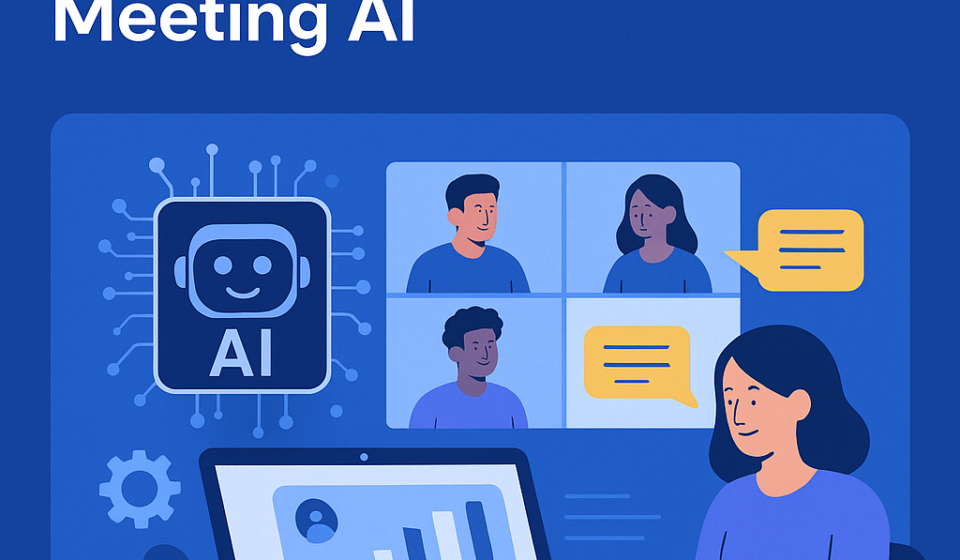
Product-Led Freemium: Architecting Competitive Meeting AI

We’re obsessed with the accuracy of AI transcription – but we often underplay the harder problem: who pays for it, how it reaches users, and how it fits into an enterprise’s architecture.
A crowded market of meeting note-takers and a flurry of new features have made one thing clear: product capability alone no longer guarantees adoption. Recently, an early-stage meeting‑notes startup introduced a free tier that removes trial friction while limiting history retention – a classic freemium move that speaks to a deeper strategic shift in how AI services compete. The company also reports healthy unit economics and deliberate avoidance of paid acquisition, choosing product-led distribution instead.
Why this matters to CTOs and architects
Freemium is not merely a pricing decision; it’s an architectural commitment. Offering “unlimited” transcription while restricting historical access or integrations pushes cost and complexity into three places: compute (real-time and batch inference), storage (audio + transcripts + indices), and governance (access controls, retention, and audit). Those are the exact system boundaries that determine an AI offering’s long-term sustainability.
The trade-offs every architect must weigh
- Economics vs. experience: Unlimited transcription increases CPU/GPU load and storage costs. Limiting history to 30 days is an intentionally coarse control over long‑tail storage cost and search index size. But it also alters the UX for power users – and shapes conversion cohorts. I advise engineering and product teams to instrument these cohorts early: retention, feature usage, and cost per active user must be visible from day one.
- Edge vs. cloud inference: Server-side inference simplifies product updates and model upgrades, but it centralizes risk (cost and data sovereignty). Hybrid architectures – local pre-processing on device, with cloud‑only heavy inference or enterprise BYOK (bring‑your‑own‑key) options – can be a practical compromise for regulated customers.
- Composable integrations as moat: Integrations (Slack, Linear, calendar systems) are not “nice to have” add-ons – they’re the primary channels by which users turn AI outputs into workflows. An event-driven integration layer with clear webhooks and retry semantics reduces fragility and improves conversion from free to paid users.
- Data governance and compliance: Retention windows, encryption-at-rest/in-transit, access logs, and deletion workflows are legal and reputational liabilities. For enterprises, offering clear SLAs and auditability is often more important than raw transcription quality.
Operational levers to manage runaway costs
If you launch a free tier, you must also operationalize throttles and prioritization: soft quotas, adaptive downsampling for low-value recordings, delayed batch processing for free users, and paid-priority inference for subscribers. These are product knobs that translate directly into capacity planning and SRE playbooks.
What this means for Indian enterprises and startups
India’s SMEs and startups are extremely cost-sensitive – a free tier accelerates trial and adoption locally. But two localized considerations are non-negotiable: language and connectivity. Supporting Indian languages (and code‑mixed speech) and designing offline-first mobile capture with incremental sync will win real users across India’s geographies, including the Northeast. For regulated sectors, offering regional processing options or BYOK will be a practical differentiator that addresses data sovereignty concerns.
Takeaways for founders, CTOs and product leaders
- Treat freemium as an architectural decision, not just marketing. Model the cost of “free” at scale before you launch.
- Invest early in integration infrastructure – it’s the conversion engine from free to paid.
- Provide transparent retention and privacy controls; these reduce churn among enterprise buyers.
- Design tiered processing: real‑time for paid users, best‑effort batch for free users.
- Localize for language and connectivity if you want enterprise traction in India and the Northeast.
Free tiers will continue to reshape how AI services distribute themselves. But the companies that win will be those that align their pricing, product, and architecture so the math and the experience move in the same direction.
About the Author: Sanjeev Sarma is the Founder Director and Chief Software Architect at Webx Technologies. With a core focus on Generative AI integration, Cloud-Native Scalability, and Enterprise Software Architecture, he has spent over two decades driving digital transformation across Northeast India and beyond. Beyond his corporate leadership, Sanjeev is deeply invested in shaping the future of the IT industry. He serves as an Industry Expert on the Board of Studies for Assam Don Bosco University’s School of Technology, advises state technology committees, and actively mentors emerging tech startups at STPI. He brings a unique, dual perspective of high-level enterprise execution and future-ready academic curriculum development.