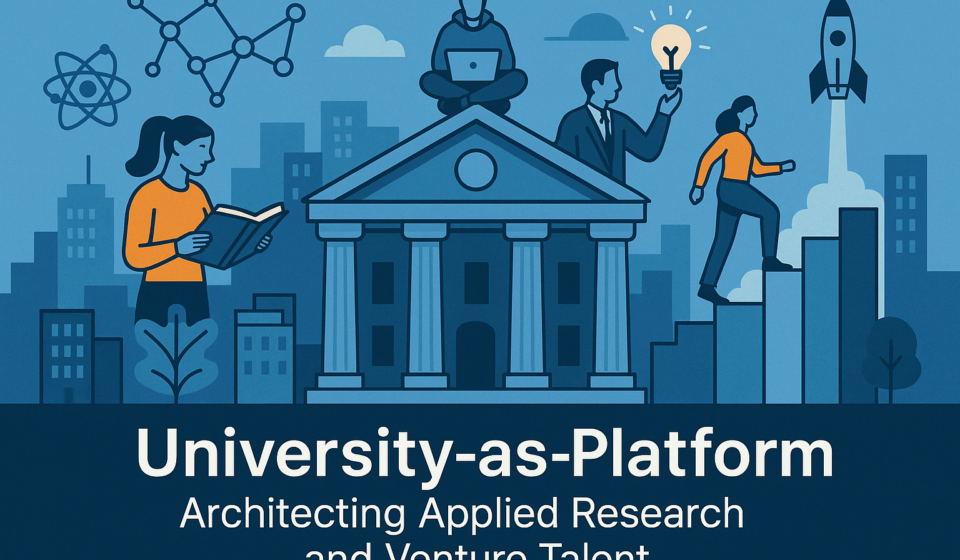
University-as-Platform: Architecting Applied Research and Venture Talent

Higher education is being re-architected – and Masters’ Union’s elevation to a full private university is an important waypoint.
What happened (signal)
The Haryana Legislative Assembly has passed the Haryana Private Universities (Amendment) Bill, 2026, granting Gurugram-based Masters’ Union full university status. The institution plans to expand a 5.14‑acre campus with accelerator hubs, maker labs, research infrastructure, and to create new departments across law, medicine, agriculture and biotech while launching PhD and diploma programmes.
Why this matters for architects, CTOs and founders
We tend to debate whether universities should prepare students for jobs or for inquiry. The Masters’ Union case compresses both responses into a single design challenge: how to build an education ecosystem that simultaneously trains practitioners, incubates ventures, and produces rigorous, reproducible research. For enterprise and systems architects, that raises five interlocking shifts:
-
Infrastructure is hybrid and domain-specific
Accelerators and maker labs are not just physical assets – they are systems that combine physical instrumentation, edge compute, secure data stores, and cloud-native workflows. Biotech and medical research demand controlled labs, data-honest pipelines, and governance that can handle sensitive health and genomic data. Engineering the campus IT stack means clearly separating environments for experimentation (fast, ephemeral) from those for compliance and clinical-grade workflows (audited, stable). -
Data governance becomes a first-class design concern
When student startups, faculty research and industry partners co-exist on the same platform, IP, consent, and data lineage problems explode. Architectural patterns I recommend: immutable data provenance, policy-as-code for access controls, and clear data escrow/IP handoff processes. These reduce legal friction and accelerate commercialization. -
Research-to-product paths must be industrialised
Launching PhD programmes alongside venture incubation is an opportunity – if the handoff from lab prototype to scalable product is formalised. That requires reproducible research processes (containerised experiments, standardised datasets, CI for models), shared R&D backplanes (private registries, artifact stores), and a commercialization governance layer that adjudicates faculty‑spinout conflicts. -
Talent pipelines change organizational risk profiles
Companies hiring from such practitioner-led universities will find graduates who have built product and business experience – but potentially less depth in single-domain theory. For CTOs, the trade-off is speed versus research depth. The architectural response is to invest in internal R&D mentorship, rotational fellowships, and clear career ladders that convert practitioner energy into long-term technical capability. -
Funding models and conflict-of-interest need clear architecture
When an educational institution also operates venture funds, fellowships, and incubation grants, legal and ethical guardrails matter. Technology systems should embed transparency – automated disclosures, audit trails for funding decisions, and separation of financial flows from academic outcomes.
A regional lens (why this matters for India’s Northeast)
This model offers a template for regions like Northeast India. We can avoid a zero-sum brain drain by building smaller, disciplined hubs that combine local domain expertise (agriculture, forestry, healthcare) with shared R&D infrastructure. Practically, that means low-cost maker labs, interoperable DPI (Digital Public Infrastructure) services for student records and research credentials, and targeted industry partnerships that map to regional strengths. I’ve seen early successes where modest seed funding plus a committed industry mentor produced locally relevant innovations – scaling that requires the same technical and governance architecture described above.
Practical takeaways for decision-makers
- Treat campus infrastructure as a distributed system: define clear boundaries between experimental, clinical, and production environments.
- Make data governance proactive: policy-as-code, provenance logs, and consent-by-design.
- Standardize reproducibility: containerised experiments, artifact registries, and CI for research.
- Formalize research-to-startup flows: transparent IP policy, escrowed datasets, and staged commercialization gates.
- Invest in lifelong learning pathways: rotational hiring and in-company fellowships to convert practitioner skill into durable capability.
Closing thought
Education that builds, funds and scales startups alongside rigorous research is an architectural problem as much as an academic one – and solving it well will determine whose innovations survive the transition from lab to market.
About the Author: Sanjeev Sarma is the Founder Director and Chief Software Architect at Webx Technologies. With a core focus on Generative AI integration, Cloud-Native Scalability, and Enterprise Software Architecture, he has spent over two decades driving digital transformation across Northeast India and beyond. Beyond his corporate leadership, Sanjeev is deeply invested in shaping the future of the IT industry. He serves as an Industry Expert on the Board of Studies for Assam Don Bosco University’s School of Technology, advises state technology committees, and actively mentors emerging tech startups at STPI. He brings a unique, dual perspective of high-level enterprise execution and future-ready academic curriculum development.