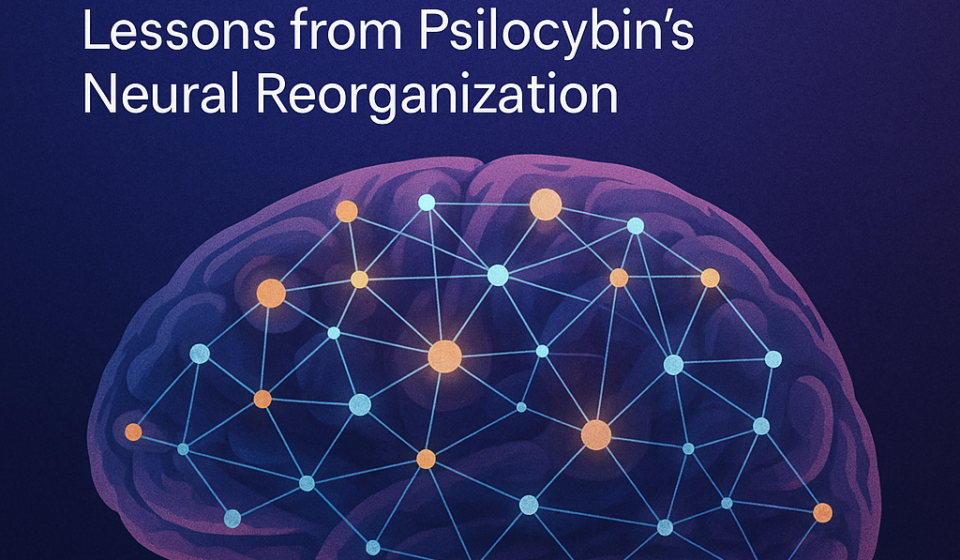
Context-Driven Architectures: Lessons from Psilocybin’s Neural Reorganization

When disorder becomes a signal: what a psilocybin study teaches architects about context, observability and design
We tend to treat complexity as noise. More randomness means less predictability and therefore less control. A recent neuroimaging study upends that tidy assumption: under psilocybin, the brain’s large‑scale networks may blur, yet moment‑by‑moment neural patterns tied to what a person is doing become clearer – not noisier. In plain terms: apparent disorder at one level revealed a different, sharper order at another.
Why this matters beyond neuroscience
That finding is more than a curiosity about altered states. It is a useful lens for anyone responsible for designing complex systems – enterprises, AI pipelines, digital public infrastructure, or large‑scale product telemetry. Two immediate principles jump out for architects and CTOs: (1) context radically reshapes signal, and (2) better, multimodal measurement plus AI can reveal structure hidden under apparent chaos.
What the study signals for system design
First, context is not peripheral. The research shows that the same underlying substrate (the brain) reorganizes depending on task and environment – and yields clearer, task‑specific patterns when context is strong. Translate that to software systems: adding stochasticity or turbulence (load, feature flags, noisy data) doesn’t always mean loss of useful information. Under the right instrumentation and analytical lens, the system may expose richer, actionable signals tied to user intent or workload patterns. If you treat every anomaly as mere randomness, you will miss emergent, context‑dependent behaviors.
Second, instrumentation matters. The researchers used multimodal telemetry (fMRI + EEG) and machine learning to detect patterns that were invisible to simpler analyses. For enterprises, this argues for richer, orthogonal observability – combining logs, traces, metrics, user telemetry, and even domain signals (business KPIs, session context). Machine learning models trained on fused, contextual data can surface latent structure that single‑source monitoring will miss.
Third, measurement enables ethical and effective interventions. In the study, stronger neural signatures mapped to deeper subjective experiences – a reminder that objective telemetry and subjective outcomes must be bridged in any intervention, whether clinical therapy or user experience optimization. For AI deployments, that means coupling model outputs with human‑in‑the‑loop feedback and fairness checks; for product experiments, it means tracking both behavioral metrics and user sentiment.
Trade-offs and architectural implications
There’s a tension between adding entropy (exploration, randomized experiments, synthetic noise) to discover new behaviors and maintaining stability for production. The pragmatic approach is layered: allow controlled exploration in sandboxes and feature flags with rigorous observability, then selectively promote patterns that demonstrate robust, interpretable value. That reduces systemic debt while enabling serendipitous discovery.
Another consideration is interpretability. Finding patterns with AI is one step; explaining them so clinicians, regulators, or business stakeholders trust the insight is another. Invest in models that provide explainability, provenance of data, and reproducible analysis pipelines. Without those, you get interesting signals that are unusable in governance or therapy.
Practical steps for leaders
- Treat context as first‑class data: capture environment, session state, and task metadata alongside primary telemetry.
- Fuse modalities: combine orthogonal data sources (performance metrics, user events, domain KPIs) for richer models.
- Design controlled exploration: use feature flags, canary releases and experiment platforms to probe emergent behaviors safely.
- Prioritize interpretability and auditability in ML workflows; provenance matters for adoption.
- Align objective signals with human outcomes: pair quantitative telemetry with qualitative feedback to validate impact.
A note to founders and students
Curiosity-driven research often returns architectural lessons. The same methods that reveal hidden neural structure – multimodal measurement, contextual labelling, and careful modeling – are exactly the practices that separate resilient platforms from brittle ones. If you’re building systems today, invest early in observability and contextual data capture; it will pay dividends when your system behaves in ways you didn’t predict.
Closing thought
Apparent chaos can be a doorway to hidden order – but only if you have the sensors, the models, and the humility to look for patterns where you once assumed none existed.
About the Author: Sanjeev Sarma is the Founder Director and Chief Software Architect at Webx Technologies. With a core focus on Generative AI integration, Cloud-Native Scalability, and Enterprise Software Architecture, he has spent over two decades driving digital transformation across Northeast India and beyond. Beyond his corporate leadership, Sanjeev is deeply invested in shaping the future of the IT industry. He serves as an Industry Expert on the Board of Studies for Assam Don Bosco University’s School of Technology, advises state technology committees, and actively mentors emerging tech startups at STPI. He brings a unique, dual perspective of high-level enterprise execution and future-ready academic curriculum development.