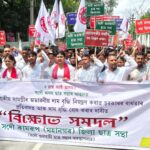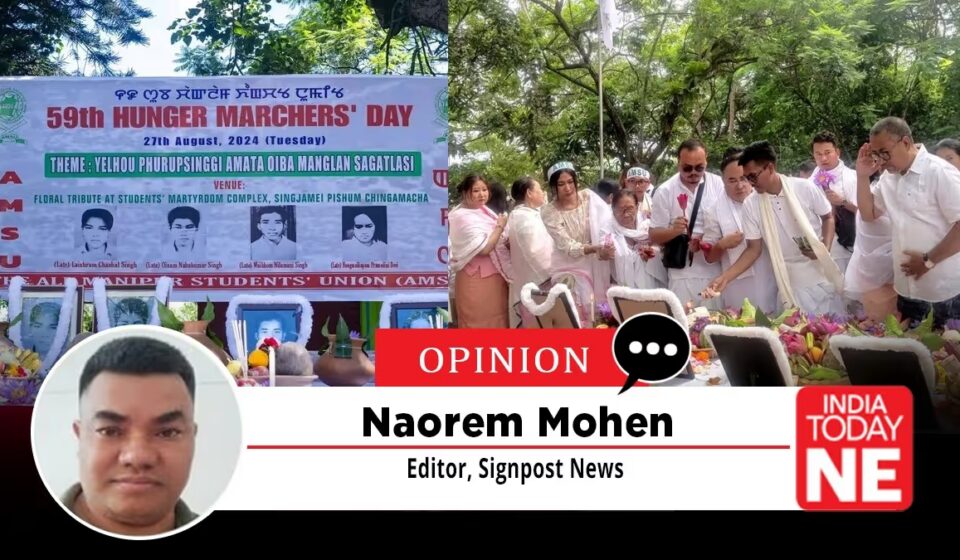

On August 27, marking the 61st Hunger Marchers’ Day, former Manipur chief minister N. Biren Singh paid tribute to Waikhom Nilamani, Oinam Nabakumar, Nongmeikapam Pramodini and Laishram Chaobhal Singh-four students who died during a 1965 protest against an artificial rice scarcity-and urged that their sacrifice be honoured “not only with words” but through tangible action for the welfare and dignity of the people. He and others framed that demand as a test for governments, political parties, student bodies and civil-society organisations in the state.
The 1965 march, when protesters advanced on the chief commissioner’s residence demanding food and a functioning ration system, ended in firing by security forces. Three died on August 27, 1965; Laishram Chaobhal Singh succumbed to injuries on September 26. The episode led to a unified student platform and helped catalyse the formation of the All Manipur Students’ Union. At its core the movement asserted that access to food is inseparable from human dignity and that administrations must be answerable when policies fail citizens.
Organisers and commentators say that same collective spirit is urgently needed today as Manipur faces divided responses to the NRC–Census debate, protracted displacement after the violence that began on May 3, 2023, and restricted movement on key highways. Calls for an updated National Register of Citizens to precede the Census have split opinion along ethnic and geographical lines; critics argue that the state needs an institutional process trusted by all communities rather than another confrontation. Student groups, civil-society bodies, elected representatives and experts from both the hills and the valley are urged to produce a common minimum position on transparent procedures, protection of genuine citizens and prevention of fraudulent enumeration.
More than three years after the 2023 violence, thousands remain displaced. Children have grown up in relief camps and families that once farmed or ran small businesses still depend on intermittent assistance. Complaints persist about delayed ration money and missed essential supplies in camps across the hills and the valley. The article stresses that hunger and displacement have no ethnic identity: Meitei, Kuki or any other displaced family requires the same basic assurances of safety, food, shelter, education, healthcare and a dignified right to return.
Resettlement must be planned transparently, village by village and locality by locality, with clear timelines, security assessments, reconstruction support and compensation. Token returns staged for photographs cannot substitute for rebuilt homes, restored livelihoods, functioning schools and revived local administration that together rebuild confidence between neighbours.
The reopening of national highways-especially the Imphal–Dimapur and Imphal–Moreh routes-also requires more than escorted government buses. A highway is open only when ordinary citizens of every community can travel without fear of being stopped, identified, threatened or forced back. Reopening needs dialogue with communities along the routes, enforcement against obstruction, protection for passengers and drivers, and a public explanation of who may travel and under what arrangements.
Manipur’s structural vulnerability in food production deepens the risk. The State’s Economic Survey for 2024–25 estimated clean-rice production at 361,910 tonnes from the 2024 kharif and pre-kharif crop, with paddy productivity at 2,470 kg per hectare versus a cited national average of 2,700 kg. An earlier survey estimated a foodgrain shortfall of about 267,000 tonnes in 2019–20 against consumption needs. Reliance on supplies routed over highways exposed to blockades, landslides and conflict leaves the population at risk; interruption of movement can quickly mean interruption of food.
Honouring the Hunger Marchers, the article concludes, requires a practical commitment to welfare, dignity and the future: reduce the foodgrain deficit, ensure ration entitlements reach beneficiaries, deliver timely assistance and a clear resettlement roadmap, guarantee free movement on national highways, and conduct any NRC and Census through lawful, transparent processes trusted by all communities. Only with such collective action, it argues, can Manipur move beyond divisions and secure a shared future.
Original Source: https://www.indiatodayne.in/opinion/story/61-years-after-the-hunger-march-can-a-divided-manipur-recover-its-lost-unity-1443605-2026-08-27?utm_source=rssfeed
Category:
Tags:
Publish Date: 2026-08-27 18:04:00