Architecting Human-in-the-Loop AI Workflows for Reliable Outcomes

We obsess about model size, latency and benchmark scores – and then hand the AI a vague brief and wonder why the output fails us. The smarter bottleneck isn’t the model; it’s how teams structure the work and the safety rails around it.
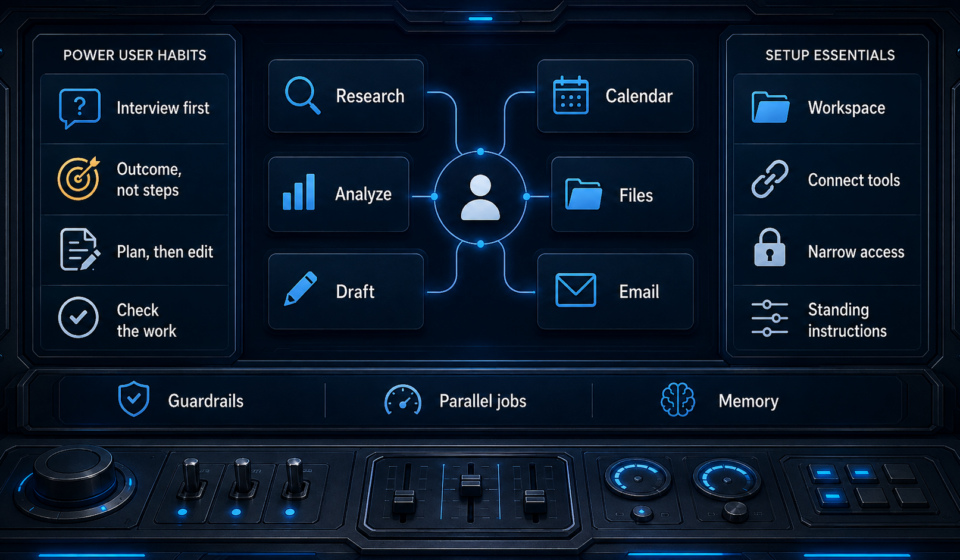
A recent column I read distilled a compact playbook of “AI power‑user” habits: quick interrogation prompts, outcome‑focused requests, grading checklists, narrow tool access, persistent workspaces, and a set‑and‑forget settings mindset. Those tactical moves are deceptively simple, but they expose a larger strategic truth: deploying generative AI at scale is less about raw capability and more about workflow design, verification architecture, and governance.
Why this matters for architecture and product leaders
The column’s hacks map directly to three architectural concerns every CTO must solve.
-
Operational correctness (not just speed). Asking AI to self‑grade, to produce multiple options plus counterarguments, or to be interrogated about edge cases are all ways to force the system into verifiable states. Architecturally, that means designing pipelines where model outputs pass automated and human review gates, with traceable artifacts (source links, provenance metadata, versioned prompts). Treat prompts and evaluation checklists as configuration that lives in source control.
-
Least‑privilege and data governance. The guidance to grant “the narrowest access” possible is a security and compliance imperative. In practice that requires an orchestration layer that mediates AI access to calendars, drives and inboxes – tokenized, auditable, and revocable. For enterprises working with regulated data, embed policy enforcement at the API gateway so an LLM never directly touches raw PII without consent and cryptographic controls.
-
Long‑tail usability and technical debt. Standing preferences, persistent workspaces and “skills” reduce repeated effort – but they create long‑lived state. That state becomes technical debt unless there are audit processes: quarterly memory reviews, schema migrations for saved prompts, and mechanisms to expire or rollback reusable skills. Treat AI memories like any other production datastore.
Practical design patterns to adopt now
- Prompt as spec: Store canonical outcome descriptions and acceptance criteria in a versioned repository. Let the AI generate the plan; require the plan to be reviewed and approved before execution.
- Dual‑track evaluation: Every high‑impact output goes through automated rule checks (citations present, numeric traceability) and a lightweight human audit. Automate the easy rejects, allocate human attention to nuanced failures.
- Narrow connectors: Use broker services that implement least privilege when connecting models to calendars, email, or file storage. Log access and actions centrally.
- Cost calibration: Match model complexity to business risk. Use cheap, fast models for ephemeral lookups and reserve larger models for high‑value, high‑risk tasks with stronger validation.
A note for Indian startups and public systems
These hacks scale especially well in resource‑constrained contexts common across many Indian startups and public initiatives. Small teams in Northeast India or other regions can capture outsized returns by investing minutes to set up standing instructions, narrow access patterns, and simple grading checklists – low upfront cost, recurring payoff. For Digital Public Infrastructure projects, the same patterns translate into stronger citizen protections: transparent acceptance criteria, auditable memories, and strict connector policies.
Key trade‑offs to be explicit about
- Speed vs. assurance: Faster automation increases throughput but multiplies downstream risk if verification is inadequate.
- Convenience vs. sovereignty: Deep tool integration improves productivity but creates larger attack surfaces and governance complications.
- Reuse vs. rot: Reusable skills save time but require active lifecycle management to avoid silent decay.
Takeaways
- Design prompts and checklists as engineering artifacts – version them, test them, and review them.
- Implement least‑privilege connectors and centralized logging for any tool access.
- Automate the easy validation rules and focus human review where it matters.
- Treat AI memories and skills as stateful systems needing quarterly audits.
Closing thought
The models will keep getting faster and cheaper; the lasting advantage will go to teams that turn AI into a disciplined, auditable part of their architecture – not a black box shortcut.
About the Author: Sanjeev Sarma is the Founder Director and Chief Software Architect at Webx Technologies. With a core focus on Generative AI integration, Cloud-Native Scalability, and Enterprise Software Architecture, he has spent over two decades driving digital transformation across Northeast India and beyond. Beyond his corporate leadership, Sanjeev is deeply invested in shaping the future of the IT industry. He serves as an Industry Expert on the Board of Studies for Assam Don Bosco University’s School of Technology, advises state technology committees, and actively mentors emerging tech startups at STPI. He brings a unique, dual perspective of high-level enterprise execution and future-ready academic curriculum development.
