Urban Mines to Strategic Metals: Architecting India’s Circular Battery Industry

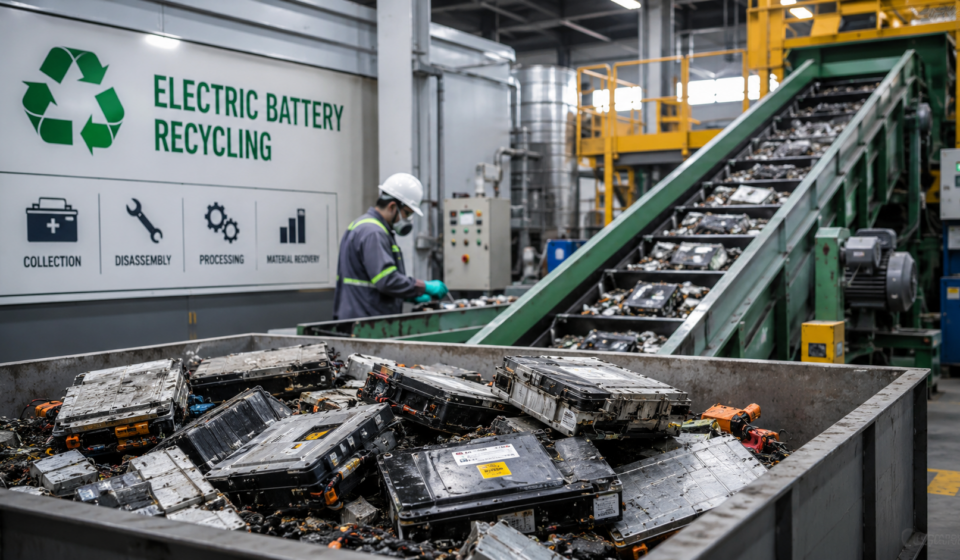
We treat end-of-life EV batteries as waste at our peril. The more useful – and far more strategic – view is to see them as concentrated urban mines: mobile vaults of lithium, nickel, cobalt and graphite whose fate will decide whether India becomes resource‑resilient or simply swaps one import dependence for another.
What the data signals
Recent industry and policy reports project enormous battery waste volumes as EV adoption accelerates in India. That “waste” contains tonnes of recoverable critical minerals and, if refined domestically, represents a multi‑billion dollar industrial opportunity. However, technical variability across packs, the rise of low‑value chemistries such as LFP, informal-sector leakages, and the capital intensity of refining create a gap between potential and practice.
Why this matters for architects, founders and policymakers
Think of the battery value chain as a national-scale system architecture problem – not simply a metallurgical one. The failure modes are familiar to anyone who designs complex systems: brittle incentives, opaque supply lines, lack of observability, and a tendency to optimise for short‑term gains (cherry‑picking high‑value feedstock) at the expense of long‑term resilience.
From an enterprise and industrial architecture perspective, three realities are key:
- Value capture happens downstream. Producing shredded “black mass” is equivalent to creating raw logs; the real economic value is extracted through refined metals and salts that feed manufacturing. If that refinement happens offshore, the country cedes not only jobs but strategic control.
- Heterogeneous inputs demand chemistry‑agnostic, scalable processes. Rigid, multi‑stage chemical flows increase reagent use, waste, and operating cost – the wrong tradeoffs if you want to scale domestically across NMC, LFP and future chemistries.
- Traceability and enforcement are system‑level necessities. With large proportions of battery waste currently handled informally, we face both environmental harm and material attrition. This is a governance and data‑infrastructure challenge as much as an operational one.
A pragmatic systems blueprint
I recommend approaching battery circularity like designing a resilient digital platform:
- National battery lifecycle registry: Link a lightweight digital identity to packs at manufacturing, integrated with vehicle registration and EPR reporting. This provides provenance, enables incentives, and mirrors the “data lineage” patterns we already champion in DPI initiatives.
- Last‑mile collection network as an API ecosystem: Formalise collection through regulated aggregators – from OEMs to authorised garages and certified recyclers – with clear SLA and financial flows. Use mobile apps/QR codes and minimal IoT telemetry for condition and location metadata to reduce informal leakage.
- Tiered industrial stack for recycling: Encourage modular, scalable pilot refineries that move beyond black mass export. Public capital – through Viability Gap Funding or chemistry‑specific incentives – can de‑risk early plants while standards for reagent efficiency and emissions are codified.
- Open standards and certification: Define interoperability for battery passports, EPR compliance data schemas and recycler accreditation. This reduces vendor lock‑in, builds trust and attracts responsible private capital.
India’s moment – and a regional angle
There is a genuine opportunity to convert material scarcity into industrial sovereignty. For India (including the Northeast), the economic upside is twofold: high‑value manufacturing jobs in refining and downstream battery assembly, and a reduced exposure to commodity price shocks. In regions with weaker logistics, focused collection hubs and public‑private collection incentives can convert rural and semi‑urban flows into formal feedstock – a classic frugal‑innovation play that converts last‑mile complexity into competitive advantage.
Takeaways for leaders
- Treat battery circularity as systems architecture: align data, logistics, finance and metallurgical capability.
- Incentivise processing of low‑value chemistries (LFP) via targeted subsidies/VGF, not ad‑hoc tariffs.
- Invest in traceability (battery passports + registry) to plug leakages to the informal sector.
- Prioritise modular, chemistry‑agnostic processes to future‑proof industrial capacity.
- Make standards and accreditation the bridge between policy intent and private capital.
Closing thought
If we design the circularity stack deliberately – combining digital traceability, targeted public incentives and scalable refining – exhausted EV batteries will not be a disposal problem but the feedstock for India’s next wave of industrial self‑reliance.
About the Author: Sanjeev Sarma is the Founder Director and Chief Software Architect at Webx Technologies. With a core focus on Generative AI integration, Cloud-Native Scalability, and Enterprise Software Architecture, he has spent over two decades driving digital transformation across Northeast India and beyond. Beyond his corporate leadership, Sanjeev is deeply invested in shaping the future of the IT industry. He serves as an Industry Expert on the Board of Studies for Assam Don Bosco University’s School of Technology, advises state technology committees, and actively mentors emerging tech startups at STPI. He brings a unique, dual perspective of high-level enterprise execution and future-ready academic curriculum development.