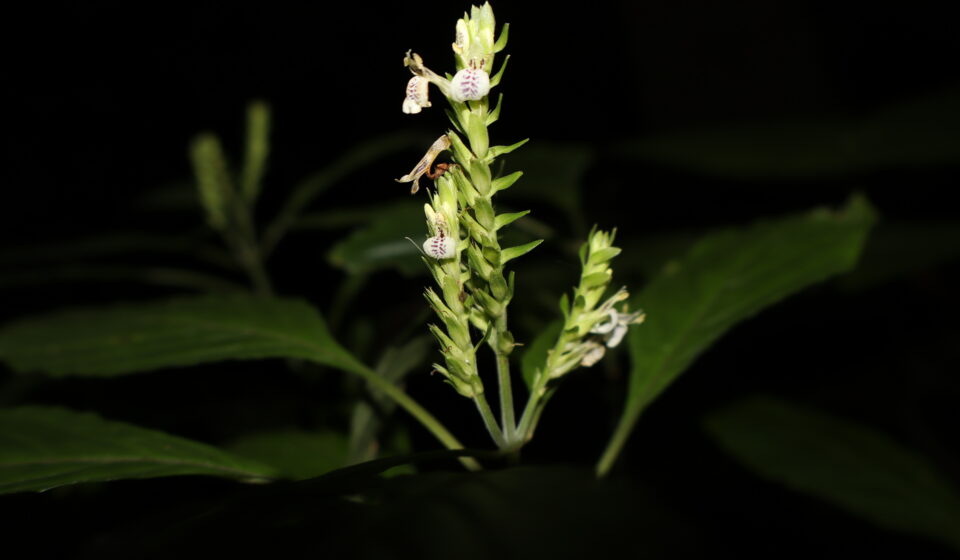

Researchers from Assam University have rediscovered Rungia mastersii, a rare endemic flowering plant missing from scientific records for 180 years, during field surveys in the Jatinga Hills of Dima Hasao district. The find — reported in the international journal Feddes Repertorium — gives botanists a chance to study and conserve a species long thought lost after being known only from a single 1845 specimen collected by British botanist J.W. Masters.
Rungia is a herbaceous genus in the Acanthaceae family with 88 accepted species worldwide, distributed across tropical Africa, tropical to subtropical Asia and the southern Arabian Peninsula. Assam hosts four Rungia species: R. mastersii, R. pectinata, R. repens and R. tinsukiaensis.
Researchers Kangkan Kumar Das and Debjyoti Bhattacharyya located the rediscovered population on moist, shaded rocky slopes beside a stream at elevations between 900 and 1,250 metres. They found only one population of roughly 40 plants, indicating the species is extremely rare in the wild.
Until this survey, scientists knew R. mastersii only from a single herbarium sheet preserved at the Botanical Survey of India, and the exact site of Masters’ original collection had remained unknown. The Jatinga Hills record is the first confirmed locality for the species and resolves a long-standing gap in its natural history.
Because so little is known about its distribution, Rungia mastersii has not yet been assessed for the IUCN Red List. The researchers and conservationists are calling for urgent, targeted surveys across Assam’s forests to determine whether additional populations survive and to assess the species’ conservation status.
The published study documents the plant’s habitat, flowering pattern and distinguishing features for the first time since 1845, creating a practical reference for future fieldwork and identification.
“The species is currently known from a single surviving population in the world, raising urgent concerns over its future survival amid the continuing degradation of the region’s forest ecosystems,” said Kangkan Das. The rediscovery underscores that Northeast India’s forests still conceal species overlooked for generations and highlights the region’s standing as one of the country’s richest-and least explored-biodiversity hotspots.
Original Source: https://eastmojo.com/assam/2026/07/24/assam-rare-plant-rediscovered-after-180-years/
Category: Assam,Environment,National News,News,Northeast News,Premium ,Top News
Tags:
Publish Date: 2026-07-24 12:07:00