Architecting Resilient EV Ecosystems Amid Regulatory and Political Risk

When national policy turns adversarial, the obvious instinct is to retreat – pause investments, wait for regulatory clarity, and hope market forces realign. That’s the intuitive playbook. But recent events in California show a different truth: local policy, consumer economics, and resilient system design can blunt – or even reverse – national-level shocks.
Context: What happened (in short)
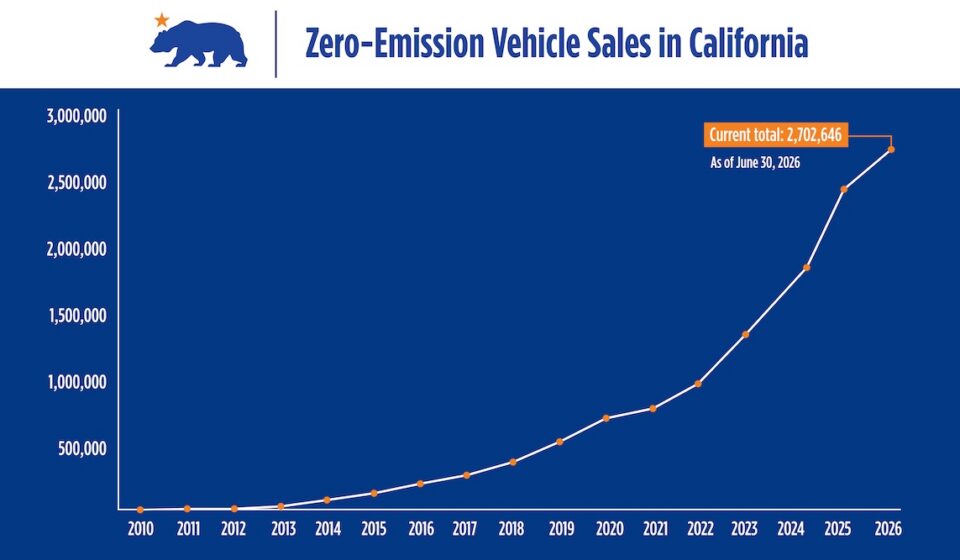
I recently reviewed reporting on how federal actions sought to reclassify long-standing California Clean Air Act waivers and how state leaders pushed back legally. At the same time, the California Energy Commission reported that zero-emission vehicle (ZEV) share rose to 19.1% of new vehicle sales in Q2 2026, despite the expiry of a federal EV tax credit and broader political headwinds. California is also deploying state-level incentives aimed at first-time EV buyers.
Why this matters to architects, CTOs and founders
Policy volatility is not a technology problem – it’s an architectural constraint. Enterprises building for clean mobility, energy, or any regulated market must treat regulatory uncertainty as a first-class non-functional requirement. Here are the strategic implications I see for enterprise architecture and product strategy.
-
Design for subsidy-agnostic product-market fit
Reliance on a single incentive (e.g., a federal tax credit) creates brittle business models. Product roadmaps and pricing engines should be modular so that vehicles, subscriptions, or services can be re‑priced, repositioned, or bundled quickly as external incentives change. Feature toggles, configurable finance modules, and decoupled billing systems reduce time-to-market for alternate offers. -
Build composable integration with local incentive workflows
State rebate programs like California’s “instant rebate” show the operational complexity of administering incentives at scale. Architect systems to integrate securely and programmatically with local government APIs, dealer systems, and identity platforms. Real-time reconciliation, tamper-evident audit trails, and automated fraud-detection reduce operational friction and compliance cost. -
Treat grid and telematics as part of your platform
An increase in EV share amplifies grid interactions and data flows. Charging management, demand-response logic, and vehicle telematics must be designed with data governance and privacy in mind. Zero-trust endpoints, anonymized telemetry pipelines, and clear data-retention policies are essential to avoid regulatory and reputational risk. -
Scenario-driven supply chain and cost modeling
When incentives change, price-sensitive consumers react fast. Maintain scenario models that quantify how different subsidy outcomes influence demand, inventory velocity, and component sourcing. That enables hedging decisions: ramp local sourcing, re-route inventory, or accelerate lower-cost product variants. -
Legal and policy engagement as a product capability
Large regulatory shifts can be anticipated and shaped. Companies should institutionalize policy monitoring and create playbooks for rapid legal responses, public affairs, and technical adaptations. This reduces reaction time and preserves customer confidence.
A practical lesson for India (and for Northeast India)
The core lesson – resilience through local ecosystems – translates directly to the Indian context. India’s EV transition is driven by a mix of central schemes and state-level incentives. The organizations that will succeed are those that can plug into Digital Public Infrastructure (identity, payments, and DBT-like delivery), manage intermittent grid constraints creatively (microgrids, smart chargers, battery-swaps), and tailor offerings for geography – for instance, EV solutions for hilly or low‑connectivity regions in the Northeast. Frugal, modular engineering combined with secure DPI integrations will lower the cost of delivering subsidies and widen uptake.
Key takeaways
- Treat regulatory uncertainty as a design requirement, not an afterthought.
- Build modular pricing, finance, and product layers to switch quickly between incentive scenarios.
- Integrate securely with local government workflows to deliver instant rebates and reduce friction.
- Make grid-interaction and data governance integral to the platform architecture.
- Localize – both operationally and technically – to benefit from subnational policy support.
Closing thought
Markets respond to incentives, yes – but systems and architectures determine how effectively an enterprise captures the opportunity when incentives shift. Build for adaptability, and you convert policy volatility from a threat into a competitive advantage.
About the Author: Sanjeev Sarma is the Founder Director and Chief Software Architect at Webx Technologies. With a core focus on Generative AI integration, Cloud-Native Scalability, and Enterprise Software Architecture, he has spent over two decades driving digital transformation across Northeast India and beyond. Beyond his corporate leadership, Sanjeev is deeply invested in shaping the future of the IT industry. He serves as an Industry Expert on the Board of Studies for Assam Don Bosco University’s School of Technology, advises state technology committees, and actively mentors emerging tech startups at STPI. He brings a unique, dual perspective of high-level enterprise execution and future-ready academic curriculum development.