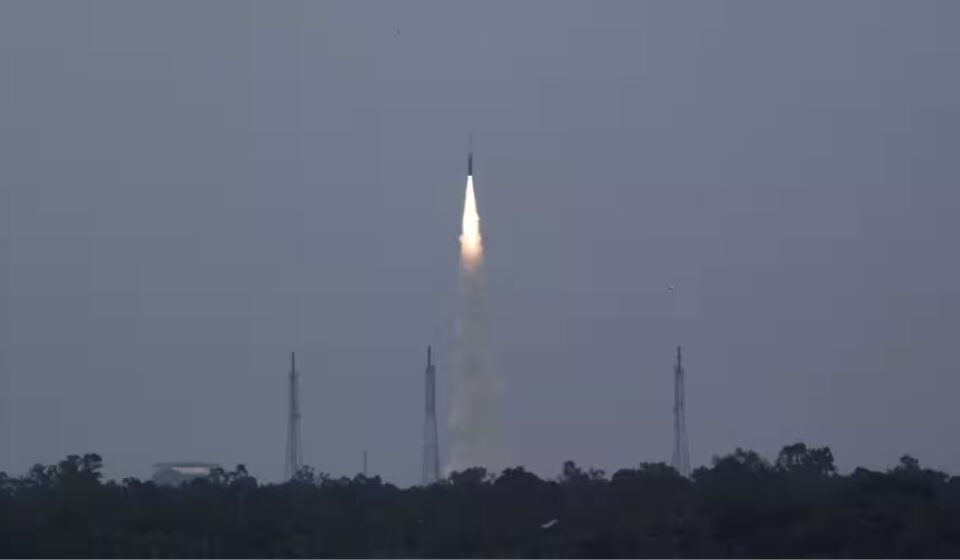

India’s first privately developed orbital-class rocket, Vikram‑1, launched successfully from the Satish Dhawan Space Centre at Sriharikota on Saturday, July 18, 2026, placing its payloads into Low Earth Orbit and completing Mission Aagaman (“Arrival”). The Hyderabad-based startup Skyroot said the 24‑metre vehicle reached a targeted 450‑kilometre orbit at 60 degrees inclination, marking a milestone that the company and officials described as putting India into an elite group of countries — after the United States and China — with independent private orbital launch capability.
Tens of thousands of spectators at the Sriharikota viewing gallery and millions more watching online saw a brief, planned hold in the final minutes of the countdown after the Automated Launch Sequence flagged minor navigation‑alignment anomalies. IN‑SPACe and Skyroot engineers paused the sequence, verified sensor synchronization with ground trackers and recalibrated the path‑correction algorithms. Within 30 minutes they restarted the automated countdown and shifted liftoff from a planned 11:30 a.m. IST to 12:05 p.m. IST, when the first‑stage solid motor ignited in a cloud of golden exhaust and the rocket arced out over the Bay of Bengal.
Vikram‑1 is a clean‑sheet design optimized for rapid, repeatable production. The four‑stage launcher uses three solid boosters for initial ascent and a liquid‑fueled Orbital Adjustment Module (OAM) for precise multi‑burn orbital insertion. Built with an all‑carbon composite airframe and extensive 3D‑printed cryogenic and liquid‑engine components, the vehicle is rated to carry up to 350 kilograms to LEO. Skyroot reports the flight followed 14 automated operational phases and completed payload deployment roughly 15.46 minutes after liftoff.
Skyroot converted the maiden mission into a commercial and technological demonstration rather than flying only ballast. The manifest included India’s Grahaa Space nanosatellite for high‑stream video mapping, a Cosmoserve dual‑spacecraft debris‑servicing demo that tested a soft‑robotic capture system, German DCubed GmbH deployment modules, and Skyroot’s internal SCOPE diagnostic satellite to record flight telemetry. The fairing also carried cross‑disciplinary payloads: a lab‑grown diamond installation by Cosmos Diamonds and an 18‑carat gold micro‑sculpture by artist Ajay Kumar Mattewada. A handwritten note from Prime Minister Narendra Modi reading “Vande Mataram,” flown to mark 150 years since the song’s creation, was also aboard; Modi called mission control after the launch to congratulate the team, saying the achievement shows India can be self‑reliant and “You fly higher, and I am with you.”
Skyroot CEO Pawan Kumar Chandana said the company intends to ease the small‑satellite bottleneck by offering on‑demand, flexible launch services, noting that the market is “deeply constrained on the supply side” and that the firm aims to move “from single, bespoke launches to an industrial cadence.” Skyroot will now analyse the flight telemetry at its Hyderabad facilities, refine composite structural thicknesses and automated launch protocols, and scale production of its solid motors as it readies for regular commercial operations. Other Indian private players such as Agnikul Cosmos and the commercialisation of ISRO’s SSLV and PSLV lines are expected to follow in building a larger domestic launch ecosystem.
Original Source: https://www.firstpost.com/explainers/how-skyroot-vikram-1-launch-makes-india-global-private-space-power-14032285.html
Category: India
Tags:
Publish Date: 2026-07-18 14:10:00