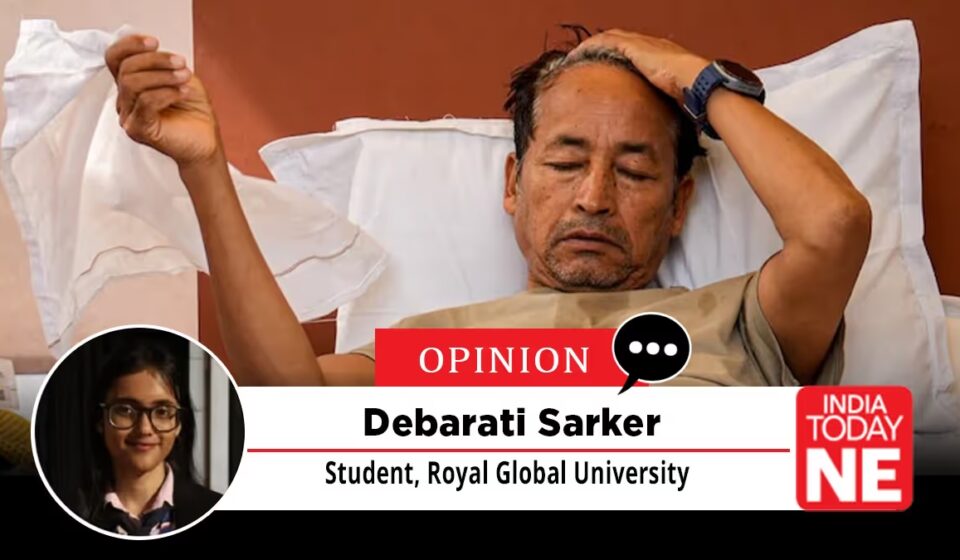

After eighteen days of an indefinite hunger strike at Jantar Mantar, education reformer and climate activist Sonam Wangchuk has lost more than eight kilograms and is showing signs of serious physical deterioration, according to medical reports. Wangchuk, who joined the Cockroach Janata Party (CJP) protest, is demanding accountability over alleged NEET examination irregularities, the resignation of Union Education Minister Dharmendra Pradhan, and justice for affected students and their families.
Medical reports cited in the article say his blood sugar has fallen, his blood pressure remains low, and he has begun to lose muscle mass; those close to him describe him as being in constant pain. Politicians, writers, actors and supporters across the country have urged him to end the fast for the sake of his health. Wangchuk’s reply is direct: “Instead of asking me to end my hunger strike, ask the government why it refuses to listen,” he tells supporters.
Wangchuk’s protest rests on a Gandhian belief in non-violent resistance and the moral pressure of personal sacrifice when institutions fail to respond. The article draws an uncomfortable historical comparison, noting that hunger strikes by figures such as Mahatma Gandhi and Bhagat Singh once forced the colonial administration to act, and asks whether a modern democracy should require greater patience before it begins a conversation.
The fast has drawn widespread attention because of who Wangchuk has become in the public imagination: the real-life inspiration for Phunsukh Wangdu in the film 3 Idiots, a character associated with questioning rote learning and promoting innovation. Actor Omi Vaidya, known for playing Chatur, summed up many citizens’ anxiety: “I don’t want Phunsukh Wangdu to die.” The irony, the article suggests, is that a celebrated on-screen figure struggles to be heard in reality.
Public reaction has been mixed. Several public figures have expressed solidarity and appealed to Wangchuk to protect his health, while others have questioned the authenticity of his fast, speculating about what he consumes and circulating rumours that he is secretly eating. The piece argues this tendency to scrutinise the protester rather than the systems he criticises reflects poorly on public priorities.
At its core, the movement is about students who spend years preparing for high-stakes exams on the promise of merit and fairness. The article urges that no citizen should have to starve to be heard and calls on those in authority to open meaningful dialogue before the protest reaches a tragic end. The larger question, it concludes, is whether India’s conscience can endure another day without courage.
Original Source: https://www.indiatodayne.in/opinion/story/will-india-listen-before-sonam-wangchuk-falls-silent-1425151-2026-07-16?utm_source=rssfeed
Category:
Tags:
Publish Date: 2026-07-16 12:45:00