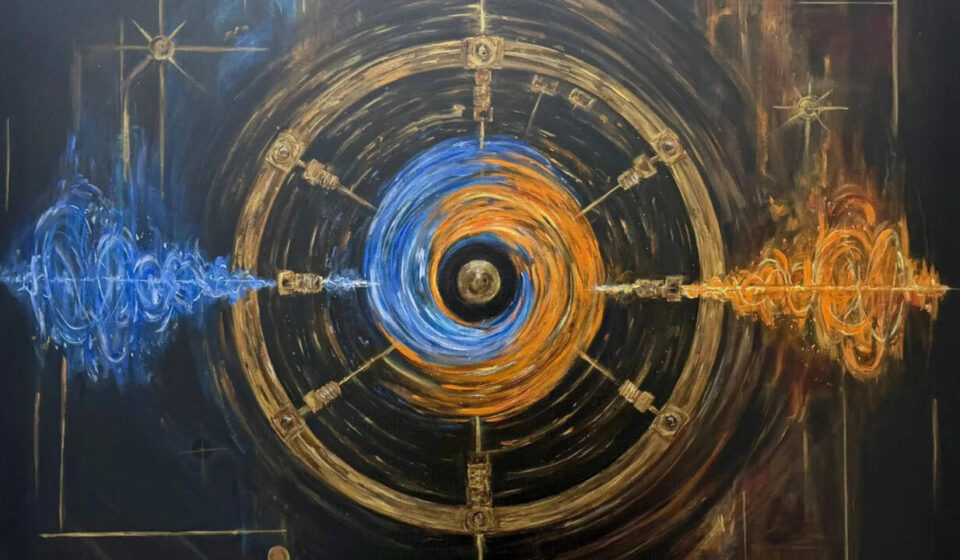

Physicists at the Advanced Science Research Center (CUNY ASRC) have recreated key aspects of black hole physics in a laboratory by building a stationary device that mimics the effects of impossibly fast rotation. Reported in the journal Nature, the experiment implements an artificial, time-varying pattern around a radio-frequency metamaterial ring so that incoming electromagnetic waves gain energy from the engineered motion-validating a theoretical idea dating back to Sir Roger Penrose and later extended by Yakov Zel’dovich.
In 1969 Penrose proposed that energy could be extracted from a rapidly spinning black hole via its ergosphere, a zone where the black hole drags space and time. Zel’dovich showed the same principle could apply to waves: light or radio waves scattering off an object rotating fast enough could be amplified. Testing that idea mechanically is impossible because materials would fracture under the required speeds.
The CUNY team avoided moving parts by using a still metamaterial ring with electronic components whose electrical properties are switched in a controlled sequence. That sequence creates a travelling-wave pattern around the ring that behaves like an object rotating faster than light, allowing certain input waves with specific rotational characteristics to draw energy from the synthetic rotation and emerge amplified.
“Our approach facilitates a new method of wave–matter interaction in which waves with selected rotational properties extract energy from synthetic time‑engineered rotation, producing a form of broadband selective amplification,” said principal investigator Andrea Alù. Co-lead Hady Moussa added, “Waves with the appropriate rotational characteristics extracted energy from the system and became amplified, reproducing the essential physics of the Penrose‑Zel’dovich process.” Lead author Hadiseh Nasari said the platform moves extreme rotational dynamics from theory to practice and opens experimental study across astrophysics, wave physics and quantum science.
Beyond advancing fundamental physics, the method could inform new devices in wireless communication, radar, advanced optics and photonics, and quantum information. The team plans to shrink the design and test it with light-based photonic systems to control light propagation on chips. The project was supported by U.S. federal agencies and foundations, and researchers caution further improvements are needed before metamaterial rings can be deployed in commercial communication hardware.
Original Source: https://timesofindia.indiatimes.com/science/scientists-just-created-a-black-hole-like-energy-system-in-a-lab-without-moving-anything-recreating-a-50-year-old-theory-that-could-transform-future-communication-and-quantum-technology/articleshow/132351246.cms
Category:
Tags:
Publish Date: 2026-07-13 01:01:00