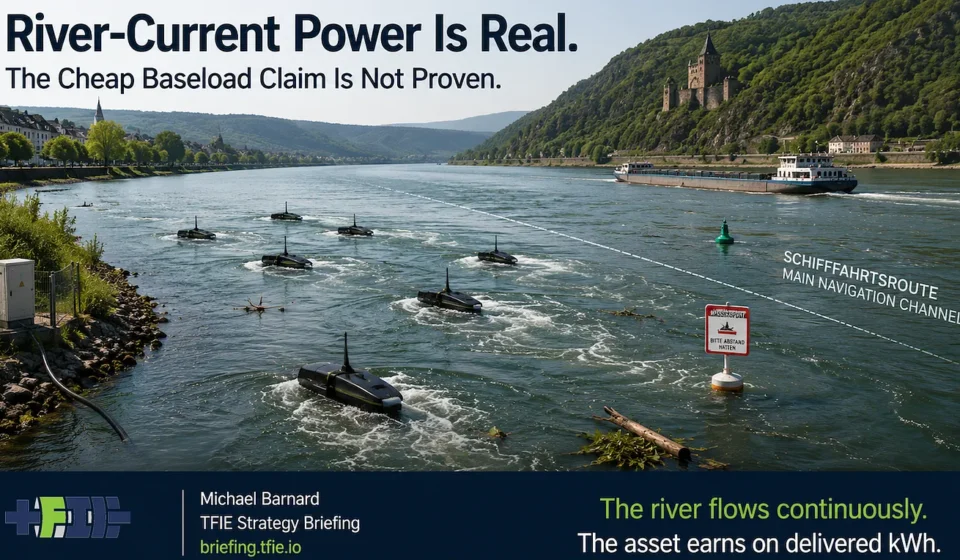
From Turbine to System: Architecting River-Current Power for Grid Reliability

Contrarian hook – rivers are not always a “baseload” silver bullet
We love clean-technology narratives that promise small hardware, big impact. But engineering a spinning turbine is only the opening move; the real contest is whether a clustered deployment can deliver reliable, affordable energy once you add anchors, cabling, grid interfaces, permitting, debris events and long-term service. I recently read a detailed case about a floating hydrokinetic turbine swarm being deployed in Europe. The hardware looks promising, but the strategic questions it raises are what matter to architects, policymakers and founders.
Signal in two sentences
The core development is simple: companies are moving from prototypes to multi-unit “swarms” of small in-stream turbines that export to shore. These systems redefine distributed hydro generation away from dams toward modular, less-invasive units – but the headline claims around “cheap baseload” require system-level proof, not just device performance.
What this means for systems architects and energy strategists
-
From device physics to systems economics
Enterprises and utilities must stop evaluating such technologies on per-unit rated power alone. The appropriate lens is a delivered-system model: resource variability, site civils (anchors, moorings), cable and grid-interface costs, insurance, financing, maintenance logistics, and the cost of downtime. In practice this means shifting procurement criteria from “kW per unit” to metrics like monthly energy yield, capacity factor, availability, and levelized delivered cost including balance-of-plant and O&M. -
Design patterns for grid integration
These turbines are a distributed generation node type. Architecturally they belong in microgrid and distribution-edge patterns: local aggregation (swarm controllers), shore-side inverters with grid compliance, telemetry for synthetic inertia or volt-VAR support, and clear islanding modes. CTOs should insist on open telemetry standards and APIs so operator systems – from SCADA to energy management platforms – can integrate units into dispatch logic and reserve calculations. -
Evidence-first adoption: what pilots must show
Early pilots should be instrumented to answer the practical questions investors and system planners care about: multi-year monthly production profiles correlated to measured river flows, mean time between failures, debris/flood events and recovery time, seasonal low-flow performance, and lifecycle replacement schedules. Independent third-party metering and environmental impact assessments must be part of any credibility-building pilot. -
Maintenance & service as core product
For distributed aquatic assets, the recurring cost driver will be servicing: retrieval for inspection, biofouling mitigation, anchor integrity checks, and cable repair. The viable business model is often not just selling hardware but providing long-term service contracts, local operations hubs, and predictive-maintenance systems (digital twins + condition monitoring). -
Regulatory and social friction are non-trivial
Smaller footprint does not remove navigation, fisheries, or permitting constraints. Expect localized stakeholder engagement to dominate timelines. For enterprise planners, regulatory risk needs to be quantified and modelled into project finance assumptions.
Relevance for India’s Northeast (short, conditional)
This class of modular river technology could be strategically useful for remote or diesel-dependent riverine communities in Northeast India – provided the projects are matched to sites with consistent flow, and pilots include rigorous local ecological studies. The region’s dispersed load centres and existing microgrid experiments make it a logical testing ground for hybrid systems combining small hydro swarms, solar and battery storage.
Takeaways for CTOs, investors and policymakers
- Demand system-level LCOE numbers that include anchors, cabling, grid-connection and long-term O&M.
- Prioritize pilots with independent metering and environmental reviews over vendor claims.
- Treat service, retrieval logistics and local operations as primary product elements, not afterthoughts.
- Design for interoperability (open telemetry, standardized inverters) so these assets can be aggregated into microgrids and distribution management systems.
- Model regulatory and stakeholder risks into financing and timelines.
Closing thought
Innovation that decentralizes generation is valuable – but its value is realized only when hardware, operations, finance and governance are architected together. Small turbines are a start; credible, repeatable baseload alternatives require the discipline of systems engineering.
About the Author: Sanjeev Sarma is the Founder Director and Chief Software Architect at Webx Technologies. With a core focus on Generative AI integration, Cloud-Native Scalability, and Enterprise Software Architecture, he has spent over two decades driving digital transformation across Northeast India and beyond. Beyond his corporate leadership, Sanjeev is deeply invested in shaping the future of the IT industry. He serves as an Industry Expert on the Board of Studies for Assam Don Bosco University’s School of Technology, advises state technology committees, and actively mentors emerging tech startups at STPI. He brings a unique, dual perspective of high-level enterprise execution and future-ready academic curriculum development.