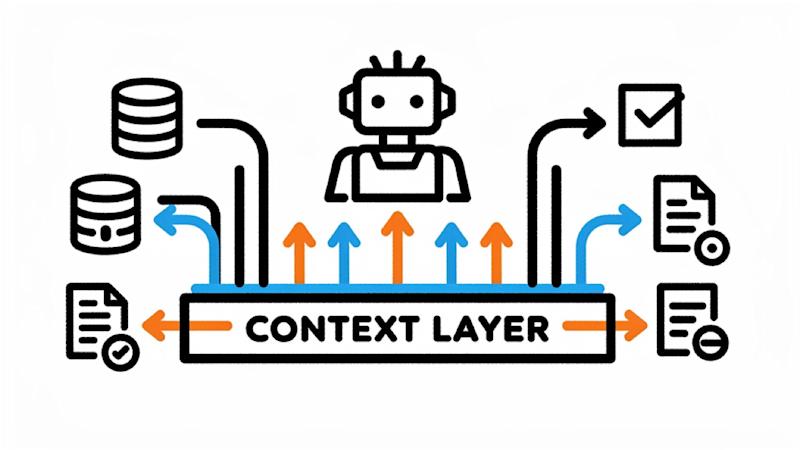

The next infrastructure problem isn’t a faster model – it’s the data agents need to act.
Hook
We’ve spent the last decade obsessing over model size and latency. The real bottleneck for production agents today is not compute; it’s finding the right, fresh, governed context at machine speed. Treating retrieval as “more RAG” is treating the symptom, not the architecture.
Context (signal)
I recently read coverage of a new class of context platforms that sit between agents and data – combining continuous ingestion, semantic access, memory, and storage optimised for SSDs. The core thesis is simple: agents issue orders of magnitude more data requests than human-driven apps, and the retrieval layer must be redesigned for that scale and pattern.
Analysis – what this means for enterprise architecture
1) Scale mismatch is an architectural problem, not a tuning problem.
Agents behave like thousands of concurrent, dynamic clients that don’t know in advance what they’ll need. Traditional retrieval stacks built for human queries – occasional, broad, and tolerant of prefetching – cannot sustain the load or cost profile agents create. The correct response is to rethink the interface between model and data: a semantic, tool-oriented layer that exposes machine-friendly primitives (row-level access, typed entities, versioned schemas) rather than dumping blobs into prompts.
2) Semantic models are now infrastructure.
The entity-relationship model and access rules that describe “what agents can ask for” must be maintained like code and pipelines. This means version control, CI for schema changes, automated migration paths, and test suites that assert not only correctness but privacy boundaries and freshness SLAs. Treating the semantic layer as a first-class artifact reduces technical debt and prevents agents from becoming uncontrolled data consumers.
3) Memory + retrieval are orthogonal but complementary.
Short- and long-term agent memory reduces repeated reasoning work; semantic retrieval ensures the memory is grounded in live data. Operationally, this implies two investment tracks: (a) a memory service for session and cross-session state, and (b) a high-throughput, low-latency retrieval fabric (with selective in-memory hot paths and cheap SSD-backed cold paths). The economics of running petabytes of context mean hybrid storage engines will be attractive – but they bring new trade-offs in consistency, TTL policies, and eviction semantics that architects must design for.
4) Governance, cost and observability must lead procurement.
Every retrieval has a cost: monetary, latency, and risk. Without strict access controls, audit trails, and retrieval metering, agent deployments will balloon into cost and compliance disasters. Observability must include unit-level retrieval traces (which agent called what tool, with what prompt, what data was fetched and cached, and why). That traceability is non-negotiable in regulated domains such as healthcare or finance.
Actionable advice for CTOs and architects
– Stop asking “Do we need a vector DB?” Start by answering: what does each agent need to know, how fresh must that knowledge be, who is allowed to access it, and what does each retrieval cost? Map these to SLOs.
– Build the semantic model early. Use typed models (pydantic-like), version them, and automate migrations and access-policy tests.
– Adopt a hybrid storage strategy: keep hot, sub-millisecond slices in memory, and move infrequently accessed context to SSD-optimised stores with predictable latencies and lower cost.
– Instrument retrievals end-to-end. Correlate agent failures with retrieval latencies, stale-data events, and permission denials.
– Pilot with a narrow, high-risk workflow (e.g., a clinical triage or financial approval) to define governance patterns before wide rollout.
A note for Indian enterprises and public systems
This architecture shift is just as relevant in India. Any DPI or healthcare deployment that introduces intelligent agents must design for intermittent connectivity, data sovereignty, and auditability. Semantic context layers that reflect existing government systems (rather than replacing them) lower integration risk and make it easier to comply with local regulations while delivering real-time services.
Closing thought
We are moving from “put everything in the prompt” to “expose the right interfaces to the prompt.” The firms that win will be those who treat context as product – versioned, testable, governed, and costed – not as an afterthought to model selection.
About the Author
Sanjeev Sarma is the Founder Director of Webx Technologies Private Limited, a leading Technology Consulting firm with over two decades of experience. A seasoned technology strategist and Chief Software Architect, he specializes in Enterprise Software Architecture, Cloud-Native Applications, AI-Driven Platforms, and Mobile-First Solutions. Recognized as a “Technology Hero” by Microsoft for his pioneering work in e-Governance, Sanjeev actively advises state and central technology committees, including the Advisory Board for Software Technology Parks of India (STPI) across multiple Northeast Indian states. He is also the Managing Editor for Mahabahu.com, an international journal. Passionate about fostering innovation, he actively mentors aspiring entrepreneurs and leads transformative digital solutions for enterprises and government sectors from his base in Northeast India.