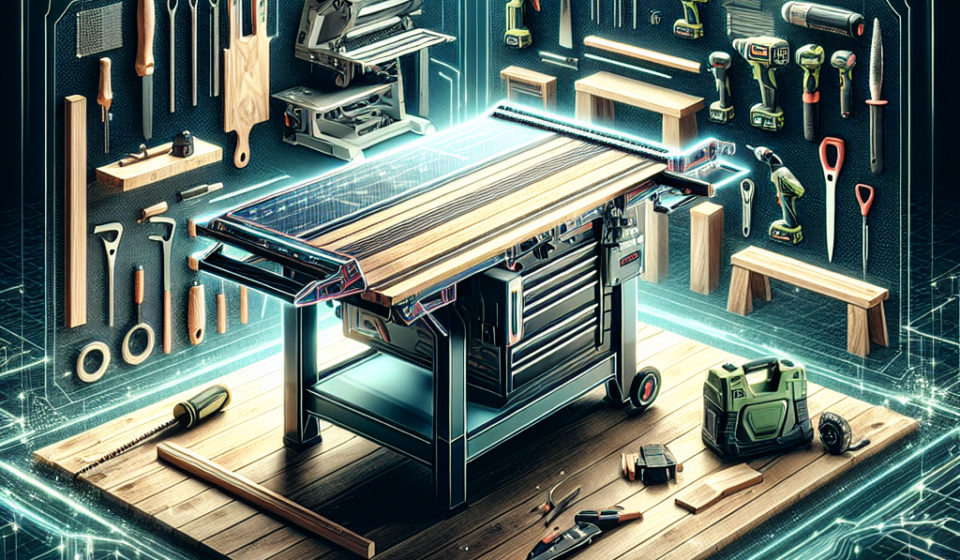

We treat commercial products as finished answers to a problem. But sometimes the smarter move is to sell the question instead of the answer – to provide a framework that invites customers to complete the solution themselves. Ryobi’s recently announced Framework Workbench is a neat physical example of that strategy: a modular “skeleton” with rails and brackets but no tabletop, explicitly designed to be completed by the buyer. I read the announcement and found it a useful prompt to think about platform design, modularity, and the trade-offs between shipped completeness and user-led customization.
The signal: Ryobi offers a configurable workbench kit that provides structure (legs, brackets, an accessory rail) but omits finishing materials such as plywood or shelves. The intent is clear – empower users to build their ideal bench using local materials and preferences, rather than locking them into a single SKU.
What this design decision highlights for product and technology leaders
– Frameworks are platforms. In software we talk about APIs, SDKs, and rails; in hardware Ryobi shipped an “accessory rail” and brackets – the physical equivalent of a well-documented API. A framework product deliberately shifts some responsibility downstream to users, partners, and the ecosystem. That can dramatically increase adaptability and longevity, but it also raises friction for users who lack skills or local supply chains.
– Trade-offs are explicit: flexibility vs. convenience. A full product minimizes the cognitive load on the buyer – unbox, ready to use. A framework maximizes adaptability and reduces SKU complexity for the vendor. For enterprises the decision is similar: adopt an off-the-shelf solution for faster time-to-value, or choose a framework to retain control and evolve the system over time.
– Ecosystem and standards matter. A successful framework often needs a community (third-party addons, how-to content) plus clear standards so that accessories interoperate safely. Without certification and guardrails, the maker ends up guessing at load-bearing limits, warranty boundaries, or safety issues.
– Sustainability and local economies. By not shipping a tabletop, the product nudges buyers to reuse or source locally, which can lower shipping footprint and support local vendors. However, it assumes access to affordable materials and basic tools – a socio-economic bet that may not hold universally.
Concrete actions for CTOs, founders and product leaders
– Decide early whether you’re building a product or a platform. If platform, design a clear “integration rail” (physical or digital) and document it like an API: tolerances, expected inputs, failure modes, and upgrade paths.
– Lower the first-mile friction. Offer optional starter packs (a basic surface, a certified parts kit), how-to videos, and “beginner” partner workshops so less-experienced users can still benefit without being forced into trial-and-error.
– Certify third parties. A certification program for accessories preserves safety and user trust while letting an ecosystem flourish. It also creates a business model: royalties, co-branding, marketplace fees.
– Make warranty and support boundaries explicit. When users mix vendor and third-party parts, clarity prevents disputes and protects brand reputation.
– Localize supply and partnerships. Work with regional suppliers to offer materials that match local climate, cost and availability – more on this below.
Why this matters for India (and Northeast India)
This pattern – platform over finished product – aligns well with the “frugal innovation” and maker movements across India. In cities and small towns alike, skilled carpenters, tinkerers, and micro-enterprises can add value by finishing such frameworks with locally sourced timber or recycled materials. In the Northeast, where supply chains and connectivity can vary, a modular approach that allows local finishing can be an advantage – provided companies support the first-mile with documentation, training, and local partnerships. For startups building hardware or developer platforms in India, remember: enabling local ecosystems is both a social good and a competitive strategy.
Takeaways
– Frameworks extend product lifespan but require explicit standards and ecosystem investment.
– Offer optional completeness to capture users who prefer convenience.
– Certification, documentation, and partner networks are strategic assets, not afterthoughts.
– Localize supply chains to turn framework designs into real, usable outcomes on the ground.
Closing thought
Designing a product as a framework is a strategic choice to trade immediate convenience for long-term adaptability – and when done with clear interfaces and community support, it turns customers into co-creators rather than mere consumers.
About the Author Sanjeev Sarma is the Founder Director of Webx Technologies Private Limited, a leading Technology Consulting firm with over two decades of experience. A seasoned technology strategist and Chief Software Architect, he specializes in Enterprise Software Architecture, Cloud-Native Applications, AI-Driven Platforms, and Mobile-First Solutions. Recognized as a “Technology Hero” by Microsoft for his pioneering work in e-Governance, Sanjeev actively advises state and central technology committees, including the Advisory Board for Software Technology Parks of India (STPI) across multiple Northeast Indian states. He is also the Managing Editor for Mahabahu.com, an international journal. Passionate about fostering innovation, he actively mentors aspiring entrepreneurs and leads transformative digital solutions for enterprises and government sectors from his base in Northeast India.