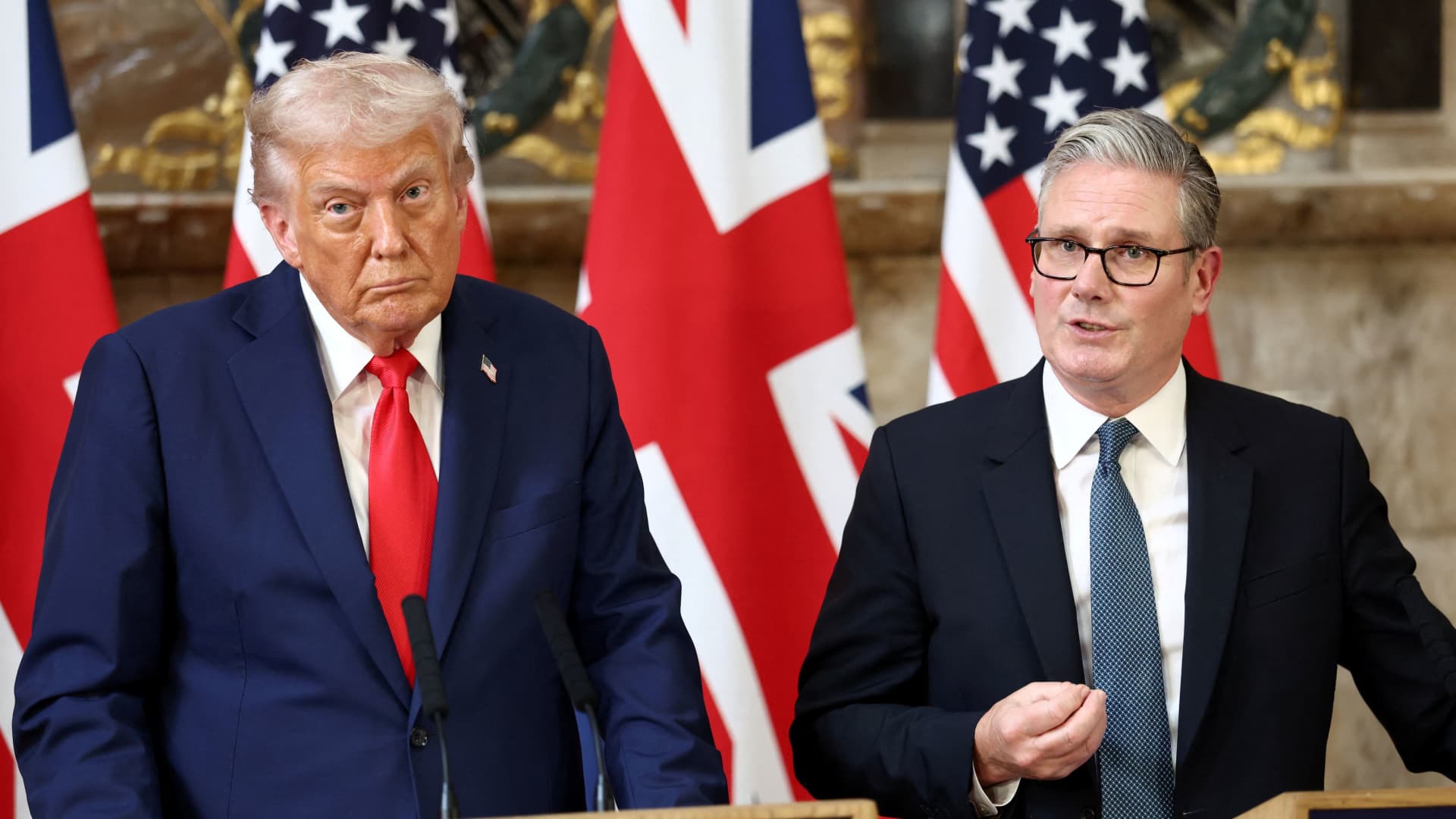

U.S. President Donald Trump and British Prime Minister Keir Starmer addressed the press following their meeting at Chequers on September 18, 2025, emphasizing differing approaches to the ongoing tensions surrounding Iran. In a clear stance, Starmer announced that the U.K. will not support the U.S. blockade of Iranian ports, underscoring Britain’s commitment to avoiding entanglement in what he labeled as the “Iran war.” His remarks coincided with an announcement from French President Emmanuel Macron, who confirmed plans for a cooperative conference with the U.K. aimed at restoring freedom of navigation in the Strait of Hormuz.
During his press engagement, Macron indicated that while the conference would involve a “peaceful multinational” and “strictly defensive” mission, France had not explicitly ruled out future involvement in the U.S. blockade. Starmer, speaking on BBC Radio 5 Live, reiterated the U.K.’s commitment to ensuring safe navigation through the Strait. “We’re not supporting the blockade,” he stated, adding that all diplomatic and military efforts, including mine-sweeping capabilities, are focused on keeping the Strait open rather than enforcing restrictions.
Starmer’s comments come as U.S. President Trump announced that a blockade aimed at curbing Iranian oil exports would go into effect at 10 a.m. ET on Monday. Trump noted that “other nations are working” with the U.S. to ensure that Iran cannot sell oil, although he did not specify which countries would be involved. This move followed unsuccessful negotiations between Washington and Tehran over the weekend, raising concerns about escalating tensions in the region.
Responses from European and Gulf states indicate a reluctance to participate in the conflict, which some view as an unnecessary “war of choice” rather than a matter of national security. German officials have also indicated they will not take part in the blockade, labeling Trump’s announcement as a “vague statement” without new substantiating facts. Germany has consistently rejected any military engagement in the Iran conflict, reaffirming its stance through government sources.
On social media, Macron stated that the upcoming conference would be open to the U.K. and other like-minded nations, aimed at a mission designed to restore safe navigation in the strategically vital Strait. He emphasized that the initiative would operate independently of the warring parties.
Starmer expressed concern over rising energy costs affecting British citizens due to the Iran conflict. While he maintained that the U.K. would not be dragged into the war, he acknowledged the necessity of defensive actions. When questioned about Trump’s role in rising energy bills, Starmer clarified that the issue stems from Iran’s control over navigation in the Strait of Hormuz.
As global leaders navigate these complex dynamics, the U.K.’s commitment to avoiding direct involvement in the Iran war stands firm, while diplomatic efforts continue to address significant regional challenges that affect international navigation and energy security.
In an ever-evolving geopolitical landscape, the story underlines the delicate balance nations must maintain between national interests, international obligations, and the well-being of their citizens, making it a pivotal moment in global affairs.
Choose CNBC for reliable insights and updates on international relations and business news, ensuring you stay informed on pivotal issues that impact the global stage.
Original Source: https://www.cnbc.com/2026/04/13/uk-us-blockade-on-iranian-ports-iran-war-nato-.html
Category :
Tags:
Publish Date: 2026-04-13 15:24:00