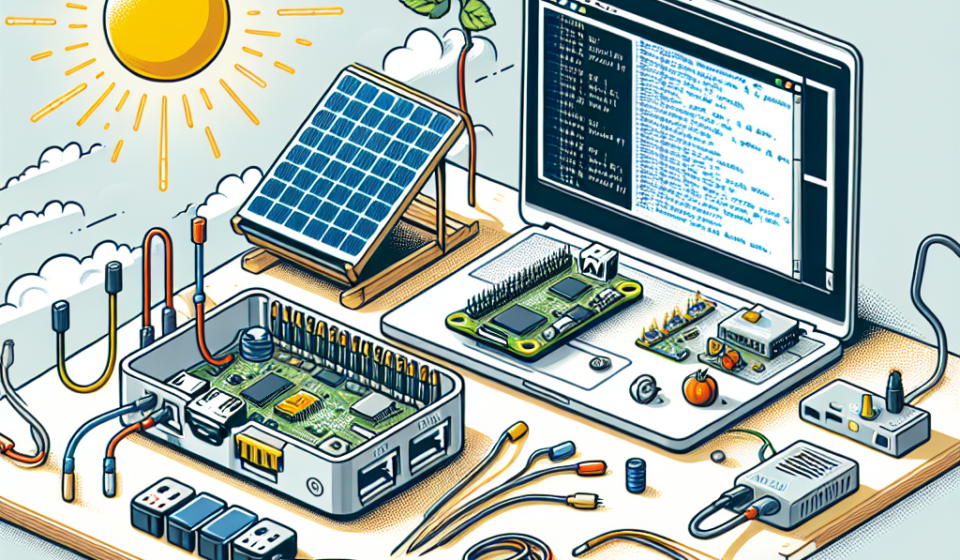

We often equate modern web scale with giant data centres and continuous power. That assumption blinds us to a parallel frontier: extreme efficiency at the edge – low-power devices that serve real users reliably with tiny energy budgets. A recent project I came across – a solar-powered Raspberry Pi Zero W configured to run “diskless” in RAM and housed in a passive SLS-printed aluminium case – is a neat demonstration of that frontier and why architects should pay attention.
The signal: a developer built a Pi Zero W web server that boots Alpine Linux in diskless/RAM mode to protect the SD card and lower I/O, runs a very small service set (lighttpd, a Python file server, SSHD, dchron) consuming only ~27 MB for those services on a 512 MB board, and is enclosed in a case that doubles as a heatsink. The project was submitted to the 2026 Green Powered Challenge (which runs until April 24, 2026) and reportedly handled 50 simultaneous connections with an average response time around 1.3 seconds.
Why this matters for enterprise architects and technology leaders
– Rethinking constraints as features: Resource constraints (power, I/O, memory) are not just handicaps – they force disciplined architecture. Designing for statelessness, fast in-memory serving, and minimal background services reduces attack surface, lowers energy consumption, and simplifies failure modes.
– Energy as a first-class non-functional requirement: For certain deployments – rural caching nodes, disaster recovery endpoints, sensor gateways – energy efficiency determines feasibility. Measuring energy per request or per unit of work should sit alongside CPU, latency, and cost in the architecture KPI dashboard.
– Durability and lifecycle management: Running diskless protects SD cards from wear but moves the persistence problem elsewhere. You must decide what state must survive reboots and design secure, reliable mechanisms for selective persistence and backups (e.g., sync to remote object storage or periodic write-backs).
– Security trade-offs: Minimal, ephemeral stacks limit persistent malware footholds, but they also complicate forensics and logging. Secure boot, immutable OS images, robust key management, and secure OTA are essential to maintain Zero Trust principles on devices that may be physically exposed.
– Observability and manageability: At scale, fleets of solar-powered nodes require remote health telemetry, graceful updates, and alerting that is tolerant of intermittent connectivity. Architectures must include resilient sync strategies and local queues for telemetry when the network is down.
Practical guidance for CTOs and founders
– Treat energy and reliability as core design constraints for edge use-cases; quantify energy-per-request during prototyping.
– Design systems as ephemeral-first: keep services stateless where possible, and make persistence an explicit, minimized choice.
– Build secure OTA and recovery flows before deployment; without them, remote fleet management becomes unmanageable.
– Include passive thermal design early – a well-designed enclosure can reduce power used for active cooling and extend component life.
– Plan for intermittent connectivity: implement backpressure, retry strategies, and eventual consistency for non-critical operations.
Relevance to India (and Northeast India)
This style of frugal, resilient engineering has direct applicability to India’s last-mile connectivity challenges. In regions with unreliable grid power and limited broadband, solar-powered, diskless cache nodes can host essential government forms, local health content, or community learning resources. A small fleet of such devices, paired with thoughtful offline-first applications, can materially improve citizen access while keeping operating costs and environmental footprint low.
Key takeaways
– Edge-first does not mean low-impact: small devices can deliver meaningful service if designed with energy and statefulness in mind.
– Minimal software stacks reduce attack surface but demand mature device management and logging strategies.
– Passive cooling and mechanical design are as important as software choices for long-term reliability.
– In regions with intermittent power/connectivity, solar-backed diskless nodes are not a novelty – they are practical infrastructure.
Closing thought
If cloud was about centralising power and scale, the next decade will be about decentralising responsibility – pushing resilient, energy-efficient compute to where people actually are, not just where the datacentres sit.
About the Author Sanjeev Sarma is the Founder Director of Webx Technologies Private Limited, a leading Technology Consulting firm with over two decades of experience. A seasoned technology strategist and Chief Software Architect, he specializes in Enterprise Software Architecture, Cloud-Native Applications, AI-Driven Platforms, and Mobile-First Solutions. Recognized as a “Technology Hero” by Microsoft for his pioneering work in e-Governance, Sanjeev actively advises state and central technology committees, including the Advisory Board for Software Technology Parks of India (STPI) across multiple Northeast Indian states. He is also the Managing Editor for Mahabahu.com, an international journal. Passionate about fostering innovation, he actively mentors aspiring entrepreneurs and leads transformative digital solutions for enterprises and government sectors from his base in Northeast India.